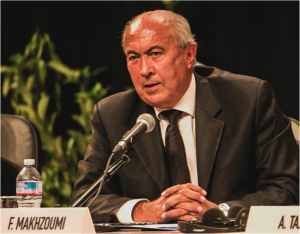
 Fouad Makhzoumi is a leading industrialist, philanthropist and statesman. In 1997, Mr. Makhzoumi founded the Makhzoumi Foundation, a private Lebanese non-profit organization that contributes through its vocational training, health care and micro-credit programs to Lebanese civil society development.
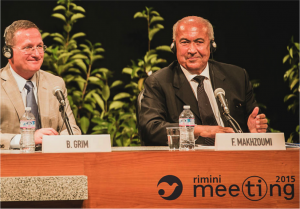
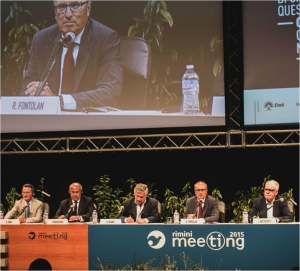
The following are Mr. Makhzoumi’s prepared comments for a 21st August 2015 address to the Rimini Meeting, a gathering attracting up to 800,000 people from across Italy and the world each summer.
This is part of the Religious Freedom & Business Foundation’s new Leaders Speak series of talks and articles where business, religious and civic leaders speak out on countering violent extremism and increasing interfaith understanding and peace. For more on the Religious Freedom & Business Foundation’s own work on countering radicalization, see the Empowerment+ Initiative.
* * *
Religious freedom is a fundamental pillar of democracy, and we cannot talk about democracy in its absence. However, the process leading to religious freedom has been difficult and, could be characterized by discriminations, persecutions and religious wars.
Christians began as a persecuted group but then Christianity became the state religion of the Roman Empire, and later, for the Catholic powers of medieval Europe. The Catholics moved from being persecuted to intolerance as Inquisition and forced conversion in Central and Latin America have shown.
Europe has been ravaged by religious wars between Sixteenth and Seventeenth Century. Only after roughly 150 years of conflict the relationship between State and Church has been settled in Europe. Also in America dissenting religious groups were outlawed. A significant change came only with the 1776 Virginia Declaration of Rights, which affirmed not just “toleration” of dissenters, but the “free exercise of religion.”
Islam’s schism, simmering for fourteen centuries, does not explain all the political, economic, and geostrategic factors involved in the current conflicts in the Middle East, but it has become one prism through which to understand the underlying tensions. Two countries that compete for the leadership of Islam, Sunni Saudi Arabia and Shia Iran, have used the sectarian divide to further their ambitions.
Early theological differences between Sunnis and Shias on the legitimate successor of the Prophet are still played today for political purpose.
 Shias, like Catholics, believe that God always provides a guide, first the Imams and then Ayatollahs, or experienced Shia scholars who have wide interpretative authority and are sought as a source of emulation. Shi’ites believe that the 12th Imam Muhammad al-Mahdi is kind of the messiah figure, which Christians hold in Jesus (except non-divine). They think he did not ever die, but basically went into an extended mystical ‘hiding’ period which he is still in today. And that he will come again at the end of days, just before the return of Jesus and together they will usher in the apocalyptic era which will bring peace and true justice to the world before the resurrection and final judgment.
For Sunnis, like Protestants, authority is based on the texts, the Quran and the traditions of Mohammed. Sunni religious scholars are constrained by legal precedents. Sunni groups have no central authority they all report to. Even Osama Bin Laden at his height had multiple partners who were killed (like Abdullah Azzam) or sidelined (Ayman Al Zawahiri), not to mention that multiple branches of Al-Qaeda refused his direct orders like Zarqawi in Iraq (which later became ISIS).
Sunni militants like Muslim Brotherhood and now ISIS do not follow one particular school, only their perception of the Koran and the life examples of Muhammad and his companions; which they may interpret in their own way. This is why it is more difficult to tame Sunni radical groups.
Alongside the proxy battle is the renewed fervor of armed militants, motivated by the goals of cleansing the faith or preparing the way for the return of the messiah. Today there are tens of thousands of organized sectarian militants throughout the region capable of triggering a broader conflict.
Two points should be clear notwithstanding all the news you hear and watch:
(1) Muslims have not found yet, as the Christians did after 150 years of war, a reasonable compromise between State and Church; still today for many Muslims it is quite difficult to accept the concept of Nation State. This fact can help in understanding why the appeal of the Islamic State and for the rebirth of the Caliphate is so strong among certain Muslims and why there is still so much resentment in the Muslim world for the abolition of the Caliphate in 1924. This latter decision, even if executed by the Young Turks was unanimously attributed to a nefarious Western cultural influence.
(2) The overwhelming majority of the victims of Islamic terrorism and fundamentalism are Muslims and mainly Sunnis. Therefore, while I fully agree with the wise words of the of the Italian Republic President Mattarella in his message to this Meeting about the planting of the seeds of a Third World War by fundamentalism, I would also like to highlight that this war is mainly fought in the Middle East and its casualties are almost entirely Muslims.
 Today, the majority of Muslim leaders have, of course, gone on record favoring religious freedom and tolerance, and with the sea of change happening now in the Muslim world, there has never been a better chance to apply the freedom principle. Moderate Muslims should insist upon religious freedom as an essential part of any new democratic order as it prevents instrumentalization and misinterpretation of religion and its political misuse.
Unfortunately, even nowadays, we are assisting in religious discrimination in many countries such as Switzerland against Muslims; China against Christians and Buddhists; and Iraq’s abuses of Christian, Yazidi and Kurdish minorities by IS militants.
We all know that economic development is driven by the freedom to develop new ideas, to test them and the related risk taking. A disproportionate share of the innovations and entrepreneurship that raises living standards occurs in cities because urban environments offer particularly great opportunities for expressing new ideas freely, challenging established ways of doing things, and experimenting. By the same logic, restrictions on producing, sharing, or executing ideas can limit economic development. Religious restrictions can hold back economic development by constraining to a larger extent what can be discussed, by narrowing the social spaces in which new ideas can be shared, by limiting communication among social groups, and by ruling out certain ideas merely because of their religious associations.
For decades, Turkey’s secular governments limited entrepreneurship outside of Istanbul and Ankara through policies that diminished the resources going to the businesses of devout Muslims. With the softening in the 1990s of these implicitly anti-Muslim policies, entrepreneurship received a massive boost and the country was transformed into an industrial country and one of the world’s top six tourist destinations. Releasing the resources, talents, and energies of devout Turks has played an important role in this rapid transformation.
Pakistan offers a sad example of a country that has harmed its economic development through cascading religious restrictions imposed in the name of religion. In stages since the 1940s, Pakistani Islamists have narrowed the definition of a good Muslim, stigmatized Muslims who interpret Islam differently, and declared certain strands of Islam heretical. They have limited the contributions that they and their followers could make to debates on economy.
Religious freedom does not automatically promote economic freedom, dynamism, development, and prosperity. The results depend partly on the unleashed political agendas. As essentially secular regimes allowed Islamists more political rights, some of the ideas that the latter promoted in the name of Islam did economic harm. As a case in point, in the 1970s Islamists in Egypt, Pakistan, and Libya, among other places, promoted the idea of “Islamic socialism,” which contributed to keeping Muslims wedded to economically inefficient state policies. During its year in power (2012-13), Egypt’s Muslim Brotherhood resisted calls to reduce inefficient food and fuel subsidies, mainly on the ground that this would be unfair from an Islamic viewpoint.
Nevertheless, religious freedom generally promotes economic advancement by boosting other freedoms that are essential to economic development. Where religious freedoms are respected, people find it more natural to respect political, artistic, and social freedoms. This is a basic reason why international freedom rankings are highly correlated across contexts. Countries with high religious freedoms have high political freedoms, and vice versa. Religious freedom advances economic development by making people comfortable with diversity of opinion, the expression of new ideas, and challenges to vested interests.
But it is also important to remember the value religion provides for society as a whole. When we shift our attention to the benefits religion provides as a public good, then the case for protecting religious freedom becomes even stronger. Religious freedom is about respecting the rights of others to believe and worship according to their own consciences and then to live out those beliefs in their various walks of life.
Religious freedom thus energizes participation in civil society, which in turn supports democracy and economic development.
According to a study conducted in 2014 by researchers at Georgetown and Brigham Young Universities, religious freedom is one of the factors significantly associated with global economic growth. The research compared the GDP growth of 173 countries and found a positive relationship between religious freedom and 10 of the 12 pillars of global competitiveness. According to the study, among the effects of having religious freedom there are:
(1) Reduced corruption: Nine of the 10 most corrupt countries have high or very high governmental restrictions on religious liberty. This includes North Korea one of the most religiously restrictive countries.
(2) More peace: When religious freedoms are not respected, the result can be violence and conflict. Normal economic activities become vulnerable to disruption, with local and foreign investment driven away and sustainable development undermined.
(3) Less harmful regulation: Some religious restrictions can directly affect economic activity, creating legal barriers for import and export industries, using anti-blasphemy laws to attack business rivals, and others.
(4) Reduced liabilities: Stocks of Abercrombie & Fitch dropped when news broke that the clothing retailer had allegedly refused to hire a Muslim woman wearing a headscarf, potentially a violation of American equal opportunity employment laws. By avoiding religious discrimination in the workplace, businesses can avoid such liabilities.
(5) More diversity and growth: Freedom of religion can contribute to a rich pluralism that is itself associated with economic growth. For instance, the world’s 12 most religiously diverse countries each outpaced the world’s economic growth between 2008 and 2012, according to recent research. A study led in part by Professor Ram Cnaan, of the University of Pennsylvania, finds that a wide diversity of religious congregations in a city contributes many millions of dollars to the economy through direct spending and activities ranging from educational and health services to a network of relationships that helps provide jobs and a safety net for those facing hard times.
Religious hostilities and restrictions create climates that can drive away local and foreign investment, undermine sustainable development, and disrupt huge sectors of economies. Such has occurred in the ongoing cycle of religious regulations and hostilities in Egypt, which has adversely affected the tourism industry. A few current examples from the Muslim-majority countries, which are countries with particularly high levels of religious restriction, illustrate how the lack of religious freedom contributes to worse economic and business outcomes.
Religious restrictions in Muslim-majority countries take many forms. One direct religious restriction that affects economic freedom involves Islamic finance. For instance, businesses involved in creating, buying, or selling Islamic financial instruments can find themselves in the situation that one Islamic law board deems a particular instrument acceptable while another board does not, making the instrument’s acceptance on stock exchanges subject to differing interpretations of Islamic law. Other examples include the banning of Hollywood films in some Arab countries for religious reasons and the misuse of anti-blasphemy laws to attack business rivals.
And it is not difficult in a Region, the MENA, where the young population constitutes more than 40% of the total adult population and registers the highest unemployment rate in the world, as for the IMF data.
On this regard, it is very interesting how the original and authentic concept of Jihad has been transformed by ISIS from a personal spiritual battle that every person is constantly requested to fight within his inner soul, and eventually, in rare cases, towards real enemies into a fight against not only the representatives of all the other religions and secular powers, but also against the moderate Muslims, perceived as a product of the Western culture.
One of the first actions to be taken in support of economic development and inclusive growth is, without any doubts, job creation and with jobs come dignity, stability, choice, and typically moderation. The estimated need for MENA region is of over 100 million new jobs in this decade.
Unfortunately, the current political and economic situation, characterized by wars and uncertainty, makes this task even harder. The solution could not be found in large governmental employment programs or welfare state policies; entrepreneurship must fuel the next generation of jobs.
To encourage entrepreneurship, governments need to reform the regulatory framework reducing the time and the cost of setting up a business as well as the barriers to operate including severe laws on local ownership, bankruptcy, labor relations. The movement of goods and services must be relaxed and protectionist policies need to be stripped away.
In Dubai, for example, where my company is headquartered, business friendly policies have meant that thousands of new companies have incorporated in the last year alone. Dubai has solidified its position as the regional business capital. The supportive steps the UAE took include free zones to allow international investments within commonly recognized corporate structures, relatively fast and efficient incorporation practices, more transparent regulations, and lower barriers to the movement of global talent and capital.
A more comprehensive and inclusive growth could lead to better results both at the social and economic level. One of the elements that can foster this process is, without any doubts, religious freedom and tolerance that are the way to peace and stability, the pillars of economic development. Where stability exists, in fact, there is more opportunity to invest and conduct normal and predictable business operations, especially in new and emerging markets as it has been proved by the 2014 study by the Institute for Economics and Peace.
Religious freedom is a key ingredient to peace and stability, as measured by the absence of violent religious persecution and conflict. This is particularly important for business because where stability exists; there are more opportunities to invest and to conduct normal and predictable business operations, especially in emerging and new markets.
Beyond promoting peace and stability, religious freedom can contribute to positive socioeconomic development in much the way that freedom in general does. Removing impediments to religious freedom facilitates freedom of other kinds. Religious freedom is highly correlated with the presence of other freedoms, such that it can be considered part of a bundled commodity of social goods that have significant correlations with a variety of positive social and economic outcomes ranging from better health care to higher incomes for women. Indeed, when religious groups operate in a free and competitive environment, religion can play a measurable role in the human and social development of countries. This is not the case of the Arab world.

 Protecting Religious Freedoms Will Strengthen Our Global Economy
 How religious will the world be in 2050?
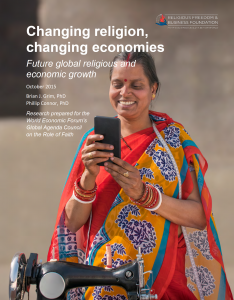
 Treasures on Earth: How Religion Is Redistributing the World’s Wealth
 The impact religious diversity will have on the world’s economic growth