Working for workplace religious belonging, inclusion & freedom

E-NEWS ACTION DONATE

Peres Calls on Pope Francis to Unite Religions to Combat Terror

5 Sep, 2014

By Pasquale Annicchino

Soon after Pope Francis was elected, a TEDx conference at the Vatican documented the rising tide of religious hostilities in the world. Since that time, religious hostilities have only risen.

At the Vatican yesterday, ANSA reports that former Israeli President Shimon Peres proposed the formation of a “United Religions” organization to combat terrorism. “The UN has had its time,” Peres was quoted as saying by Catholic weekly Famiglia Cristiana. “What we need is an organization of United Religions, the UN of religions.”

“It would be the best way to combat these terrorists who kill in the name of their faith, because most people are not like them, they practise their religions without killing anyone, without even thinking about it. I think that there should be a charter of the United Religions, just like there is the UN Charter. The new charter would serve to establish in the name of all the faiths that slitting people’s throats or conducting mass slaughters, like the ones we have seen in recent weeks, has nothing to do with religion. This is what I proposed to the pope,” said Peres.

In a period a growing restrictions on religious freedom, the call from President Peres is an important reminder of the role and contribution that religious and belief groups can make to public life. They can not only inform our daily policy making, but also contribute to a commom higher call to the respect of human dignity against the instrumentalization of religion to justify terrorist acts.

If President Peres moves forward with his proposal, he deservers the greatest attention from the international community, including the business community. Indeed, religious restrictions and hostilities not only affect peace and security, they also jeopardize the socio-economic future of societies around the globe, according to the latest research.

Also, a recent publication documents several ways the business community is involved in fostering interfaith understanding and peace.

Stay up to date with the weekly Newsletter!

Ban Ki-moon Receives Religious Freedom & Business Foundation Joint Publication with UNGC

29 Aug, 2014

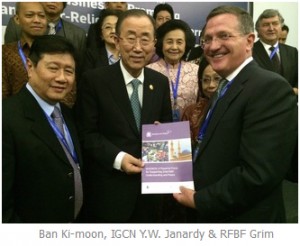
IMMEDIATE RELEASE – Bali, Indonesia: United Nations Secretary-General Ban Ki-moon received today “BUSINESS: A Powerful Force for Supporting Interfaith Understanding and Peace,” a new joint publication by the Religious Freedom & Business Foundation and the UN Global Compact Business for Peace platform.

The following are RFB Foundation President Brian Grim’s remarks made during today’s UN Alliance of Civilizations (UNAOC) side event organized by the Indonesia Global Compact Network (IGCN) where the publication was launched.

*** *** ***

Your Excellency, Secretary-General Ban Ki-moon, and distinguished guests, we are thrilled for your participation in this UNAOC side event organized by the Indonesia Global Compact Network (IGCN), “The Role of Business in Promoting Inter-cultural and Interreligious Peace and Harmony.”

It’s my honor to give a brief summary of three themes we have explored today: Research, Action and Partnership.

RESEARCH

Our discussion today is informed by Pew Research data presented at the past two UNAOC meetings in Doha and Vienna showing that the world has been swept by a rising tide of global restrictions on religious freedom or belief, which come from governments and perhaps, even more powerfully, from groups in societies. These data show that three-in-four people today live with high religious restrictions or hostilities.

Of course, the pressing question is: What can be done to roll back the tide? As a social scientist and NGO leader, it is clear to me that the answer lies in engaging the creativity and power of the global business community, because business is the crossroads of culture, commerce and creativity.

Indeed, recent research shows that freedom of religion or belief is not only a powerful instrument of peace, but also one of only a handful of factors that predicts economic growth. Data show that freedom of religion or belief is strongly associated with global competitiveness, including education, innovation, health and better lives for women and children.

ACTION

So, how are businesses approaching interfaith understanding and peace? To answer this, the Religious Freedom & Business Foundation and the Business for Peace platform are pleased to announce a new training resource: “BUSINESS: A Powerful Force for Supporting Interfaith Understanding and Peace.” I’ll highlight several of the approaches from the publication:

  • Business can Use Marketing Expertise to Bridge Borders: The Coca-Cola Small World campaign, including vending machines linking people in Pakistan and India by video, shows that getting along is good for society and good for business.
  • Business can Incentivize Innovation: The BMW Group’s intercultural innovation award in partnership with the UNAOC is an excellent example of incentivization as well as of a successful public-corporate partnership.
  • Business can Incubate and Catalyze Social Entrepreneurship: For instance, Petrobras in Brazil supports business incubation for Afro-Brazilians, helping members of marginalized communities engage in empowering entrepreneurship.
  • Business can Support Workforce Diversity: For instance, businesses in Indonesia are known for accommodating faith in the workplace. They are also known for addressing difficult unmet social needs, such as organizing a mass wedding for interfaith couples who had lived without legal status and with no ready means to become legitimately wed.

PARTNERSHIPS

It is important to recognize that joint action – like that occurring in this side event – plants seeds that grow into fruit-bearing trees in the years to follow. For instance, the 3rd UNAOC meeting was held in Rio de Janeiro in 2010. I’m pleased to announce that together with partners in Brazil and Rio, we will hold the first global awards for business, interfaith understanding & peace during the 2016 Olympics. This is especially significant because Brazil is a country with an unprecedented story of peaceful religious change that can serve as a model for many conflict situations today. Indeed, in peacemaking, it is critical that countries with success stories like Brazil and Indonesia exercise global leadership in this area.

All of us look forward to working together to addresses these issues, and turning potential into practice. For instance, why don’t we put to practice a suggestion hinted at this morning by Indonesian President Susilo Bambang Yudhoyono and build a network of diaspora business leaders committed to the vision of a global future of innovative and sustainable economies where religious freedom and diversity are respected.

And finally, an episode in the life of the prophet Isaiah captures what I believe is the spirit of many, many business people willing to help realize this vision: “Then I heard the voice of the Lord saying, ‘Whom shall I send? And who will go for us?’ And I said, ‘Here am I. Send me!’”

Thank you.

Pope Francis Annicchino

25 Aug, 2014

PRESS RELEASE: Vatican City

Pope Francis received Dr. Pasquale Annicchino at the Vatican at the start of a two-day conference, “International Religious Freedom and the Global Clash of Values.”

Pope Francis stressed a theme critical to the ethical functioning of the global business community: “Religious liberty is not only that of thought or private worship. It is freedom to live according to ethical principles consequent upon the truth found, be it privately or publicly. This is a great challenge in the globalized world, where weak thought — which is like a sickness — also lowers the general ethical level, and in the name of a false concept of tolerance ends up by persecuting those who defend the truth about man and the ethical consequences.”

The conference brought leading scholars, practicing lawyers, diplomats, and representatives of different faiths and of no faith to Rome on June 20-21, 2014. It was jointly sponsored by the Center for Law and Religion and the Center for International and Comparative Law at St. John’s Law and the Department of Law at the Libera Università Maria SS. Assunta (LUMSA), a private Catholic university in Rome.

Pasquale Annicchino

Last week Dr. Annicchino’s newest article, Is the European Union Going Deep on Democracy and Religious Freedom?, appeared in a special issue of The Review of Faith & International Affairs devoted to “Internationalization of International Religious Freedom Policy.” Recently, he has critiqued the Italian government for not doing enough to address religious freedom, including contributing to the special issues of Formiche (an Italian web magazine) on ISIS and religious freedom, with responses from the former Italian Minister for Foreign Affairs, and the former President of the Italian Chamber of Deputies.

Groundbreaking Publication – BUSINESS: A Powerful Force for Interfaith Understanding and Peace

21 Aug, 2014

*** UPDATE: UN Secretary-General Ban Ki-moon gives keynote address at the launch of this new, groundbreaking publication on Aug. 29, at UNAOC, Bali, Indonesia, during the event organized by the Indonesia Global Compact Network (IGCN) ***

IMMEDIATE RELEASE: USA and Indonesia – August 21, 2014: The UN Global Compact Business for Peace platform and the Religious Freedom & Business Foundation announce a new resource to highlight how businesses can promote interfaith understanding and peace.

The resource – available here – will be introduced during the 2014 Global Forum of the United Nations Alliance of Civilizations ( UNAOC ) held in Bali, Indonesia, August 29-30. The approaches highlighted in the resource include:

  • Using Marketing Expertise to Bridge Borders: Companies can make positive contributions to peace in society by mobilizing advertising campaigns that bring people of various faiths and backgrounds together, as seen in Coke Serves Up Understanding Across Borders.
  • Incentivizing Innovation: Because cross-cultural dialogue and cooperation is an essential part of daily work for multinational companies, one company, the BMW Group, incentivizes other organizations to create innovative approaches to interfaith understanding through an award organized in collaboration with the UN Alliance of Civilizations. Organizations that have won this award include a tour company in the Middle East, which offers new paths to build bridges and bring cultures together, as seen in Promoting Understanding Through Tourism in the Holy Lands. Another recognized intercultural innovator uses job placements agencies to help contribute to the religious diversity of workforces, as seen in Helping Muslim Youth in the Philippines.
  • Incubating and Catalyzing Social Entrepreneurship: Business can also provide common ground where religious differences give way to shared concern and enterprise. Opportunity and Entrepreneurship in Nigeria describes an approach modeled by a peace-building organization showing how supporting companies and new entrepreneurs in conflict-affected areas can reduce extremism. Petrobras Supporting Business Incubation for Afro-Brazilians similarly shows how company support for new small enterprises can have a significant impact in developing marginalized communities.
  • Supporting Workforce Diversity: When businesses are sensitive to the religious and cultural issues around them, they can not only increase employee morale and productivity, but also address unmet difficult social needs, as shown in Indonesia Businesses Open Their Doors to Faith and Action.

Through this collaborative publication, the UN Global Compact’s Business for Peace platform and the Religious Freedom & Business Foundation seek to raise awareness among business, Governments and other stakeholders of the ways in which business can and are contributing to interfaith understanding and peace.

“Given its role in building economies, mobilizing people around a shared purpose and pioneering cross-cultural management styles, business has an important stake in promoting intercultural and interreligious understanding. Successfully managing diversity and fostering tolerance and understanding – among employees, consumers and other stakeholders – is increasingly essential for long-term business success.”

— Georg Kell, Executive Director, United Nations Global Compact

“Business is at the crossroads of culture, commerce and creativity. This means businesses have the resources to make the world more peaceful as well as the incentive to do so. Indeed, as these case studies show, business is good for interfaith understanding, religious freedom and peace.”

— Brian Grim, President, Religious Freedom and Business Foundation

Indeed, interfaith understanding – and its contribution to peace – is in the interest of business.

  • Recent research shows that economic growth and global competitiveness are stronger when social hostilities involving religion are low and Government respect for, and protection of, the universally recognized human right of freedom is high.
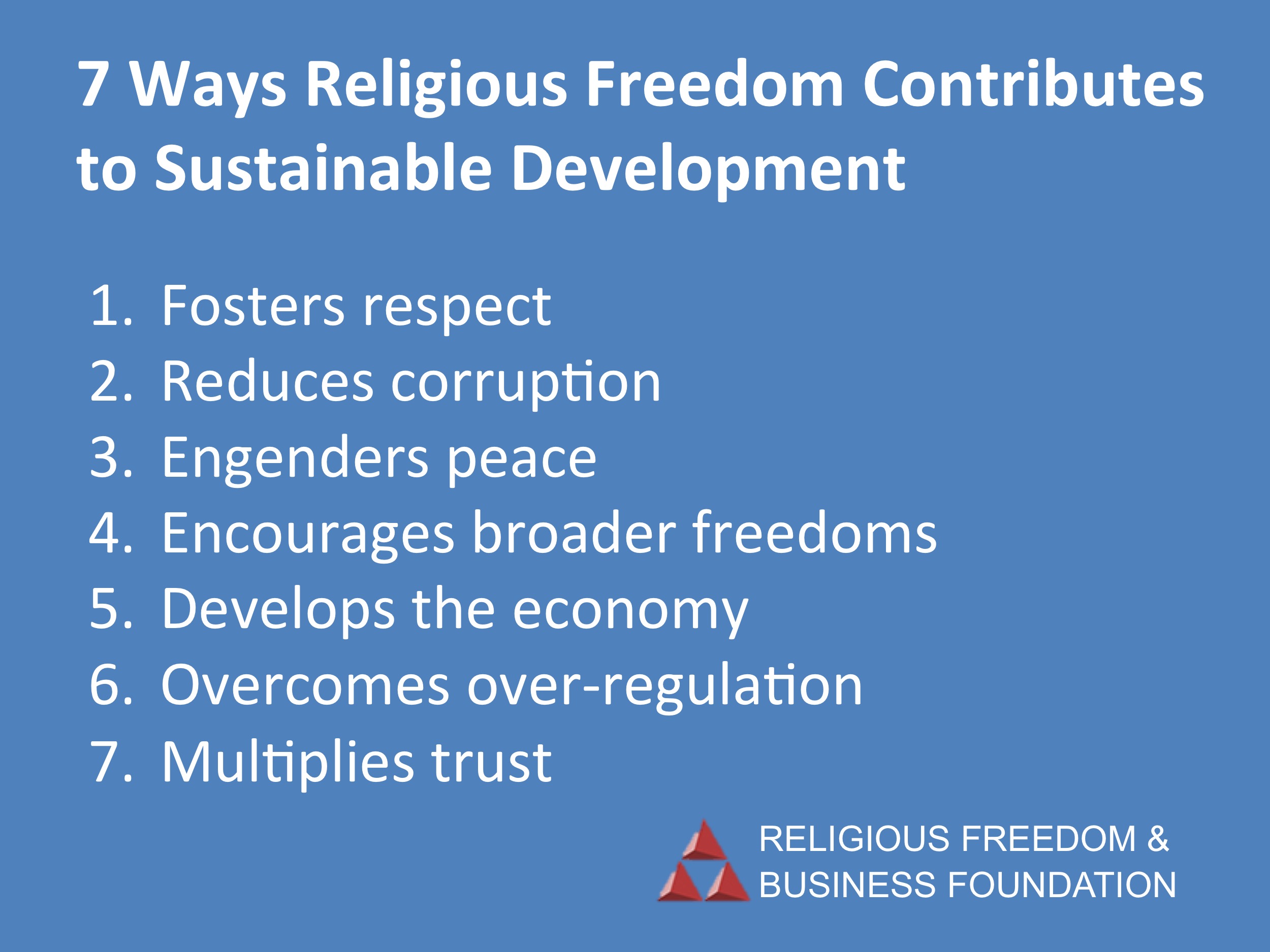
  • Interfaith understanding also strengthens business by reducing corruption and encouraging broader freedoms while also increasing trust and fostering respect. Research shows that laws and practices stifling religion are related to higher levels of corruption. Similarly, religious freedom highly correlates with the presence of other freedoms and a range of social and economic goods, such as better health care and higher incomes for women.
  • Positively engaging around the issue of interfaith understanding also helps business to advance trust and respect with consumers, employees and possible partner organizations, which can give companies a competitive advantage as sustainability and ethics come to the forefront of corporate engagement with society.
  • With the shared vision of a more sustainable and inclusive global economy that delivers lasting benefits to people, communities and markets, it is clear that companies can make significant contributions to advancing interfaith understanding and peace through both core business and outreach activities. The examples in this publication offer an important step forward in providing companies with guidance on why and how they can make practical contributions in this area – in ways benefitting both their business and the societies where they operate.

Stay up to date with the weekly Newsletter!

Workplace Religious Discrimination Encountered by 1-in-3

11 Aug, 2014

36% of Americans — some 50 million people — report experiencing or witnessing workplace religious discrimination, according to a recent Tanenbaum survey, “What American Workers Really Think about Religion.”

Nearly half of non-Christian workers (49%) report experiencing or witnessing religious non-accomodation at work. White evangelical workers (48%) are equally as likely to report experiencing or witnessing religious non-accommodation at work. And two-in-five (40%) atheists also report experiencing or witnessing religious non-accomodation.

The survey notes that when it comes to addressing religion in the workplace, different religious groups have different needs for accommodation. For instance, a non-Christian may care more about the right to display a religious object or the right to pray during the day, while a Christian will be more concerned about attending service on Sunday. The survey found that the most commonly experienced or witnessed forms of religious non-accomadation are being required to work on Sabbath observances or religious holidays (24%) and attending company-sponsored events that did not include kosher, halal or vegetarian options (13%).

Less than half of all workers report that their companies have the following key policies related to religious diversity: 1) flexible work hours to permit religious observance or prayer (44%); 2) materials explaining the company’s policy on religious discrimination (42%); 3) a policy to allow employees to “swap holidays” (21%); and 4) programs to teach employees about religious diversity (14%).

The Tanenbaum survey found that 41% of workers at companies without clear processes for handling employee complaints – including religious discrimination complaints – say they are looking for a new job where they would be happier. This is nearly twice the rate as workers who say their companies do have clear processes (22%). Likewise, 32% of workers at companies without materials explaining the company’s policy on religious discrimination report that they are looking for a new job, significantly higher than workers at companies that offer these materials (25%).

Morale is higher in companies that provide flexible hours for religious observance. In such companies, 13% say that they do not look forward to coming to work, compared with 28% of workers at companies that do not provide this flexibility (13%) – more than a twofold difference.

Tanenbaum concluded from the survey that companies gain a competitive edge by adopting proactive policies of religious accommodation. Doing so makes good business sense, in that it increases employee morale and corporate reputation with regards to employee recruitment and retention.

OTHER FINDINGS OF INTEREST:

  • The survey found that one-in-two U.S. workers have contact with people of different beliefs at work.
  • Half of non-Christians say that their employers are ignoring their religious needs.
  • More than half of American workers believe that there is a lot of discrimination against Muslims.
  • Nearly 6-in-10 atheists believe that people look down on their beliefs, as do nearly one-third of white evangelical Protestants and non-Christian religious workers.
  • Regardless of a company’s size, workers whose companies offer education programs about religious diversity and flexibility for religious practice report higher job satisfaction than workers in companies that do not offer such programs.

ABOUT THE SURVEY

Tanenbaum’s 2013 Survey of American Workers and Religion was conducted by Public Religion Research LLC among a random sample of 2,024 American adults (age 18 and up) who are currently employed in a part-time or full-time position and who are part of GfK’s Knowledge Panel. Interviews were conducted online in both English and Spanish between March 19 and April 1, 2013. The margin of sampling error is +/- 2.8 percentage points at the 95% level of confidence.

Tanenbaum is a secular, non-sectarian nonprofit that promotes mutual respect with practical programs that bridge religious difference and combat prejudice in schools, workplaces, health care settings and areas of armed conflict.

Stay up to date with the Foundation’s Newsletter!

Religious Market Theory of Peace Yields Interfaith Harmony and Economic Growth

4 Aug, 2014

“The Religious Market Theory of Peace” developed by Brian Grim, President of the Religious Freedom & Business Foundation, and Penn State Professor Roger Finke, has led to a new and novel means to create harmony while promoting economic growth, finds Valentina Gasbarri.

Gasbarri goes through the seven reasonsfor why religion freedom and business are good for each other. For instance, religious freedom reduces corruption, a key impediment to sustainable economic development. And, research shows that religious freedom engenders peace by reducing religion-related violence and conflict, which inhibits economic growth.

Gasbarri, looking at data from Pew Research and the Religious Freedom & Business Foundation, observed that there is increasing recognition that faith and religious freedom play a vital role in promoting peaceful and harmonious relationships between nations. She notes that while international organizations such as the United Nations have long recognized the principle of religious freedom, there have been few quantitative contributions that review the positive impact of faith and religion to social and economic well being.

Indeed, religious freedom is one of only three factors significantly associated with global economic growth, according to a new study by researchers at Georgetown University and Brigham Young University. The study looked at GDP growth for 173 countries in 2011 and controlled for two-dozen different financial, social, and regulatory influences.

Gasbarri cites a study by the Pew Research Center’s Forum on Religion & Public Life, published in January 2014, showing that 5.3 billion people – nearly 76 percent of the world’s population – live under high or very high restrictions on the freedom of religion and beliefs. These restrictions come from both the private sector and from government policies and religious restrictions reached a six-year peak in 2012.

Given this global peak in restrictions on religion and the accompanying social and economic harm, Gasbarri writes that “The Religious Market Theory” is a viable solution with a clear plan.

Valentina Gasbarri is a Junior Expert of the European Instrument for Democracy and Human Rights (EIDHR).

Brazil Human Rights Minister Praises Foundation’s Work

25 Jul, 2014

Human Rights Minister, Ideli Salvatti, praised the innovate work of the Brazilian Religious Freedom & Business Association ( ALRN ) in a meeting this week in Brasilia. (ALRN is the Brazilian affiliate of the Religious Freedom & Business Foundation, based in the U.S.)

Minister Ideli received ALRN board members Romanna Remor and Silvio Guimarães on Tuesday. During the meeting, Ideli invited ALRN to attend the Second World Human Rights Forum this December in Morocco, a follow up to last year’s Forum in Brasilia. Minister Ideli discussed with Remor and Guimarães possible collaboration between Ministry and ALRN for a global prize for initiatives protecting religious freedom.

This meeting comes on the heels of other high level meetings between the Religious Freedom & Business Foundation and Brazil’s Vice President Temer and Secretary General of the Republic Carvalho.

During the meeting, the Minister praised the innovative nature of ALRN. “By associating religious freedom and diversity to economic and social development, it addresses a key topic from a unique perspective,” she said. “And this fits with the Brazilian love of difference and diversity … which promotes the development of the country itself.” And indeed, research indicates that Brazil does value religious freedom and diversity.

Brazil has lowest government restriction on religion among 25 largest countries

Among the 25 most populous countries, only six have low government restrictions on religion (average between 2006-2012), with Brazil having the lowest of all (see chart). Brazil has lower restrictions, in fact, than the United States, where restrictions have been rising.

Religious freedom is highly valued in Brazil. For instance, when Brazilians were asked in a 2006 Pew Research survey whether it was important to live in a country where there is freedom of religion for religions other than their own, nearly the same percentage of people indicated that this was important (95%) as indicated that it was important to live in a country where they can practice their own religion freely (96%).

An expression of such support for religious freedom occurred this spring when the government of São Paulo – Brazil’s commercial center and the western hemisphere’s most populous city at 20 million – declared that henceforth May 25th will be “religious freedom day.” This declaration coincided with a multi-faith religious freedom festival that drew nearly 30,000 participants, including the participation of the Catholic archdiocese, leading politicians and celebrities.

Stay up to date with the Foundation’s Newsletter!

Business brings peace and religious freedom, finds new study

22 Jul, 2014

IMMEDIATE RELEASE – Business is a powerful force for peace, interfaith understanding and religious freedom, finds a new study by the Religious Freedom & Business Foundation.* The study breaks new ground by showing that business is good for religious freedom.

This new study, authored by Melissa E. Grim, builds on another recent global analysis that found the converse is also true – religious freedom is good for business.

While human rights organizations often focus on holding businesses accountable to human rights standards (perhaps understandably), these case studies begin with a different question: How can business be a force for social good and at the same time make a profit?

The new study examines a range of case studies and finds that “impact investments” by businesses can result in increased interfaith understanding, religious freedom and peace.

The case studies come from the Middle East, Asia, Africa and South America, and were chosen to be illustrative, not exhaustive. The study’s limitation, however, is that it does not show the extent to which business is a force for peace, interfaith understanding and religious freedom. Rather, the study shows that business can be, and some businesses certainly are.

CASE STUDIES

  • Coke Serves Up Love and Peace with Small World Machines – Last year, Coca-Cola brought some laughter and joy to one of the most volatile and dangerous regions on earth, when it installed two Small World Machines in New Delhi, India, and Lahore, Pakistan.
  • BMW AWARD, Driving Global Peace and Success – For luxury carmaker BMW, intercultural understanding is more than just a nice sentiment, it’s “an essential part of our daily work,” says Bill McAndrews, the company’s Vice President for Communications. Indeed, since 1997, BMW has been actively promoting cooperative dialogue between different cultures, giving out awards to support businesses that innovate interculturally. Awards highlighted are (1) Helping Muslim Youth in the Philippines; (2) Giving a Voice to the Voiceless in India; and (3) Promoting Understanding Through Tourism in the Holy Lands.
  • Nigerian Conflict: Is Business the Answer? – In Nigeria, businesses and economic development NGOs are working to stop widespread religious violence between Christians and Muslims, which has already taken hundreds of lives and threatens to thrust parts of the country into civil war.
  • World Cup Highlights Struggles & Contributions of Afro-Brazilians

    – In Brazil, where religious freedom is generally well-protected, Brazilians of African descent still face discrimination for their appearance and beliefs, including their religious beliefs. But an NGO, the Afro-Brazilian Incubator, is working to fight this discrimination by promoting entrepreneurship among Afro-Brazilians.

  • Indonesian Businesses Open Their Doors to Faith and Action – In Indonesia, businesses are at the forefront of efforts to promote interfaith understanding. For instance, EXPRESS Taxi, with a fleet of more than 7,000 taxis in Jakarta, promotes a faith-friendly workplace by setting up prayer rooms and facilitating Muslim and Christian observances as well as celebrations of Chinese New Year. In addition, businesses in Indonesia have worked to fix large, seemingly intractable social problems such as helping 4,541 poor couples in interfaith marriages to receive the proper marriage licenses.

* These case studies do not imply an endorsement of any company profiled. The Religious Freedom & Business Foundation has no tie to any of the companies studied. The case studies are part of collaboration with the UN Global Compact’s Business for Peace platform and will be presented at the next UN Alliance of Civilizations meeting in Bali, Indonesia, at the end of August 2014. The Religious Freedom & Business Foundation also solicits more case studies, and will recognize and give global awards for the best innovations in religious freedom & business in 2016 in Rio de Janeiro, host of the 2016 Summer Olympics.

BMW Award, Driving Global Peace and Success

20 Jul, 2014

Melissa E. Grim, Case Studies*

For luxury carmaker BMW, intercultural understanding is more than just a nice sentiment, it’s “an essential part of our daily work,” says Bill McAndrews, the company’s Vice President for Communications. Indeed, since 1997, BMW has been actively promoting cooperative dialogue between different cultures.

One reason for BMW’s emphasis on cross-cultural dialogue and cooperation is the nature of its business. The carmaker may famously be headquartered in Germany, but its business is truly global, with 28 production and assembly facilities in 13 countries and a sales network in more than 140 nations.

The importance of intercultural understanding has led BMW to help found the Intercultural Innovation Award. Created in partnership with the United Nations Alliance of Civilizations (UNAOC), the award provides financial and other support each year for ten nonprofit organizations that are promoting intercultural dialogue and cooperation around the world.

McAndrews says that the award enables BMW “to highlight some of the wonderful cross-cultural work being done worldwide.” The BMW Group’s commitment to the awardees extends beyond financial support and includes other resources, such as helping winning organizations become part of a global network of organizations working for intercultural and interfaith understanding. McAndrews emphasizes that “this can make the crucial difference in turning an idea into a practice that enriches peoples’ lives.”

Helping Muslim Youth in the Philippines

One recent Intercultural Innovation Award winner is Kapamagogopa (KI), an organization that aims to promote religious understanding in the Philippines, where tensions between the nation’s Muslim minority and its Christian majority have led to violence and other problems. KI mobilizes young Muslims on the island of Mindanao to work as volunteers for non-Muslim organizations. By bringing Muslims into non-Muslim settings, KI aims to combat anti-Muslim bias from the majority Christian population and give young Muslims a sense that they can take positive steps to change to their lives.

KI also provides Muslims experience in working with foreign organizations. For instance, one KI volunteer, Nohman Khalil, worked with Forum ZFD, a German NGO that develops tools for dealing with violent conflicts. Khalil was able to help ZFD’s consultants gain an insider’s understanding of religious tensions in Mindanao. He thinks his greatest contribution was assisting in a project to integrate peace education into teacher training courses.

For Khalil, the job was a challenge. “Apart from it being the first time that I was far from home, my biggest challenge is that I was the only Muslim in the office,” he said, adding: “There were lots of new situations for me to deal with.” However, he considers his time at ZDF a great success. “They have made me feel very welcome,” he says. “I do not feel like a volunteer but like a member of staff.”

UN Secretary General Ban Ki-moon praised KI, stating that the project “is addressing a long history of Muslim-Christian violence by forging communications, job creation, and promoting employment.”

Giving a Voice to the Voiceless in India

Another recipient of the BMW/UN award is the Chintan Environmental Research and Action Group, an Indian NGO that has begun a recycling project in New Delhi to promote understanding between the lower caste garbage-pickers and those in the higher castes who produce much of the waste.

Across hundreds of cities in the world – ranging from Rio de Janeiro to Istanbul, and Lahore to New Delhi – tens of millions of waste-pickers spend their days sifting through garbage in the hope of feeding themselves and their families on others’ trash. In urban India, this trash recycling is undertaken by abjectly poor, mostly low caste and marginalized migrants, often at great risk to their own health.

Hoping to bridge the gap between trash-pickers and trash producers, Chintan organizes trash recycling projects in the city’s high-rise offices and encourages the higher caste residents to volunteer at charities that assist the waste-pickers. The idea is to make these largely invisible lower castes visible.

Bharati Chaturvedi, the founder of Chintan, is helping to transform the image of those who work in the Delhi garbage dumps from “waste-pickers” to “environmentalists.” Chintan does this by organizing waste-pickers into teams who approach individuals at train stations with an appeal for them to sign a pledge to stop littering. Perhaps this is a small step, but it is a significant way to make this formerly invisible community more visible and better understood.

Promoting Understanding Through Tourism in the Holy Lands

Another award winner, the Middle East and Justice Development Initiative ( MEJDI Tours ), is bringing Jews and Arabs together through the promotion of tourism. MEJDI runs the ‘Dual Narrative’ tour, which is led by Israeli and Palestinian guides who each offer their own perspectives on culture, politics and religion at each tour location.

The organization is led by Liel Maghan, an Israeli, and Aziz Abu Sarah, a Palestinian. While the two men are now good friends, they understand the challenges many Israelis and Palestinians face, particularly in perceiving and understanding those on the other side. “You say the word ‘soldier’ and an Israeli thinks protection while a Palestinian thinks fear and apprehension,” Sarah said. Only by working together can people on one side begin to understand the other side’s perspective.

* This is the second in a series of case studies highlighting how companies – in their core business activities – can help reduce religious and cultural tensions, increase social understanding, and promote peace. This case study does not imply an endorsement of any company profiled. The Religious Freedom & Business Foundation has no tie to any of the companies profiled.

To stay up to date, subscribe to our Newsletter!

Nigerian Conflict: Is Business the Answer?

19 Jul, 2014

Melissa E. Grim, Case Study*

9538446

In Nigeria, businesses and economic development NGOs are working to stop widespread religious violence between Christians and Muslims, which has already taken hundreds of lives and threatens to thrust parts of the country into civil war.

For instance, in Adamawa State in northeast Nigeria, groups like the Yola Innovation Machine are helping a new generation of entrepreneurs create businesses. The need is great. Young adults in many of Adamawa’s poor rural and marginalized communities lack the necessary entrepreneurial skills they need to break out of the poverty trap that often feeds violent extremism. The majority of youth in the area have no employment. In Adamawa, and throughout Nigeria, the population doubles every 30-35 years, so assisting people to create their own jobs is perhaps the most immediate solution to unemployment.

The Yola Innovation Machine and others are working in this direction. For instance, they helped create and nurture a new business called Yola EcoSentials (YES), which recycles discarded materials into sellable goods such as purses, mats, handbags and wristlets. The goods are made from “plarn,” a yarn spun from recycled plastic grocery bags. The venture results in multiple social goods because every item sold by Yola EcoSentials generates much needed income and employment, and at the same time helps protect the deteriorating ecological environment.

In the Plateau State in the country’s center, Muslim and Christian business people are cooperating to work around religious violence. In Jos, Plateau’s capital, there is an unwritten rule that when religious tensions flare up, Christians and Muslims should not cross certain city boundaries. But this can be devastating for the fresh produce vendors and other businesses, which serve people on both sides of the divide.

In response, Muslim and Christian business people have taken it upon themselves to work around these limitations, risking their lives and not just their livelihoods to keep business moving across the religious divide. For example, Madam Ngozi, a vegetable seller and widow raising seven children on her own, often cannot go to the market to restock her supply of vegetables due to religious violence or warnings of possible violence. However, a cell phone call to her Muslim supplier, Mallam Yahaya, can solve the problem. They find a discrete place to meet, agree on a price, and make the transaction.

Still, many are skeptical that businesses can ultimately make much of a real difference in Nigeria. “On what basis could it work?” asks Clement Nwankwo, a political analyst who heads the Policy and Legal Advocacy Centre in Abuja. “There is no peace in the northeast. Can any construction company go in there to work?”

But U.S.-trained Nigerian economist Soji Adelaja argues that business can be an important part of the long-term solution to violent religious extremism currently exploding in northeast Nigeria today. Mr. Adelaja, born in Lagos, recently returned to his homeland after 34 years in the United States to help put together what the government calls a “Marshall Plan” to counter the extremist violence and bring prosperity. The concept being put forward is that an improved economy and more opportunity could be an effective tool in countering the advances of groups like Boko Haram, the radical Islamic organization that recently made headlines around the world when it kidnapped 200 girls.
Picture
img018* This is the third in a series of case studies highlighting how companies – in their core business activities – can help reduce religious and cultural tensions, increase social understanding, and promote peace. This case study does not imply an endorsement of any company profiled. The Religious Freedom & Business Foundation has no tie to any of the companies profiled.