
As AI accelerates, are organizations overlooking one of their oldest—and most powerful—sources of human capability?
Over the past few months, I have been having conversations with senior business leaders on both sides of the Atlantic about how artificial intelligence is changing their organizations. Two conversations, in particular, have stayed with me.
The first was with an executive at a large corporation that had dramatically reduced its marketing department after concluding that AI could perform much of the team’s work. Initially, the decision appeared to make sound business sense. AI was generating content faster, campaigns were becoming more automated, and significant cost savings were realized.
But an unexpected problem emerged. The company soon discovered it did not have enough salespeople who truly understood its products. Many of the people who had been let go possessed precisely the product knowledge, customer understanding, and communication skills needed to become highly effective sales specialists. Looking back, the executive told me they regretted losing that human capability. They had measured the cost savings. They had not fully appreciated the value of the people.
A second conversation, this time with a Chief People Officer in the United Kingdom, highlighted a different challenge. As part of a broader software agreement, the company was given access to an expanding suite of AI tools. Initially, the tools appeared almost free because they were bundled into the existing platform. But as employees began relying on them, the premium features required paid upgrades. What had seemed like a complimentary addition to existing software evolved into a multi-million-dollar annual expense. The organization had underestimated not only the power of AI, but also the long-term economics of using it at scale.
Although these stories are very different, they point to the same governance challenge.
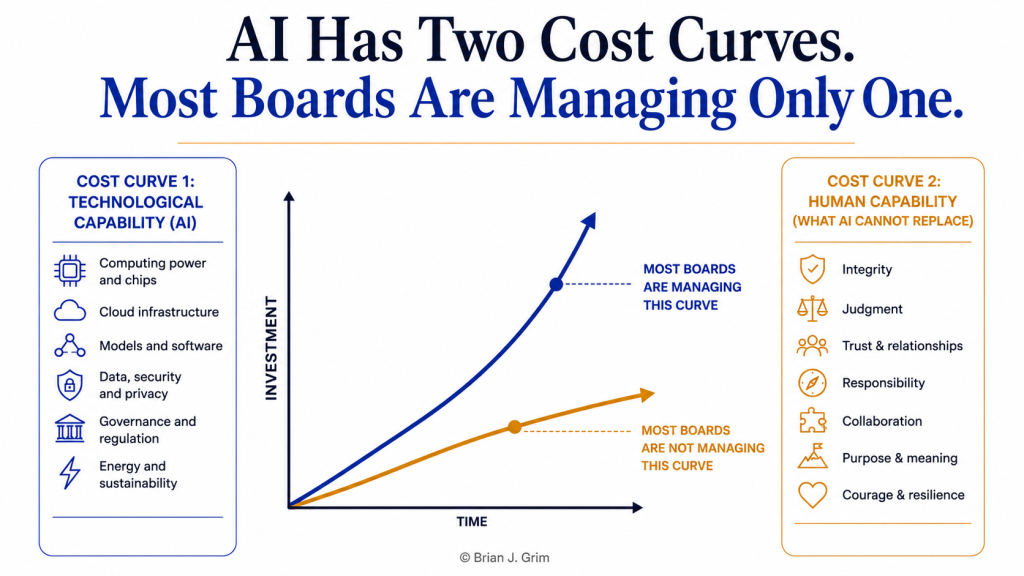
One company underestimated the value of human capability. The other underestimated the cost of technological capability. Both were managing only one of AI’s two cost curves.
McKinsey’s recent report, The Cost of Intelligence, focuses on one of those curves. As organizations move beyond experimentation and begin embedding AI across their operations, costs mount quickly. Computing power, cloud infrastructure, model selection, governance, cybersecurity, and energy all require substantial investment. AI is no longer simply an IT initiative. It is becoming one of the largest strategic investments many organizations will make over the coming decade.
McKinsey’s central message is that these investments require new forms of financial discipline and governance. Boards must understand not only what AI can do, but what it costs to operate responsibly and at scale.
That is sound advice.
Yet the first conversation suggests there is a second cost curve that deserves equal attention.
As organizations invest more heavily in technological capability, they are also making decisions that affect human capability. In some cases, they may inadvertently weaken the very capabilities that become more valuable as AI becomes more capable. The question is no longer simply, What does AI cost? It is also, What human capabilities become more valuable because of AI—and are we investing in them or diminishing them?
Artificial intelligence can process information at extraordinary speed, recognize patterns across enormous datasets, and generate increasingly sophisticated outputs. It can assist with analysis, prediction, and even creative tasks. What it cannot do is exercise judgment in the fullest human sense. It cannot accept responsibility for a difficult decision, build trust within a fractured team, inspire confidence during uncertainty, or create a shared sense of purpose. Those responsibilities remain stubbornly—and strategically—human.
This suggests that AI is creating not one cost curve but two. The first is the rapidly rising investment required to build technological capability. The second is the investment required to sustain and strengthen human capability. Most boards are paying increasing attention to the first. Far fewer appear to be asking how they will intentionally develop the second.
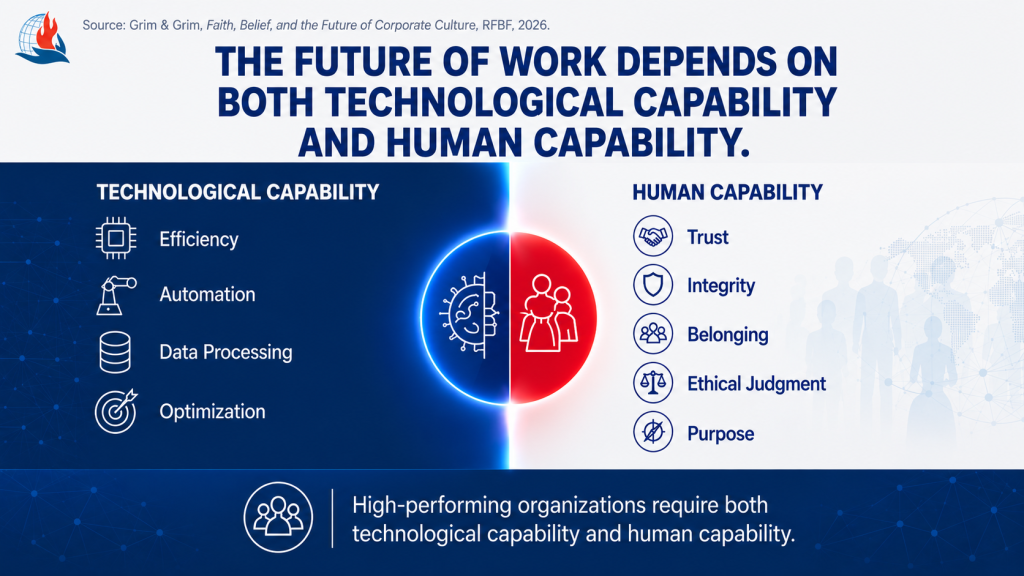
The distinction matters because AI is changing the nature of competitive advantage. As routine analysis becomes increasingly automated, value shifts toward those capabilities that technology cannot commoditize: sound judgment, integrity, responsibility, collaboration, resilience, and the capacity to lead people through complexity and change. These are often described as “soft skills,” but that label no longer seems adequate. They are rapidly becoming strategic capabilities upon which the successful deployment of AI itself depends.
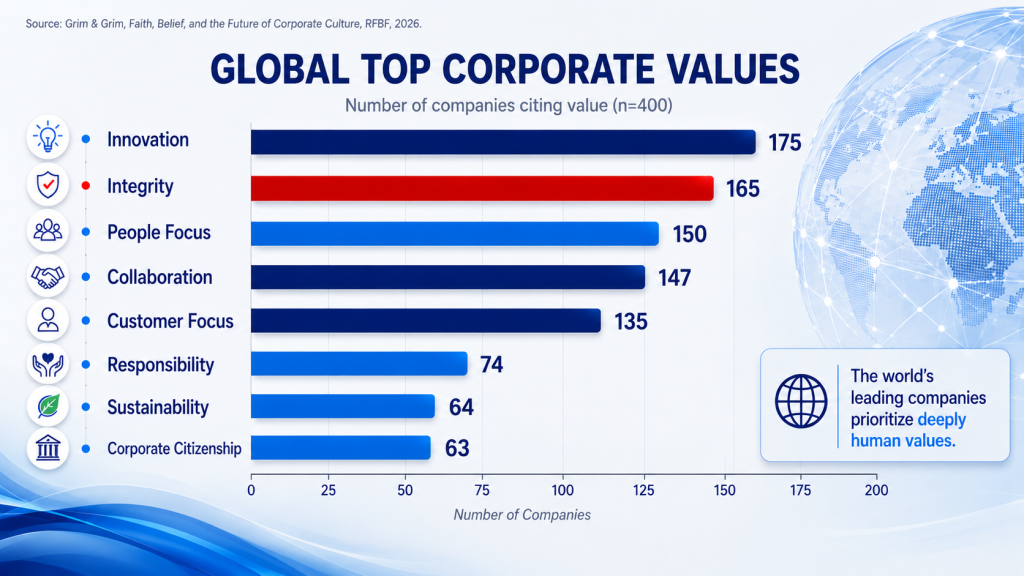
Interestingly, this appears to be a reality that many leading companies already recognize. In our recent analysis of the publicly stated values of 400 leading companies across the United States, Europe, Southeast Asia, and China, we found remarkable convergence despite enormous differences in culture, markets, and political systems. Innovation emerged as the most frequently stated corporate value, but it was consistently accompanied by integrity, people focus, collaboration, and responsibility.
That finding deserves careful reflection. Even as organizations invest billions in technology, they continue to define success in terms of capabilities that remain fundamentally human. Innovation may capture attention, but it is integrity that builds trust, people focus that develops talent, collaboration that unlocks creativity, and responsibility that sustains confidence among customers, employees, investors, and regulators.
This raises an intriguing question.
If these capabilities are becoming more valuable in the AI era, where do they come from?
Organizations rightly invest in leadership development, professional education, and corporate culture. These are important and necessary. Yet qualities such as integrity, trustworthiness, humility, courage, responsibility, and service are seldom formed solely through workplace training. They are cultivated over years through families, communities, mentors, and the traditions that shape a person’s understanding of meaning, purpose, and responsibility.
That observation may have profound implications for business.
For decades, discussions about faith in the workplace have centred largely on accommodation, legal compliance, or employee resource groups. Those conversations remain important, but they may not be asking the most strategically significant question. If organizations increasingly depend upon deeply human capabilities that artificial intelligence cannot replicate, should they also pay greater attention to the institutions and traditions that have historically helped cultivate those capabilities?
This is not an argument that companies should become religious institutions, nor is it to suggest that faith is the only source of these qualities. Rather, it is to ask whether organizations have overlooked one of the world’s oldest and most enduring sources of human capability at precisely the moment when that capability is becoming more valuable than ever.
Seen in this light, creating a faith-friendly workplace is not simply about accommodation or compliance. It may also be about enabling employees to bring to work deeper sources of integrity, purpose, service, responsibility, and resilience—qualities that increasingly determine whether organizations can deploy powerful technologies wisely and well.
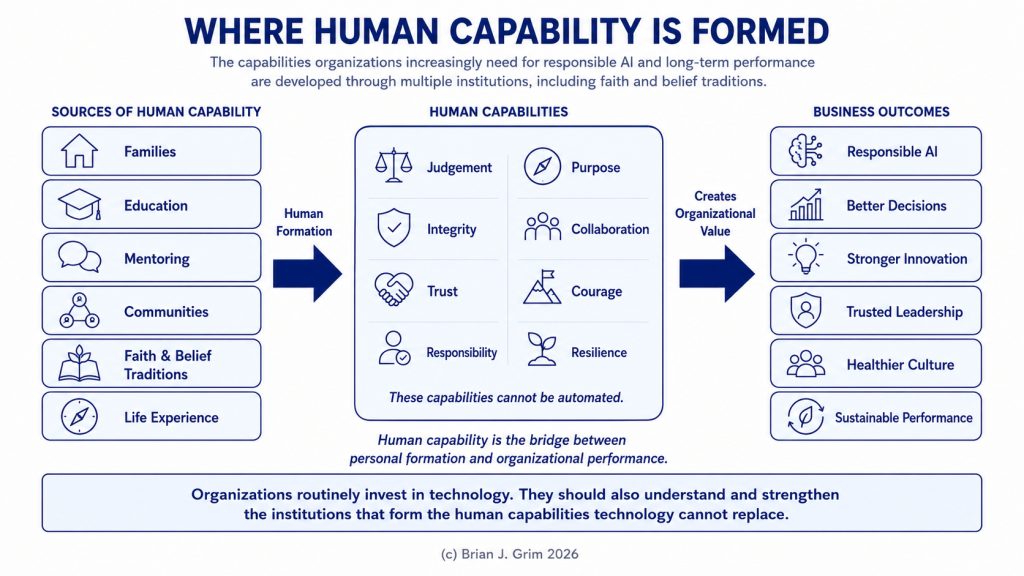
The governance challenge presented by AI is therefore broader than technology alone. Boards will certainly need to oversee algorithms, data, cybersecurity, and regulatory compliance. Increasingly, however, they may also need to ask how their organizations are cultivating the judgment, trust, responsibility, and sense of purpose that determine whether powerful technologies are used wisely. The question is no longer simply whether an organization has adopted AI. It is whether it is developing the people capable of governing AI well.
That may become one of the defining board questions of the coming decade.
This October, at Dare to Overcome London, we will continue this conversation with the release of a new Board White Paper:
The Overlooked Source of Human Capability: Why Faith and Belief Matter in the Age of Artificial Intelligence.
The paper explores a proposition that many boards have not yet considered: that faith-friendly workplaces should no longer be viewed simply through the lenses of accommodation, compliance, or inclusion, but also as part of a broader strategy for strengthening the human capabilities organizations increasingly require to thrive in an AI-enabled economy.
We hope you will join us in London as we begin what we believe is an important new conversation—not simply about the future of artificial intelligence, but about the future of human capability.