

FOR IMMEDIATE RELEASE
Religious Freedom & Business Foundation Releases Groundbreaking Global Study on Faith, Human Values, and Corporate Success
New international research finds the world’s leading companies consistently prioritize deeply human virtues traditionally cultivated by faith and belief traditions.
Washington DC — The Religious Freedom & Business Foundation (RFBF) today released a first-of-its-kind global study examining the relationship between corporate values and the human virtues historically cultivated across faith and belief traditions.
 The report, Faith, Belief, and the Future of Corporate Culture, analyzed the publicly stated corporate values of 400 leading companies across the United States, Europe, Southeast Asia, and China. The findings reveal striking global convergence around values such as innovation, integrity, collaboration, responsibility, trust, people focus, and belonging.
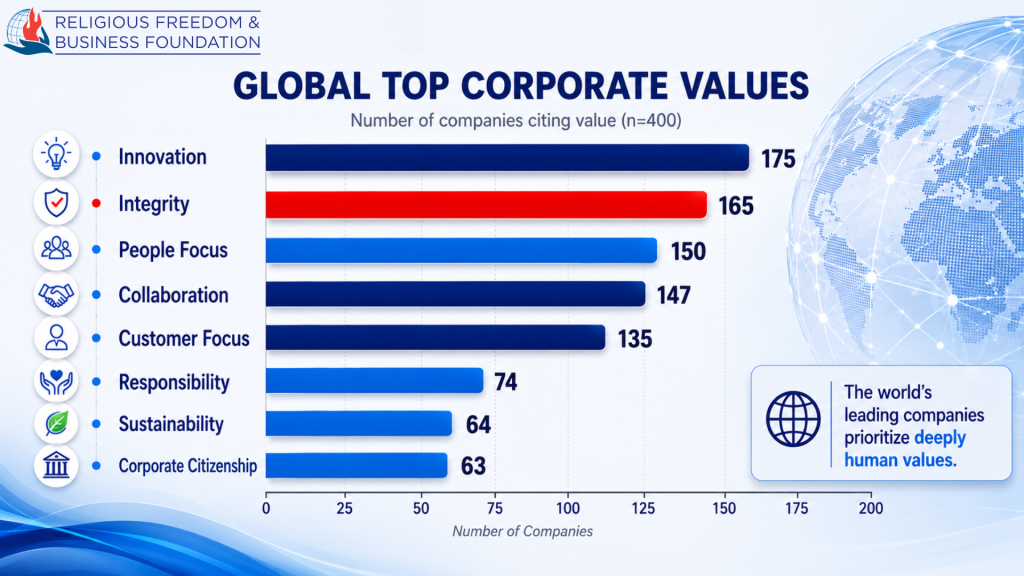
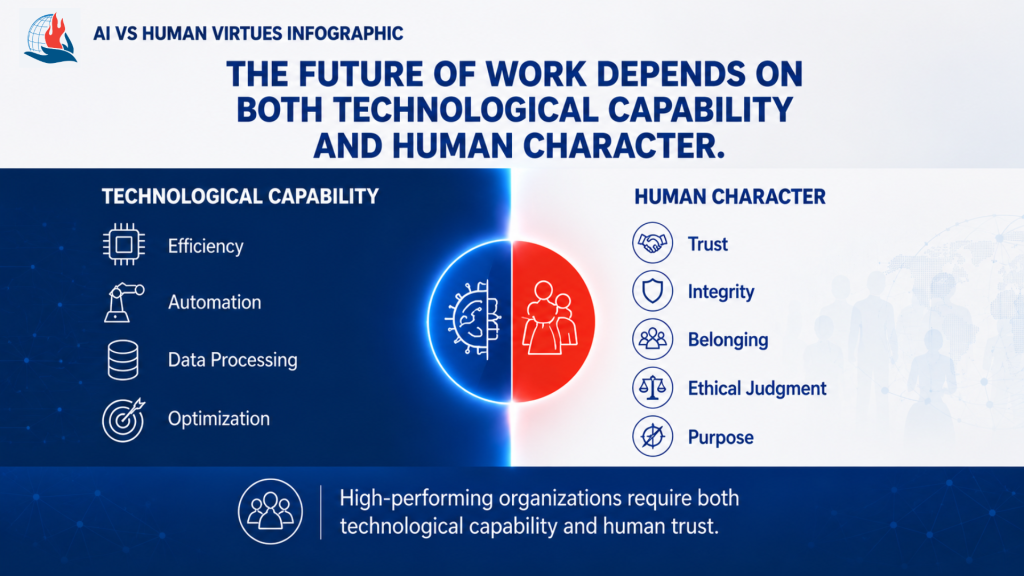
The study argues that these human-centered virtues are becoming increasingly important in an era shaped by artificial intelligence, automation, declining institutional trust, workforce fragmentation, and growing employee demand for meaning and purpose at work.
“Technology can increase efficiency, but it cannot generate trust, integrity, belonging, or moral responsibility on its own,” said Brian J. Grim, Ph.D., president of the Religious Freedom & Business Foundation and co-author of the report. “Our research suggests that the world’s leading companies increasingly depend upon deeply human virtues that faith and ethical traditions have cultivated for centuries.”
Unlike many discussions surrounding religion in the workplace, the report does not focus primarily on religious accommodation or legal compliance. Instead, it presents a new strategic framework for understanding why faith-friendly workplace cultures may strengthen organizational performance, resilience, ethical leadership, employee engagement, and long-term trust.
Among the report’s major findings:
- • Innovation emerged as the single most common corporate value globally.
- • Integrity ranked among the top values in every region studied.
- • People-focused cultures, collaboration, and responsibility appeared consistently across political systems, industries, and cultural traditions.
- • European firms placed stronger emphasis on sustainability and corporate citizenship.
- • Southeast Asian firms demonstrated stronger relational and collaboration-oriented values.
- • Chinese firms strongly emphasized innovation alongside stability, integrity, and collective responsibility.
- • American firms strongly emphasized innovation, integrity, customer focus, and agility.
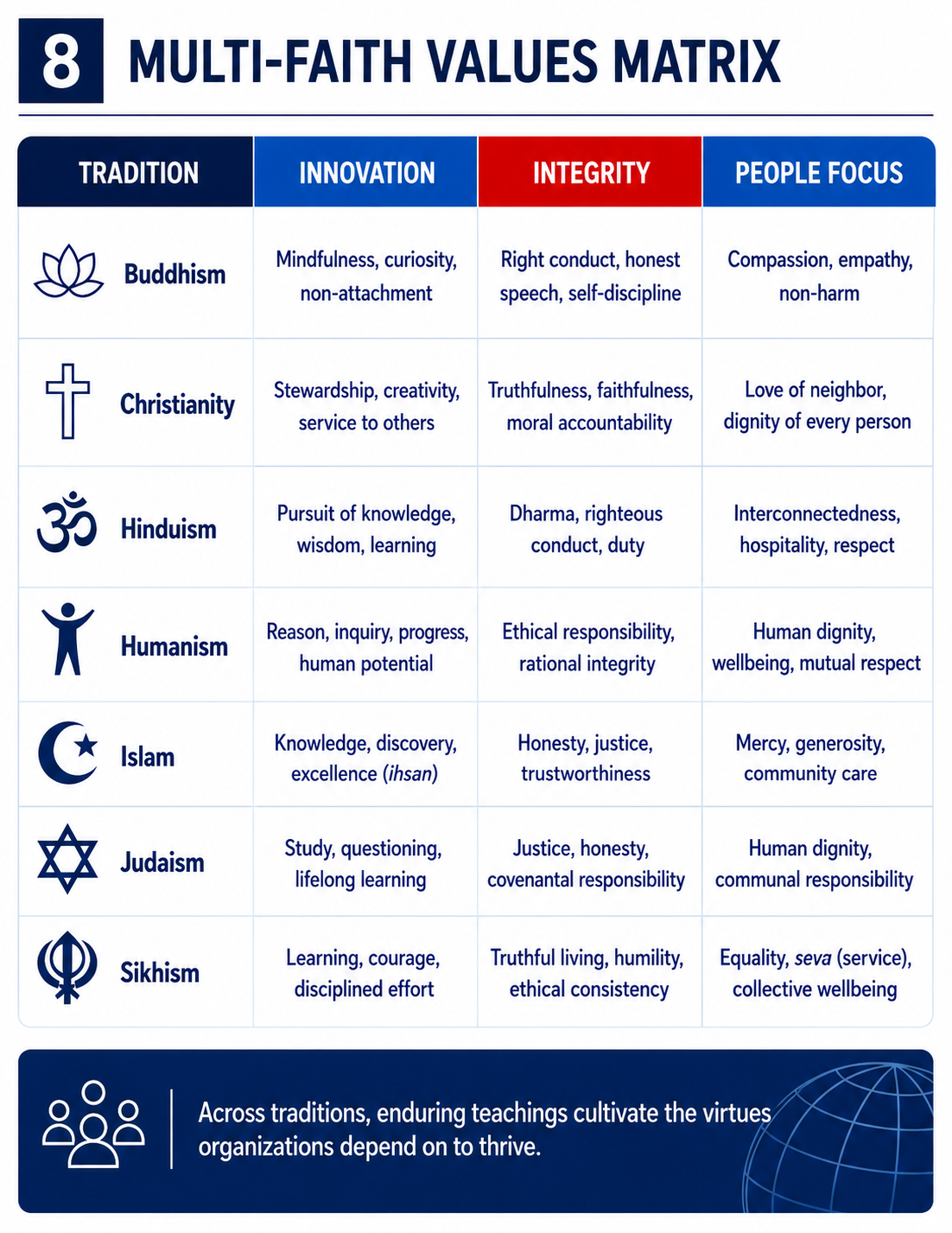
The report also explores how major faith and belief traditions, including Buddhism, Christianity, Hinduism, Humanism, Islam, Judaism, and Sikhism, cultivate many of the same virtues modern organizations increasingly recognize as essential to long-term success.
RFBF says the findings may help explain why conversations surrounding faith-friendly workplaces are gaining greater strategic relevance globally.
“This research suggests that faith-friendly workplaces are not simply about inclusion,” said Melissa E. Grim, J.D., co-author of the report. “They are also about helping organizations strengthen the human foundations that technology alone cannot provide.”
GROUNDBREAKING RESEARCH
- • First global study connecting corporate values and faith-based human virtues
- • Why AI may increase the importance of trust, ethics, belonging, and human-centered leadership
- • How leading corporations across China, Europe, Southeast Asia, and the United States converge around similar human values despite cultural differences
- • Why innovation depends upon human character and organizational trust, not technology alone
- • The emerging business case for faith-friendly workplace cultures
- • How global companies increasingly prioritize integrity, people focus, and responsibility alongside performance
- • Why meaning, purpose, and belonging are becoming strategic workplace issues
- • The role of ethical and philosophical traditions in shaping resilient organizational cultures
The full report, Faith, Belief, and the Future of Corporate Culture, is available from the Religious Freedom & Business Foundation.
About the Religious Freedom & Business Foundation
The Religious Freedom & Business Foundation is a nonpartisan nonprofit organization dedicated to educating the global business community about the positive contributions that faith and freedom of belief bring to workplaces, economies, and society. Founded by Brian J. Grim, Ph.D., RFBF works globally with businesses, policymakers, and organizations across religious and nonreligious backgrounds.
Media Contact: EMAIL