
ANNAPOLIS, Md., September 2026 — Brian J. Grim, Ph.D., President of the Religious Freedom & Business Foundation, will participate in a high-level dialogue in New York City on September 24, 2026, exploring how faith, moral traditions and responsible leadership can help shape the future of work, markets and economic power in the age of artificial intelligence.
The session comes amid growing reflection among faith, business and policy leaders following the publication of the encyclical Magnifica Humanitas, which has prompted renewed discussion about technology, human dignity, economic life and the common good. Drawing on the work of the World Economic Forum’s Global Future Council on Faith in Action, the gathering will bring together business leaders, investors, policymakers and thinkers across economics, faith and moral philosophy.
Participants will examine how AI is reshaping work, markets and economic power; how moral and social traditions can inform the responsibilities of ownership and stewardship; and how leaders can advance human dignity, trust, inclusive value creation and long-term economic resilience.
“This conversation comes at a critical moment,” said Grim. “Artificial intelligence is changing how organisations operate, compete and create value. But the qualities that determine whether these technologies serve people well, including judgement, integrity, responsibility, trust and purpose, remain profoundly human. The question for leaders is not only what AI can do, but what kind of organisations and markets it is helping to create.”
Grim recently addressed this issue in his thought piece, “AI Has Two Cost Curves. Most Boards Are Managing Only One.” The article argues that many boards are increasingly attentive to the rising investment required to build technological capability, but pay less attention to the investment required to sustain and strengthen human capability. It highlights two governance risks: underestimating the long-term cost of AI at scale and undervaluing the product knowledge, customer understanding, relationships and judgement that employees bring to an organisation.
“AI can process information, recognise patterns and generate increasingly sophisticated outputs,” Grim said. “What it cannot do is accept responsibility for a difficult decision, build trust within a fractured team or create a shared sense of purpose. Those responsibilities remain stubbornly, and strategically, human.”
The New York gathering also anticipates the October release at Dare to Overcome London of Grim’s new Board White Paper, The Overlooked Source of Human Capability: Why Faith and Belief Matter in the Age of Artificial Intelligence. The paper develops the proposition that organisations increasingly depend upon human capabilities they did not create, and that boards should better understand where those capabilities are formed, renewed, strengthened or weakened.
The white paper argues that faith and belief should no longer be viewed only through the lenses of accommodation, compliance or employee inclusion. For many people, religious and belief traditions also help form and renew the human capabilities organisations increasingly need in an AI-enabled economy: judgement, integrity, responsibility, courage, trustworthiness, service, stewardship and purpose.
“Boards routinely oversee strategy, talent, culture, risk and technology,” Grim said. “Yet few ask where the human capability on which all of these depend actually comes from. As AI becomes more powerful, that question becomes more urgent.”
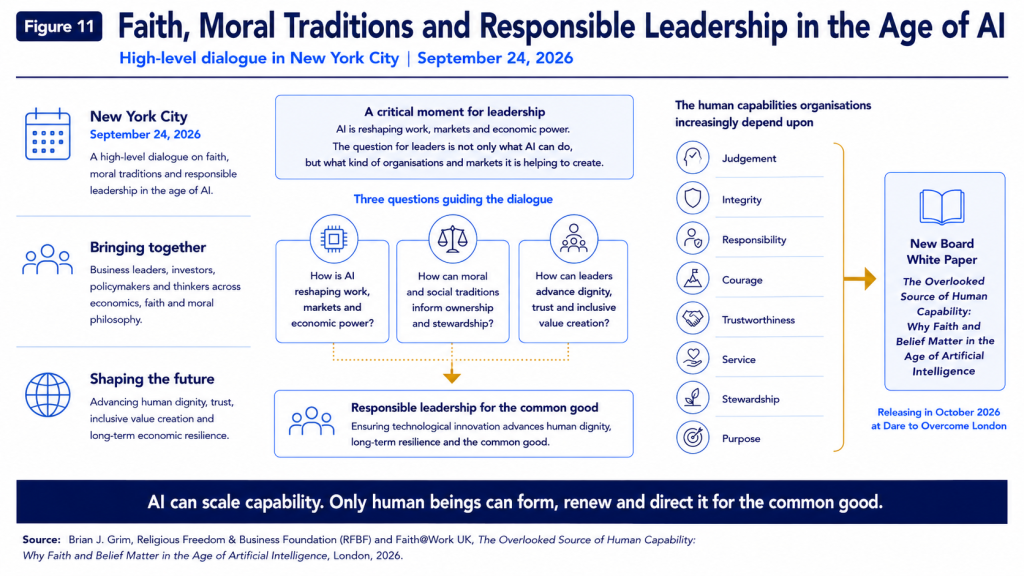
The September 24 dialogue will contribute to a growing global conversation about how faith, moral reasoning and responsible leadership can help ensure that technological innovation advances human dignity, long-term resilience and the common good.
About Brian J. Grim
Brian J. Grim, Ph.D., is President of the Religious Freedom & Business Foundation, Global Chair of Dare to Overcome, and Associate Director of Faith@Work UK. He is an internationally recognised expert on the relationship between religion, business, economics and human flourishing, and advises leaders across business, government and civil society on faith, workplace culture, leadership and social impact.
About the Religious Freedom & Business Foundation
The Religious Freedom & Business Foundation is a global nonprofit organisation that helps companies build workplaces where employees of all faiths and beliefs, including those with no religious affiliation, are respected and able to contribute fully. Through research, benchmarking, convening and practical resources, RFBF advances understanding of how faith-friendly workplaces strengthen organisational culture, trust, belonging and human flourishing.
For more information, visit Religious Freedom & Business Foundation.