
Why Character, Faith and Belief Matter
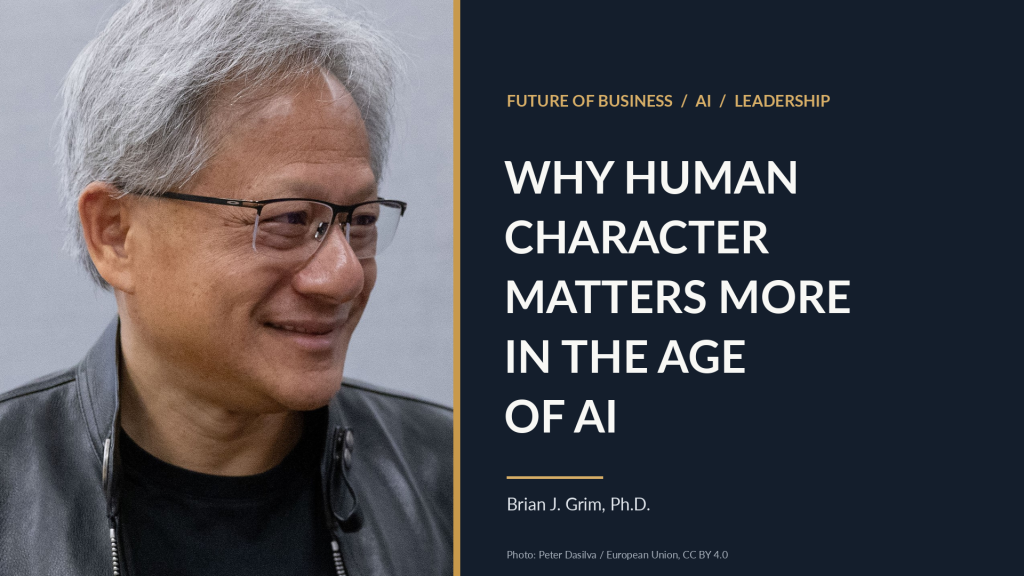
The controversy surrounding Nvidia chief executive Jensen Huang has brought questions of human character into the heart of the AI industry.
On 8 November, Huang publicly apologized for being unfaithful to his wife and for the hurt he had caused his family. His message also addressed colleagues, directors, partners and shareholders. “My responsibility is to serve you and be worthy of your trust,” he wrote.
That same day, Nvidia’s board announced an independent investigation following reports that Huang had been the target of a foreign intelligence effort. The board said it had no reason to believe that national security or company secrets had been compromised, while committing to examine all available information.
These matters should not be conflated. An admission of infidelity does not establish that security was compromised. The investigation must establish the facts, and Huang’s family deserves privacy.
But the situation raises a question that reaches well beyond Nvidia: are we giving enough attention to the character of the people entrusted with increasingly powerful technologies and businesses?
Technical brilliance does not remove human fallibility

Much of the business discussion about AI focuses on capability: what it can do, how it can improve productivity and what new skills employees will need.
My recent board paper, The Overlooked Source of Human Capability and Character: Why Faith and Belief Matter in the Age of Artificial Intelligence, asks a related question. As technology expands what organisations can do, what qualities become more important in the people deciding how that capability should be used?
The distinction is between competence and character. Competence includes the knowledge, skills and expertise needed to perform a role. Character helps determine how those capabilities are exercised, particularly when pressures are high, interests conflict or the right course is difficult. Neither is sufficient on its own.
The paper identifies seven qualities with particular relevance to business: wise judgement, integrity, responsibility, trustworthiness, courage, stewardship and care for others. These matter in decisions about technology, but also in how leaders fulfill commitments, respond to criticism and exercise authority.
This is not a claim that AI caused Huang’s conduct. It is a reminder that technological achievement does not settle questions of human judgement or trustworthiness.
We should be able to recognise exceptional competence without assuming that it makes someone less in need of accountability. Indeed, the greater the responsibilities entrusted to a leader, the more important that accountability becomes.
Character and governance belong together

The Nvidia situation is also drawing attention to the role of boards. Reuters’ reporting has raised questions about whether directors with longstanding relationships with Huang can investigate his conduct with sufficient independence. Those are questions for scrutiny, not conclusions that should be assumed in advance.
For boards more generally, the lesson should be practical. Can colleagues challenge senior leaders? Are conflicts of interest disclosed and addressed? Do expectations of conduct apply consistently, including to those whose commercial contribution appears indispensable? Can concerns be examined independently and fairly?
An emphasis on character should strengthen governance, not replace it. Trust in an individual is not a reason to dispense with oversight. Equally, policies and controls should not become a reason to neglect the character of those exercising judgement within them.
This does not mean employers should police employees’ private lives. It means they should address conduct that affects organisational responsibilities, relationships and risks, with clear boundaries and fair procedures.
The question is not whether leaders are capable of failure. It is how organisations encourage responsible conduct, respond when trust is damaged and create conditions in which concerns can be raised before harm grows.
Where character is formed and renewed
Businesses look for integrity, judgement and trustworthiness when recruiting and promoting people. Yet these qualities begin forming long before someone joins an organisation, through family, education, relationships, mentors, service and experience. For many people, religion or belief is an important part of that formation throughout their lives.
Businesses also become part of the process. What leaders reward, tolerate and demonstrate through their own behaviour can strengthen or undermine the qualities they say they value. An organisation can encourage honesty, or make people afraid to speak. It can reinforce responsibility, or allow results to excuse how they were achieved.
That is why character should not be treated simply as something assessed at recruitment and then assumed to remain unchanged. It needs continuing attention, encouragement and accountability.
For many employees, faith and belief provide some of those resources. Recognising that contribution does not imply that religious people have better character or that religion prevents wrongdoing. Nor does the Nvidia situation justify speculation about anyone’s personal beliefs.
The point is more straightforward: if businesses depend on character, they should understand the sources through which people form and sustain it.
Convictions need to become practices

In the paper, I describe this process through belief, behaviour and belonging.
Beliefs help people understand their purpose and responsibilities. Practices such as prayer, meditation, study, generosity and service give repeated expression to those convictions. Communities provide examples, encouragement, practical support and accountability. Together, these can help form and continually renew character.
This is relevant to business because declaring a value does not ensure that people will practice it. Integrity needs expression in truthful decisions and a willingness to accept responsibility. Care for others needs to shape how people are treated. Stewardship requires attention to consequences beyond immediate advantage.
The paperexamines several ways these connections already operate in organisational life. At Accenture, employee faith networks and practical support contributed to wider organisational capability. At Japan Airlines, Kazuo Inamori’s Buddhist, spiritual and philosophical formation contributed to a shared management philosophy reinforced through education, leadership expectations and accountability.
These are different approaches, not a single model for others to copy. They show why faith and belief inclusion can be relevant to leadership, culture and responsible decision-making, as well as accommodation and employee belonging.
What boards should ask

Faith and belief inclusion must respect people of all faiths and beliefs, including those who are not religious. Participation should be voluntary, privacy protected and freedom of conscience respected. No employee should be pressured to disclose beliefs or participate in religious activities.
The board’s responsibility is to govern the conditions in which people contribute, not to judge what they believe. The paper proposes four questions:
- Recognise. Do we recognise the potential contribution of religion or belief to character and working life?
- Enable. Can employees who wish to do so bring this part of themselves into working life appropriately and voluntarily?
- Value. Are we open to insights shaped by religion or belief, including those relevant to leadership and the responsible use of AI?
- Review.Are these conditions working fairly, consistently and responsibly in practice?
These questions belong within existing discussions about strategy, people, culture, ethics, risk and responsible technology. They should sit alongside clear standards of conduct and effective oversight, not be offered as substitutes for them. A responsibility that remains human.
We should allow the Nvidia investigation to establish the facts without either minimizing acknowledged wrongdoing or treating unresolved allegations as proven.
For other business leaders, however, there is no need to wait before examining their own organisations. Are we supporting the qualities of character on which we depend? Are we rewarding conduct consistent with our stated values? Are we overlooking sources of meaning, responsibility and accountability that matter deeply to our people?
AI can expand organisational capability. It does not relieve people of responsibility for how that capability is exercised.
As AI expands what businesses can do, the character of those deciding what they should do becomes more consequential.
Boards should ask where that character is formed, how it is sustained and whether their own cultures strengthen or undermine it. For many employees, faith or belief is an important part of the answer.
That conversation belongs in the boardroom.
