
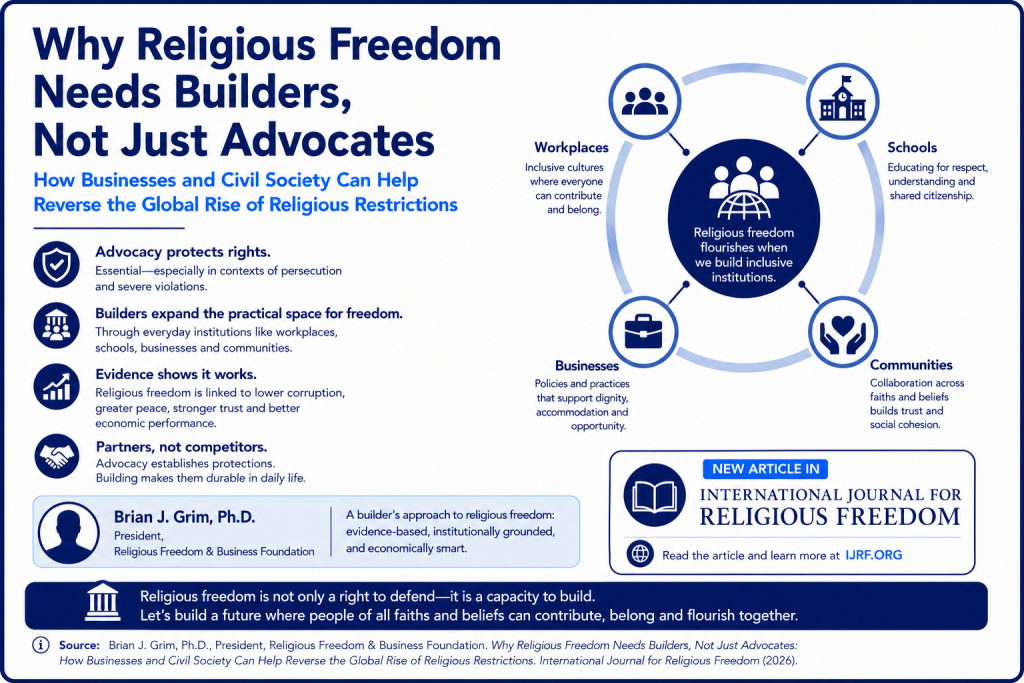
How Businesses and Civil Society Can Help Reverse the Global Rise of Religious Restrictions
For decades, efforts to advance freedom of religion or belief (FoRB) have focused primarily on advocacy: documenting violations, defending victims of persecution, promoting legal protections, and pressing governments to uphold international human-rights standards. These efforts remain essential. Yet despite decades of dedicated advocacy, religious restrictions continue to rise globally. Today, nearly three-quarters of the world’s population lives in countries with high or very high levels of restrictions on religion.
In my recent article in the International Journal for Religious Freedom, I argue that while advocacy remains indispensable, it is no longer sufficient on its own. We need a complementary strategy: a builder’s approach to religious freedom.
The builder’s approach starts with a simple observation. Religious freedom is not experienced primarily in courtrooms, legislatures, or diplomatic forums. People encounter religious freedom—or its absence—in their everyday lives: in workplaces, schools, businesses, civic organizations, and local communities. These institutions often determine whether people can live openly according to their beliefs, contribute fully to society, and engage constructively with people who think differently.
Builders seek to expand this practical space for religious freedom. Rather than focusing only on legal rights, they work through institutions that shape daily life. Businesses, in particular, are uniquely positioned to play a constructive role. They employ people of diverse faiths and beliefs, influence organizational cultures, and create environments where differences can either become sources of conflict or opportunities for cooperation.
The case for this approach is not merely philosophical. It is empirical.
Research consistently shows that societies with higher levels of religious freedom tend to experience lower corruption, greater peace, stronger social trust, and improved economic performance. Studies comparing countries around the world have found that freedom of religion or belief is associated with several key drivers of economic growth, competitiveness, and institutional effectiveness.
Religion itself also contributes significantly to economic and social life when allowed to operate freely. Congregations, faith-based charities, schools, healthcare systems, and faith-inspired businesses generate employment, strengthen communities, mobilize volunteers, support vulnerable populations, and create substantial economic value. Religious freedom enables these contributions to flourish. Restrictions on religion, by contrast, often constrain human potential while increasing social tensions and economic costs.
This insight helps explain why businesses increasingly recognize the value of religious inclusion. Practices such as faith-and-belief employee resource groups, religious accommodation policies, chaplaincy programs, and religious literacy training are often adopted not as symbolic gestures but because they improve employee well-being, reduce conflict, strengthen belonging, and support organizational performance. The growth of faith-friendly workplace initiatives illustrates how religious freedom can be operationalized through everyday institutional practice.
In the article, I distinguish between advocates and builders. Advocates focus on protecting rights through legal and policy mechanisms. Builders focus on cultivating the social and institutional conditions that allow those rights to flourish in practice. The two approaches are not competitors; they are partners. Advocacy establishes essential protections. Building helps make those protections durable by embedding them in the institutions that shape daily life.
The builder’s approach rests on four core elements: a commitment to human flourishing across differences, reliance on empirical evidence, institutional creativity, and collaborative engagement. Builders ask not only whether religious freedom is protected in law, but whether people can actually live it out within the institutions that matter most in their lives.
Religious freedom remains one of humanity’s most important rights. But if we hope to reverse the long-term rise in religious restrictions, we must think beyond advocacy alone. The future of religious freedom will be shaped not only by governments and courts, but also by businesses, schools, charities, and communities willing to build environments where people of all faiths and beliefs can contribute, belong, and flourish together.
For that reason, religious freedom should be understood not only as a right to defend, but also as a social capacity to build.