
At Tzu Chi’s Mecuzi Farm in Mozambique, food production, skills training and resilient infrastructure are helping communities build solutions that can last.
Planting Hope, Practically
By Brian Grim
After a packed day that included joining Tzu Chi representatives as they opened a medical clinic, visited schools the foundation helped reconstruct, and saw models of resilient and affordable homes they built, how did I end up in a field planting cashew trees?
And why is one of them called Captain America?
The answer is found at Tzu Chi’s Mecuzi Farm, a roughly 200-hectare agricultural project in the interior of Sofala Province. Cultivated by local volunteers, the farm produces a variety of crops, including rice, cashews and medicinal plants. The produce helps supply local hospitals, schools and vulnerable families in the region.
The foundation’s longer-term goal is to develop the farm into a large-scale commercial venture that can help support its other charitable work in Mozambique. But the project is about more than growing food. It is also about creating skills, opportunities and greater self-reliance.
That is what I was learning throughout my visit to Mozambique with the Tzu Chi Foundation. The story was not about me, of course, but about the practical ways Tzu Chi is helping communities address the challenges within their reach.
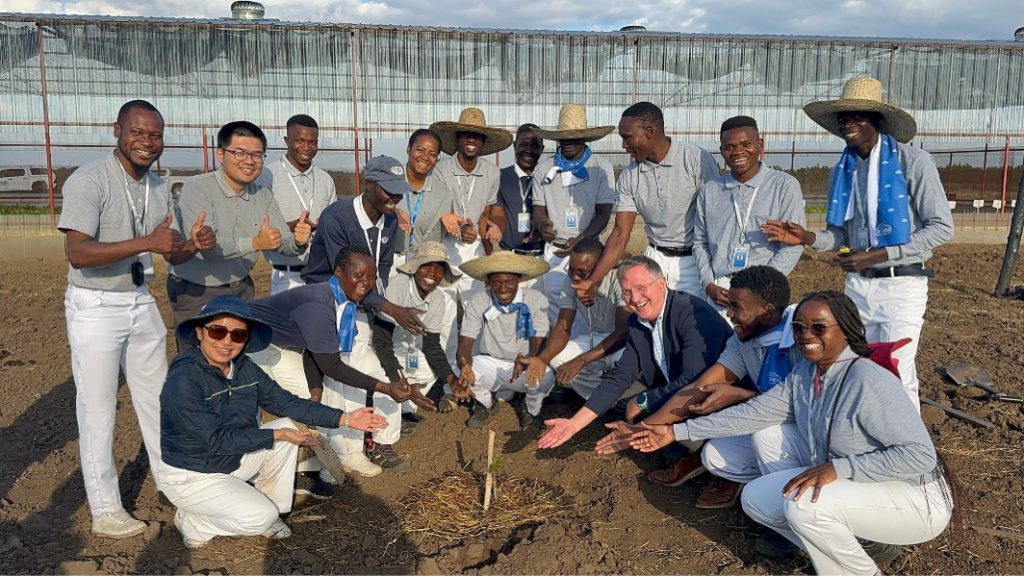
Pictured above, I am with Tzu Chi volunteers and the Mecuzi Farm team after planting “Captain America,” a cashew tree they named during my visit and later recognized as my 19th grandchild.
Before I could plant the sapling, the farm staff showed me the best technique. They explained how to position the young tree and prepare the soil so it would have the best chance to grow.
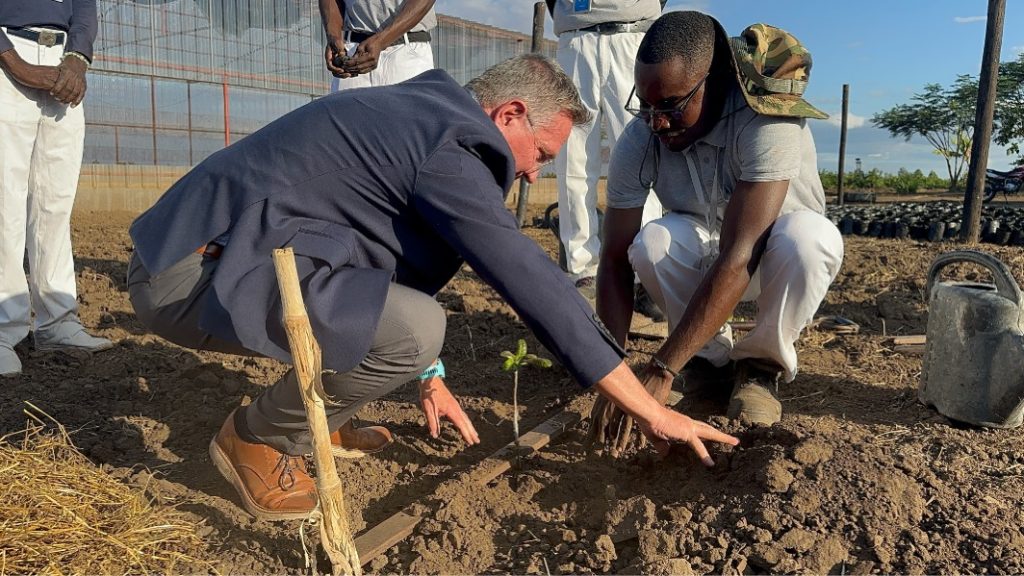
Farm staff help the author learn the best technique for planting a cashew sapling at Mecuzi Farm.
It was a simple moment, but it reflected the larger purpose of the project. Sustainable progress depends on participation, local knowledge and the sharing of practical skills. It is not simply about bringing resources from outside. It is about helping people develop solutions they can continue to manage themselves.
After the planting experience, the farm staff held a farmers’ market for the visiting delegation. They displayed produce from the farm and prepared food for us to enjoy, offering a tangible reminder of what the project is already producing.
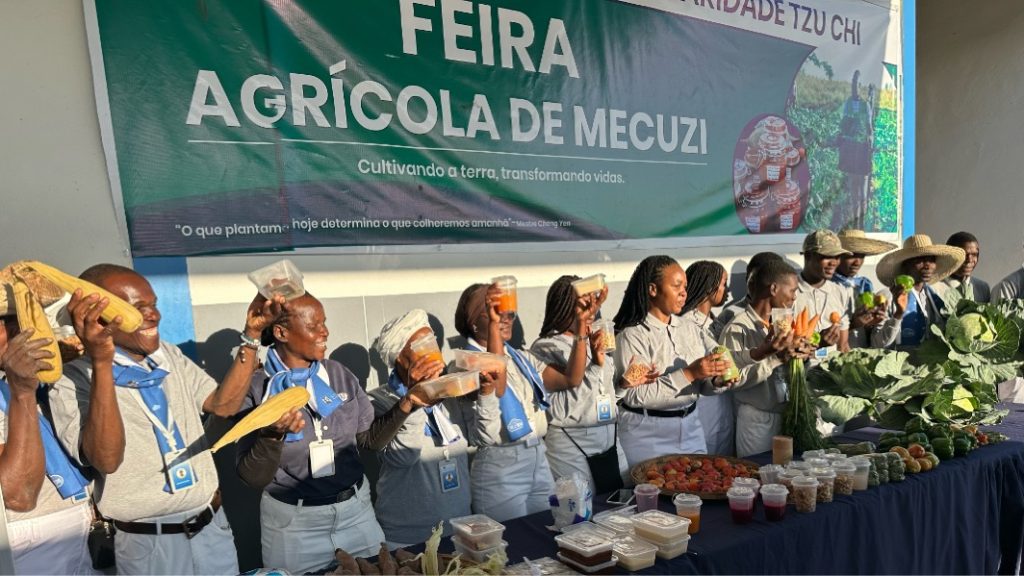
Following the planting experience, Mecuzi Farm staff held a farmers’ market featuring produce from the farm for the visiting delegation.
The farm was one part of a wider program. During the visit, I also saw a medical clinic that Tzu Chi had turned over to the local government, one of 23 schools the foundation helped reconstruct after a cyclone, models of resilient and affordable homes, and a vocational school where I was invited to hand out awards.
In a nation with so many challenges, it was wonderful to see so many reasons for hope in the faces of people who are working toward solutions within their reach, rather than relying only on charity.
That may be one of the most important lessons from Tzu Chi’s work in Mozambique. Compassion is essential, especially in times of crisis. But lasting change also requires investment in people, local leadership, practical skills and systems that can serve communities over time.
Well done, Fundação de Caridade Tzu Chi Moçambique.
As for Captain America, I am looking forward to coming back to see how much the tree has grown and to count how many great-grandchildren eventually blossom from my 19th grandchild.
Tzu Chi Foundation was established in Taiwan more than six decades ago and now works in communities around the world. Its approach is guided by the principle of “Da Ai,” which the organization translates as “great love.” The idea is not limited to compassion as an emotion. It is presented as a commitment to turn compassion into action.
The organization’s work in Mozambique will be among the subjects discussed at Dare to Overcome London, taking place from 12 to 16 October 2026. Po-wen Yen, Tzu Chi Foundation’s chief executive, will share lessons from the foundation’s experience in humanitarian work and community development.

Yen moved from a senior career in Taiwan’s semiconductor industry into humanitarian work, bringing his business and management experience to the foundation’s response to poverty, disasters and other social challenges.
Tzu Chi’s work raises a broader question for charities: should success be measured only by what an organization delivers, or also by what communities are able to do for themselves afterwards?