Working for workplace religious belonging, inclusion & freedom

E-NEWS ACTION DONATE

Category Archives: All

Why Religious Freedom is Good for Business & Business is Good for Religious Freedom – Lecture

3 Nov, 2014

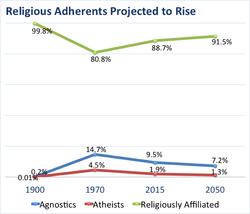
PRESS RELEASE: The UM Forum on Religion & Public Life | University of Miami | Nov. 3 | 7:30PMReligion continues to grow globally, with nearly 90% of the world’s population projected to be affiliated with religion in 2030. At the same time, there has been a dramatic rise in the level of religious restrictions and hostilities.

Religious Freedom & Business president, Brian Grim, will discuss the results of his research demonstrating that religious freedom results in better business and economies and that business respect for religious freedom pays dividends in peace and stability, and the bottom line.

To register for the free event: go to http://www.as.miami.edu/religion/about/forum/religious-freedom-and-business/ or contact the Department of Religious Studies: 305.284.4733/relgenaccs@miami.edu

Related Topics

Picture

New Study

Picture

President’s Blog

Picture

Case Studies

Picture

The Data

Religious freedom linked to peace, finds new global study

26 Oct, 2014

UPDATED 29 Sept. 2015: New report challenges myth of religious violence. The research found no general causal relationship between religion and conflict when looking at all of the current conflicts in the world.

Countries with greater religious freedoms are generally more peaceful, whereas countries with less religious freedom are generally less peaceful.

The most influential factor affecting religious freedom is the government type. Full democracies are the most peaceful and have the greatest level of religious freedom, regardless of the type of religious belief or various religious characteristics.


Picture

This report presents empirical research conducted by the Institute for Economics and Peace (IEP) in conjunction with the Religious Freedom & Business Foundation that aims to get beyond ideology to provide a more comprehensive understanding of how religion interacts with peace.

Quantitative analysis has revealed that many of the commonly made statements surrounding the relationship between peace and religion are not supported by the analysis contained in this study.

This report answers five common questions relating to religion and violence. To determine the list of questions the most common themes of discussion and opinions expressed in the media were identified.

QUESTION 1
IS RELIGION THE MAIN CAUSE OF CONFLICT TODAY?

Religion is not the main cause of conflicts today. Whilst religion has evidently been a cause of many conflicts throughout history it is by no means the only reason for conflict. Surveying the state of 35 armed conflicts from 2013, religious elements did not play a role in 14, or 40 per cent.


Picture

 It is notable that religion did not stand as a single cause in any conflict; however 14 per cent did have religion and the establishment of an Islamic state as driving causes. Religion was only one of three or more reasons for 67 per cent of the conflicts where religion featured as a factor to the conflict.

QUESTION 2
DOES THE PROPORTION OF RELIGIOUS BELIEF OR ATHEISM IN A COUNTRY DETERMINE THE PEACE OF THE COUNTRY?


There is no clear statistical relationship between either the presence or the absence of religious belief and conflict. Even at the extremes, the least peaceful countries are not necessarily the most religious and vice versa. For example, when looking at the ten most peaceful countries three would be described as highly religious, and when looking at the ten least peaceful nations two would be described as the least religious.

Conversely, the absence of religious belief, as manifested by atheism, also sees no significant link to broader societal peacefulness.

QUESTION 3
IN MUSLIM COUNTRIES, DOES THE DEMOGRAPHIC SPREAD OF SUNNI AND SHIA DETERMINE PEACE?


Despite the apparent role of Sunni and Shia sectarian violence in parts of the Middle East today, when reviewed globally, countries with high proportions of Sunni and Shia are not necessarily violent or plagued with conflict. What distinguishes Muslim-majority countries is differing performance in the Pillars of Peace, a framework developed by IEP to assess the positive peace factors that create peaceful societies. Specifically, countries that have lower corruption, well-functioning government and better relations with neighbours are more peaceful regardless of the particular levels of Sunni and Shia.
This report acknowledges the sectarian violence between Sunni and Shia that is a major feature of conflicts in the Middle East today, but highlights that Sunni and Shia conflicts are not inevitable. Although there are numerous religious divides, the paper focuses on the Sunni and Shia divide due to the high profile it is currently receiving in the media.

QUESTION 4 

IS RELIGION KEY TO UNDERSTANDING WHAT DRIVES PEACE? 

There are many other socio-economic characteristics that have more significant explanatory power in understanding why conflict and peace occurs than religion does. There are however some religious factors that are significantly related to peace.


Multivariate regression analysis reveals that there is a consistent relationship between factors such as corruption, political terror, gender and economic inequality and political instability which determine poor peace scores as measured by the Global Peace Index (GPI). The research clearly indicates that these factors are globally more significant determinants in driving violence and conflict in society than the presence of religious belief. 


Nevertheless, there are two religious characteristics which are associated with peace; restrictions on religious behaviour as well as hostilities towards religion. Countries without a dominant religious group are, on average, more peaceful and have less restrictions or social hostilities around religion than countries with a dominant religious group. However, government type has much greater explanatory power than religion in understanding differing levels of peace. 


QUESTION 5
CAN RELIGION PLAY A POSITIVE ROLE IN PEACEBUILDING?

While a lot of analysis may focus on the negative role of religion it is important to acknowledge the potential positive role of religion in peacebuilding through inter-faith dialogue and other religiously-motivated movements. It was found that countries that had higher membership of religious groups tended to be slightly more peaceful.

Religion can be the motivator or catalyst for bringing about peace through ending conflict as well as helping to build strong social cohesion. Furthermore, religion can act as a form of social cohesion and, like membership of other groups, greater involvement in society can strengthen the bonds between citizens strengthening the bonds of peace. 
.
Related Research
img024The new study also furthers previous work in the field, including The Price of Freedom Denied (by Brian Grim & Roger Finke, Cambridge, 2011). Grim & Finke’s research showed that religious freedom is a key ingredient to peace and stability, as measured by the absence of violent religious persecution and conflict.
This is particularly important for business because where stability exists, there is more opportunity to invest and conduct normal and predictable business operations, especially in emerging and new markets.  The Price of Freedom Denied shows that, contrary to popular opinion, ensuring religious freedom for all reduces violent religious persecution and conflict. Others have suggested that restrictions on religion are necessary to maintain order or preserve a peaceful religious homogeneity.
Brian J. Grim and Roger Finke show that restricting religious freedoms is associated with higher levels of violent persecution. Relying on a new source of coded data for nearly 200 countries and case studies of six countries, the book offers a global profile of religious freedom and religious persecution. Grim and Finke report that persecution is evident in all regions and is standard fare for many. They also find that religious freedoms are routinely denied and that government and the society at large serve to restrict these freedoms. They conclude that the price of freedom denied is high indeed.
.  
They offer a global profile of religious freedom and persecution, including information on nearly 200 countries and selected case studies (Japan, Brazil, Nigeria, China, India and Iran). The study also explains variation in religious persecution across countries and religious traditions, offering an explanation of why persecution tends to be higher among some populations. It also demonstrates and documents how religious freedoms are denied by the government and the society at large. Finally, it provides data showing that religious freedoms serve to defuse the potential conflict and reduce the level of violent religious persecution.
.
Like any liberty, religious freedoms force those in power to protect the rights of minorities, even when the majority does not agree. Enforcing this liberty comes with a price, but the price of denying the freedom is far higher.

Related Content

The Global Ball is Rolling for Religious Freedom & Business

26 Sep, 2014
UPDATED: OCT. 20 – The coupling of religious freedom & business provides solutions to the world’s pressing socio-economic problems. Religious Freedom & Business Foundation President Grim is discussing these solutions at major events across the world.
CURRENT

PictureBoston area, Oct. 20

God, Globalization, and The Good Society In Asia Today Oct. 20 – A one-day conference sponsored by The Review of Faith & International Affairs at the Institute for Global Engagement and the Center for Faith and Inquiry at Gordon College.


PictureWashington, DC, Oct. 22

Washington, DC: Grim has led a decade’s worth of ambitious global studies of religion. He will discuss the results of his research that empirically show that religious freedom, when protected by governments and respected by citizens, results in better business and economies

  • The research also shows that business respect for and encouragement of religious freedom pays dividends in peace and stability as well as provides benefits to the bottom line.

UPCOMING

PictureMilan, Italy, Oct. 17

Is Religious Freedom Good for Business? Grim will discuss a new study finding that religious freedom is one of only three factors significantly associated with global economic growth. The study looked at GDP growth for 173 countries in 2011 and controlled for two-dozen different financial, social, and regulatory influences.

  • Istituto Bruno Leoni – 11:00 – Piazza Castello, 23 Milano

PictureBristol, London, Oxford, Oct 13-16

ZUTSHI-SMITH MEMORIAL LECTURE: THE PRAGMATIC CASE FOR FREEDOM OF RELIGION OR BELIEF, University of Bristol, UK. Grim’s Oct. 13 lecture will be followed by a panel discussion with Baroness Elizabeth Berridge and Professor Roger Trigg. On Oct. 14, Grim will have meetings at University of Oxford.

  • Oct. 15, Grim will speak at the Foreign and Commonwealth Office, London

PictureWith Brazilians & Sen. Hatch, BYU, Oct. 3-10

Grim is speaking at a series of events at BYU Law School and the Marriott School of Management. He will address delegates from dozens of countries, including Australia, Brazil, Canada, China, France, Greece, Hungary, India, Indonesia, Israel, Italy, Japan, Malaysia, Mexico, Morocco, Nigeria, Norway, Peru, Philippines, Russia, Singapore, South Korea, Turkey, Ukraine, United Kingdom and Vietnam.

  • U.S. Senator Orrin Hatch delivered the keynote.

PictureHelsinki, Oct. 1

Grim met with leaders of the Finnish Evangelical Lutheran Mission on October 1st in Helsinki to make further plans for the waste-to-wealth project – a sustainable business in Pakistan and/or Nepal to empower the Dalit communities.

  • Dalits are members of the so-called untouchable Hindu caste. A number of Dalits in India, Pakistan and Nepal have converted to other faiths, including Islam & Christianity.

PictureIstanbul, Turkey, Sept. 29-30

Grim joined over 100 leaders from business, civil society, the UN, think tanks and Global Compact Local Networks on 29-30 September in Istanbul, Turkey for the Inaugural Business for Peace Annual Event.

  • Grim led a panel on “pathways to peace through diversity and inclusion” with Dr. Yilmaz Arguden, Chairman of the Global Compact Network in Turkey.

PictureWashington, DC, Sept. 26

Grim, other social scientists, met for Georgetown University’s Religious Freedom Project Economic Working Group. The group focuses on the impact of religious freedom on economic freedom, political economy, and development.


Media inquiries, contact Melissa Grim, melissa@religiousfreedomandbusiness.org

  • Stay up to date with the Foundation’s Newsletter

Review of Practical Wisdom in Management

13 Sep, 2014

Review Author: Melissa Grim

Practical Wisdom in Management, by Theodore Roosevelt Malloch, is the first in-depth and comprehensive case study book to explore how practical wisdom from spiritual and philosophical traditions inspires corporate leadership and permeates many corporate cultures.

7183675
Discount Code: RFBF4

Covering ten major worldwide religions, this book provides a comprehensive overview of the practical wisdom of the major faith traditions for management. Practical Wisdom is designed for the classroom and includes in-depth and informative case studies of 28 multinational corporations, analyzed with an emphasis on their values and spiritual inspiration, alongside business and strategic issues.

The book starts with a look at companies and organizations that have incorporated Catholic Social Thought with great success. For instance, Group DANONE is a French food-products multinational that is the leading dairy products company in the world. DANONE focuses not just on profitability but on social justice as well, and hires like-minded individuals. One manifestation of this is the Danone International Prize for Nutrition, which honors individuals or teams that have made advances in the science of human nutrition, one aspect of taking care of the person as a “whole.”

Grameen Bank, a highly successful for-profit bank, is owned almost entirely by its borrowers. Created by Bangladeshi economist Muhammad Yunus, he took seriously the Muslim call for charity for the poor. However, he saw fellow citizens in an endless cycle of debt. After spending decades on the problem, he developed a system that took the belief in charity, and gave the poor not temporary handouts, but a means to get out of debt and start their own businesses. He won the prestigious Peace Prize in 2006.

Yunus’ critique of modern day economics, which led to his innovation, was that: “Many of the problems in the world remain unresolved because we continue to interpret capitalism too narrowly. In this narrow interpretation we create a one-dimensional human being to play the role of entrepreneur. We insulate him from other dimensions of life, such as, religious, emotional, political dimensions.”

Infosys Limited (INFY) is a NASDAQ listed global technology services company, headquartered in Bangalore, India. It has become the second largest IT exporter in India with more than 160,000 employees. Infosys has shown remarkable growth and has received a number of accolades over the last two decades, including best employer. In founding INFY, founder Murphy held above all that he wanted to created an ethical business informed by his Hindu beliefs. Murphy’s guiding ethical and business principle is the Golden Rule, to do unto others, as you would have them do to you.

By the end of 2010, Whole Foods’ growth and leadership position in the natural and organic grocery food market was well established. The company is well known for being a values-based, mission-driven organization that regularly earned distinction among Fortune 500 companies for its employee-friendly culture and policies. It’s founder and CEO, John Mackey, has studied religion and philosophy extensively, and has been greatly informed by Buddhism incorporating the focus on moderation and health as a means to enlightenment. As such Whole Foods has a business model that is aimed at promoting human happiness and well being.

Kraft Foods is a manufacturing giant present in over 150 countries and over 99% of U.S. households. Kraft Foods boasts a unique humanistic version of servant leadership. CEO Irene Rosenfeld identifies servant leadership as central to Kraft’s management framework. Rosenfeld strongly emphasizes the value of servant leadership in corporate management. “The people that work with me understand . . . I am there to help them, not for them to help me.”  Kraft has relied on value-based product offerings as a source of growth through marketing and innovation.

Conclusion: This book will be valuable reading for MBA students and students of business ethics and spirituality in business courses, as well as business leaders looking to integrate religious values into their organization. In fact as the book notes, New York-based branding firm BBMG reports that contemporary consumers are increasingly values-conscious; that is, they care about whether the companies they buy from and products they consume reflect or support moral values they espouse. So the reading of this book is timely.

Peres Calls on Pope Francis to Unite Religions to Combat Terror

5 Sep, 2014

By Pasquale Annicchino

Soon after Pope Francis was elected, a TEDx conference at the Vatican documented the rising tide of religious hostilities in the world. Since that time, religious hostilities have only risen.

At the Vatican yesterday, ANSA reports that former Israeli President Shimon Peres proposed the formation of a “United Religions” organization to combat terrorism. “The UN has had its time,” Peres was quoted as saying by Catholic weekly Famiglia Cristiana. “What we need is an organization of United Religions, the UN of religions.”

“It would be the best way to combat these terrorists who kill in the name of their faith, because most people are not like them, they practise their religions without killing anyone, without even thinking about it. I think that there should be a charter of the United Religions, just like there is the UN Charter. The new charter would serve to establish in the name of all the faiths that slitting people’s throats or conducting mass slaughters, like the ones we have seen in recent weeks, has nothing to do with religion. This is what I proposed to the pope,” said Peres.

In a period a growing restrictions on religious freedom, the call from President Peres is an important reminder of the role and contribution that religious and belief groups can make to public life. They can not only inform our daily policy making, but also contribute to a commom higher call to the respect of human dignity against the instrumentalization of religion to justify terrorist acts.

If President Peres moves forward with his proposal, he deservers the greatest attention from the international community, including the business community. Indeed, religious restrictions and hostilities not only affect peace and security, they also jeopardize the socio-economic future of societies around the globe, according to the latest research.

Also, a recent publication documents several ways the business community is involved in fostering interfaith understanding and peace.

Stay up to date with the weekly Newsletter!

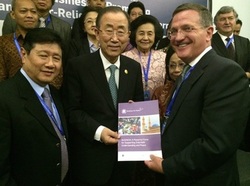
Ban Ki-moon Receives Religious Freedom & Business Foundation Joint Publication with UNGC

29 Aug, 2014

IMMEDIATE RELEASE – Bali, Indonesia: United Nations Secretary-General Ban Ki-moon received today “BUSINESS: A Powerful Force for Supporting Interfaith Understanding and Peace,” a new joint publication by the Religious Freedom & Business Foundation and the UN Global Compact Business for Peace platform.

The following are RFB Foundation President Brian Grim’s remarks made during today’s UN Alliance of Civilizations (UNAOC) side event organized by the Indonesia Global Compact Network (IGCN) where the publication was launched.

*** *** ***

Your Excellency, Secretary-General Ban Ki-moon, and distinguished guests, we are thrilled for your participation in this UNAOC side event organized by the Indonesia Global Compact Network (IGCN), “The Role of Business in Promoting Inter-cultural and Interreligious Peace and Harmony.”

It’s my honor to give a brief summary of three themes we have explored today: Research, Action and Partnership.

RESEARCH

Our discussion today is informed by Pew Research data presented at the past two UNAOC meetings in Doha and Vienna showing that the world has been swept by a rising tide of global restrictions on religious freedom or belief, which come from governments and perhaps, even more powerfully, from groups in societies. These data show that three-in-four people today live with high religious restrictions or hostilities.

Of course, the pressing question is: What can be done to roll back the tide? As a social scientist and NGO leader, it is clear to me that the answer lies in engaging the creativity and power of the global business community, because business is the crossroads of culture, commerce and creativity.

Indeed, recent research shows that freedom of religion or belief is not only a powerful instrument of peace, but also one of only a handful of factors that predicts economic growth. Data show that freedom of religion or belief is strongly associated with global competitiveness, including education, innovation, health and better lives for women and children.

ACTION

So, how are businesses approaching interfaith understanding and peace? To answer this, the Religious Freedom & Business Foundation and the Business for Peace platform are pleased to announce a new training resource: “BUSINESS: A Powerful Force for Supporting Interfaith Understanding and Peace.” I’ll highlight several of the approaches from the publication:

  • Business can Use Marketing Expertise to Bridge Borders: The Coca-Cola Small World campaign, including vending machines linking people in Pakistan and India by video, shows that getting along is good for society and good for business.
  • Business can Incentivize Innovation: The BMW Group’s intercultural innovation award in partnership with the UNAOC is an excellent example of incentivization as well as of a successful public-corporate partnership.
  • Business can Incubate and Catalyze Social Entrepreneurship: For instance, Petrobras in Brazil supports business incubation for Afro-Brazilians, helping members of marginalized communities engage in empowering entrepreneurship.
  • Business can Support Workforce Diversity: For instance, businesses in Indonesia are known for accommodating faith in the workplace. They are also known for addressing difficult unmet social needs, such as organizing a mass wedding for interfaith couples who had lived without legal status and with no ready means to become legitimately wed.

PARTNERSHIPS

It is important to recognize that joint action – like that occurring in this side event – plants seeds that grow into fruit-bearing trees in the years to follow. For instance, the 3rd UNAOC meeting was held in Rio de Janeiro in 2010. I’m pleased to announce that together with partners in Brazil and Rio, we will hold the first global awards for business, interfaith understanding & peace during the 2016 Olympics. This is especially significant because Brazil is a country with an unprecedented story of peaceful religious change that can serve as a model for many conflict situations today. Indeed, in peacemaking, it is critical that countries with success stories like Brazil and Indonesia exercise global leadership in this area.

All of us look forward to working together to addresses these issues, and turning potential into practice. For instance, why don’t we put to practice a suggestion hinted at this morning by Indonesian President Susilo Bambang Yudhoyono and build a network of diaspora business leaders committed to the vision of a global future of innovative and sustainable economies where religious freedom and diversity are respected.

And finally, an episode in the life of the prophet Isaiah captures what I believe is the spirit of many, many business people willing to help realize this vision: “Then I heard the voice of the Lord saying, ‘Whom shall I send? And who will go for us?’ And I said, ‘Here am I. Send me!’”

Thank you.

Nigerian Conflict: Is Business the Answer?

19 Jul, 2014

Melissa E. Grim, Case Study*

9538446

In Nigeria, businesses and economic development NGOs are working to stop widespread religious violence between Christians and Muslims, which has already taken hundreds of lives and threatens to thrust parts of the country into civil war.

For instance, in Adamawa State in northeast Nigeria, groups like the Yola Innovation Machine are helping a new generation of entrepreneurs create businesses. The need is great. Young adults in many of Adamawa’s poor rural and marginalized communities lack the necessary entrepreneurial skills they need to break out of the poverty trap that often feeds violent extremism. The majority of youth in the area have no employment. In Adamawa, and throughout Nigeria, the population doubles every 30-35 years, so assisting people to create their own jobs is perhaps the most immediate solution to unemployment.

The Yola Innovation Machine and others are working in this direction. For instance, they helped create and nurture a new business called Yola EcoSentials (YES), which recycles discarded materials into sellable goods such as purses, mats, handbags and wristlets. The goods are made from “plarn,” a yarn spun from recycled plastic grocery bags. The venture results in multiple social goods because every item sold by Yola EcoSentials generates much needed income and employment, and at the same time helps protect the deteriorating ecological environment.

In the Plateau State in the country’s center, Muslim and Christian business people are cooperating to work around religious violence. In Jos, Plateau’s capital, there is an unwritten rule that when religious tensions flare up, Christians and Muslims should not cross certain city boundaries. But this can be devastating for the fresh produce vendors and other businesses, which serve people on both sides of the divide.

In response, Muslim and Christian business people have taken it upon themselves to work around these limitations, risking their lives and not just their livelihoods to keep business moving across the religious divide. For example, Madam Ngozi, a vegetable seller and widow raising seven children on her own, often cannot go to the market to restock her supply of vegetables due to religious violence or warnings of possible violence. However, a cell phone call to her Muslim supplier, Mallam Yahaya, can solve the problem. They find a discrete place to meet, agree on a price, and make the transaction.

Still, many are skeptical that businesses can ultimately make much of a real difference in Nigeria. “On what basis could it work?” asks Clement Nwankwo, a political analyst who heads the Policy and Legal Advocacy Centre in Abuja. “There is no peace in the northeast. Can any construction company go in there to work?”

But U.S.-trained Nigerian economist Soji Adelaja argues that business can be an important part of the long-term solution to violent religious extremism currently exploding in northeast Nigeria today. Mr. Adelaja, born in Lagos, recently returned to his homeland after 34 years in the United States to help put together what the government calls a “Marshall Plan” to counter the extremist violence and bring prosperity. The concept being put forward is that an improved economy and more opportunity could be an effective tool in countering the advances of groups like Boko Haram, the radical Islamic organization that recently made headlines around the world when it kidnapped 200 girls.
Picture
img018* This is the third in a series of case studies highlighting how companies – in their core business activities – can help reduce religious and cultural tensions, increase social understanding, and promote peace. This case study does not imply an endorsement of any company profiled. The Religious Freedom & Business Foundation has no tie to any of the companies profiled.


World Cup Highlights Struggles & Contributions of Afro-Brazilians

18 Jul, 2014
July 18, 2014 – Melissa E. Grim, Religious Freedom & Business Foundation Case Study*

446235Afro Brazilians Help Brazilian Economy

In Brazil where religious freedom is generally well-protected, Brazilians of African descent still face discrimination for their appearance and beliefs, including their religious beliefs. But an NGO, the Afro-Brazilian Incubator, is working to fight this discrimination by promoting entrepreneurship among Afro-Brazilians. The hope is that greater economic integration for Afro-Brazilians will lead to greater social and religious acceptance for them as well.

First brought to Brazil hundreds of years ago as slaves, Afro-Brazilians have long faced great discrimination, based on race, religion and other factors. Their plight gained prominence during the run up to the recent World Cup (which was hosted by Brazil), when many of the country’s leading black soccer players were subjected to racial and other harassment. These incidents caused Brazil’s president to declare the 2014 World Cup the “anti-racism World Cup.”

In an effort to fight the discrimination faced by Afro-Brazilians and those who practice Afro-religions,
the Incubator offers a host of free services for aspiring entrepreneurs, ranging from management training to assistance with marketing and accounting. It currently supports over 1,000 businesses in the metropolitan area of Rio de Janeiro, and works in partnership with the United Nations Development Program (UNDP).

Many newly successful businesspeople credit the Afro-Brazilian Incubator with their success. Nildilene, for instance, was able to use business advice and management skills provided by the Incubator to help create a food service business that now employs nine other people. The fact that she came from a poor family and was only able to finish elementary school did not stand in the way of her becoming a successful businesswoman.


img018

* This is the fourth in a series of case studies highlighting how companies – in their core business activities – can help reduce religious and cultural tensions, increase social understanding, and promote peace. This case study does not imply an endorsement of these companies or their products or services. The Religious Freedom & Business Foundation has no tie to the companies profiled.

To stay up to date, subscribe to our newsletter.


Indonesian Businesses Open Their Doors to Faith and Action

17 Jul, 2014
July 17, 2014 – Melissa E. Grim, Religious Freedom & Business Foundation Case Study*
In Indonesia, businesses are at the forefront of efforts to promote interfaith understanding. For instance, EXPRESS Taxi, with a fleet of more than 7,000 taxis in Jakarta, promotes a faith-friendly workplace by setting up prayer rooms and facilitating Muslim and Christian observances as well as celebrations of Chinese New Year. Such efforts not only foster interfaith understanding but also increase worker productivity and satisfaction.

In addition to accommodating religious practice in the workplace, Indonesian businesses also help meet the social and religious needs of employees outside of work, while at the same time increasing safety and employee retention. For instance, PT Kereta API Indonesia, an Indonesian railway company, provides free freight transportation for its Muslim workers to return home to celebrate Eid. This is important because many would choose the more affordable but dangerous option of riding a motorcycle home. In addition to being safer, it relieves congestion across the island of Java and lowers overall accident rates.

PT XL-Axiata, a mobile telephone company, also arranges free transportation home for religious observance. In cooperation with Giant Hypermarket, the company last year helped nearly 20,000 employees and customers return home for Eid.

7462364_orig

Muslims Breaking Fast at Express Taxi
9966954_orig

Christmas Celebration at Express Taxi

899644

In addition to offering logistical help with their employees’ religious observances, businesses in Indonesia have worked to fix large, seemingly intractable social problems. For instance, companies in Jakarta, along with civil society groups and the government, helped 4,541 poor couples in interfaith marriages to receive the proper marriage licenses. Up to that point, these couples, for financial or legal reasons, could not obtain marriage certificates, preventing them from receiving birth certificates for their children. Without ID cards, marriage certificates and birth certificates, the families often did not have access to national health care, public education, legal rights and employment.

Having the necessary certificates, the businesses can further help them with the education scholarship, skills training and job opportunities.

The House of Love Foundation, in collaboration with the Jakarta Municipal Government as well as other groups, established and ran the marriage initiative. The initiative was also supported by Indonesia Global Compact Network and a variety of businesses, including  Rajawali’s B Channel (now Rajawali TV), Coca-Cola, Sari Roti, So Nice Sausage, Kopi Kamu, Papa Ron and religious organizations. Muslim, Christian, Catholic, Buddhist, Hindu and Confucius couples from across the capital took part. This initiative also promotes intercultural and interfaith understanding within the community.


img018

* This is the fifth in a series of case studies highlighting how companies – in their core business activities – can help reduce religious and cultural tensions, increase social understanding, and promote peace. This case study does not imply an endorsement of any company profiled. The Religious Freedom & Business Foundation has no tie to any of the companies profiled.

To stay up to date, subscribe to our newsletter.

Religious Freedom & Business at U.S. Capital

10 Jul, 2014
On July 8, 2014, Religious Freedom & Business Foundation research associate Melissa Grim gave the following report of the Foundation’s activities at the International Religious Freedom Roundtable.

2480718

Thank you for the opportunity to share about the work of the Religious Freedom & Business Foundation. The Foundation educates the global business community about how religious freedom is good for business, and engages the business community in joining forces with government and non-government organizations in promoting respect for freedom of religion or belief.

I would like to talk about 5 initiatives that the Foundation is working on. The first relates to Impact Investment, which is investing in sustainable businesses that have a positive social impact in ways that lower religious tensions and increase interfaith understanding. As part of this initiative, the Foundation will develop a global impact database based on the technology of the World Religion Databasebased at Boston University. The “Global Impact Investment Database” will link entrepreneurs and innovators with sustainable business opportunities in areas of social need around the world. The database will be state-of-the-art and built on the technology of the World Religion Database. The database will foster such enterprises as the waste-to-wealth project for Dalits, being developed with university, aid and development partners from Finland. Brazilian business partners are working with the Foundation to develop the web interface, include mechanisms for paid businesses memberships, which we believe will make the project self-sustaining and revenue-generating.

The second is the Business, Faith & Freedom Global Forum starting at the World Expo in Milan in 2015. “Feeding the Planet, Energy for Life” – presents a perfect platform for companies in food-related industries to showcase how religion and religious freedom makes their businesses more successful, innovative and responsive to the needs of people. The Global Forum will showcase sustainable enterprises that help ethnic & religious minorities better integrate and contribute to the societies in which they live.

Third, the Foundation will present the Religious Freedom & Business Global Awards in the host city of each summer and winter Olympics, beginning in Rio, 2016. The Global Awards recognize the best advances and innovations by businesses in improving respect for religious freedom. For-profit businesses from any country eligible to be nominated. Award winners will direct the Award prize money to a religious freedom organization of their choice from a list of those helping to educate the global business community about how religious freedom is good for business and/or engaging the business community in joining forces with government and non-government organizations in promoting respect for freedom of religion or belief.

Fourth, the Foundation is involved in Research and Education projects. President Grim along with researchers at Georgetown University and Brigham young published the study: “Is Religious Freedom Good for Business?: A Conceptual and Empirical Analysis,” which is available on the website of the Interdisciplinary Journal of Research on Religion (IJRR). The study finds that Religious freedom is one of only three factors significantly associated with global economic growth. The study looked at GDP growth for 173 countries in 2011 and controlled for two-dozen different financial, social, and regulatory influences. The study, however, goes beyond simple correlations by empirically testing and finding the tandem effects of government restrictions on religion and social hostilities involving religion (as measured by the Pew Research Center) to be detrimental to economic growth while controlling for 23 other theoretical, economic, political, social, and demographic factors.

Finally, the Foundation has a number of Education projects in development. It is working with leading business schools and educational institutions to develop an internet-based certificate course on how business, freedom and religion interact. Components of the future course include two tracks – one for corporate executives and representatives, and another for undergraduate and graduate students. There will be multi-media modules covering facts on topics ranging from religious freedom and its relation to socio-economic outcomes to case studiesof core business enterprises that promote interfaith understanding and peace.

Additionally the Foundation is working with leading interfaith groups, business schools and educational institutions to develop a “Self-Reliance Curriculum.” Obtaining self-reliance life skills is a pressing need among many vulnerable communities who are susceptible to radicalization, such as Muslims in the UK. The project will make available to interfaith training teams a curriculum of self-reliance that could be taught to members of vulnerable communities by interfaith teams beginning in the UK and then taken globally.

The Foundation is the first organization dedicated to educating businesses about why religious freedom will enable them to be more productive and successful, and how they can effectively incorporate religious freedom in their strategic business plans for the benefit of their stakeholders, their employees and society.