
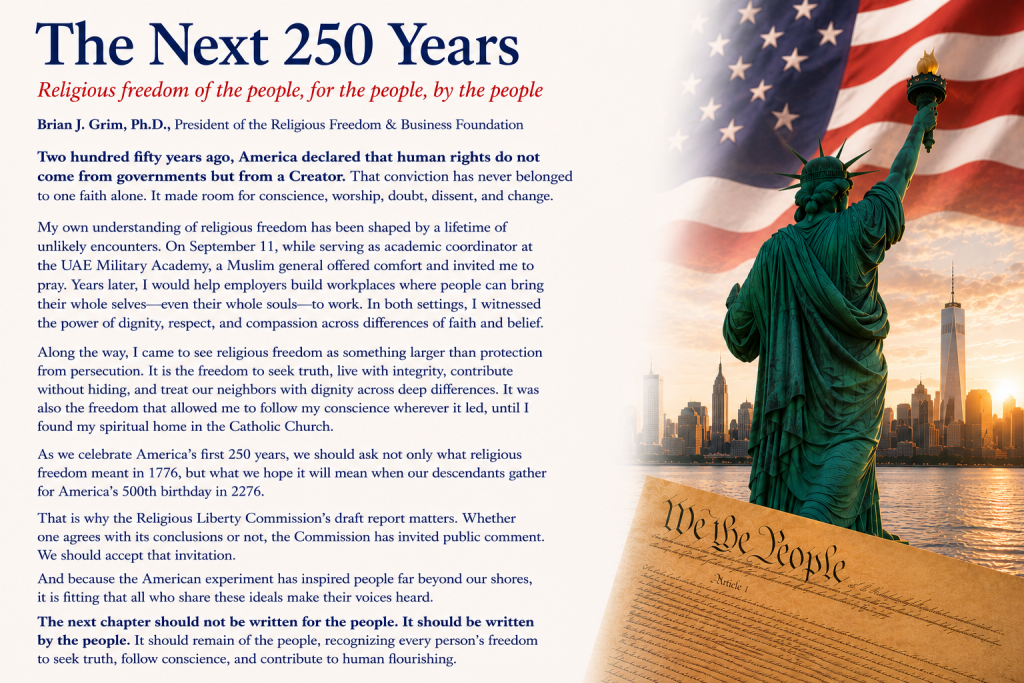
 Why your voice belongs in America’s conversation about religious freedom.
Two hundred fifty years ago, America declared that human rights do not come from governments but from a Creator. That conviction has never belonged to one faith alone. It made room for conscience, worship, doubt, dissent, and change.
My own understanding of religious freedom has been shaped by a lifetime of unlikely encounters. On September 11, while serving as academic coordinator at the UAE Military Academy, a Muslim general offered comfort and invited me to pray. Years later, I would help employers build workplaces where people can bring their whole selves—even their whole souls—to work. In both settings, I witnessed the power of dignity, respect, and compassion across differences of faith and belief.
Along the way, I came to see religious freedom as something larger than protection from persecution. It is the freedom to seek truth, live with integrity, contribute without hiding, and treat our neighbors with dignity across deep differences. It was also the freedom that allowed me to follow my conscience wherever it led, until I found my spiritual home in the Catholic Church.
As we celebrate America’s first 250 years, we should ask not only what religious freedom meant in 1776, but what we hope it will mean when our descendants gather for America’s 500th birthday in 2276.
That is why the Religious Liberty Commission’s draft report matters. Whether one agrees with its conclusions or not, the Commission has invited public comment. We should accept that invitation.
And because the American experiment has inspired people far beyond our shores, it is fitting that all who share these ideals make their voices heard.
The next chapter should not be written for the people. It should be written by the people. It should remain of the people, recognizing every person’s freedom to seek truth, follow conscience, and contribute to human flourishing.
Read the Commission DRAFT Report
- — Two-Page Summary of the Religious Liberty Commission Draft Report
- — Draft Report of the Presidential Religious Liberty Commission, June 2026
This draft of the Religious Liberty Commission Report, based on public hearings held and public comments received, is available here and open to public comment for fifteen (15) days, with comment period closing on Monday, July 13, 2026. Comments may be emailed to RLC@usdoj.gov.
–> Read My PUBLIC COMMENT: To the Presidential Religious Liberty Commission
To aid the Religious Liberty Commission in processing your comments, please format the subject line using the following:
PUBLIC COMMENT – [TOPIC OR CHAPTER NUMBER] – [NAME].
Please be aware that public comments are open to public inspection, not confidential. Please do not include personally identifiable information, such as personal addresses, in your comments.
After the fifteen (15) day comment period, Commission will hold a virtual public meeting to review comments reviewed, discuss the draft, and finalize the report. Attendance information will be posted on the “Upcoming Events” page and in the Federal Register at least seven (7) days prior to the meeting.