
 Catholic Social Thought in a Fragmented Age
By Brian Grim
The release of Pope Leo XIV’s encyclical Magnifica Humanitas comes at a moment of profound global uncertainty. Across the world, democratic societies face rising polarization, declining institutional trust, technological disruption, geopolitical instability, and growing social fragmentation. Artificial intelligence is reshaping economies, communications, and human relationships at a pace faster than most governments or civic institutions can effectively understand or regulate. Meanwhile, many societies are struggling to sustain the moral and civic foundations necessary for pluralism, democratic participation, and peaceful coexistence.
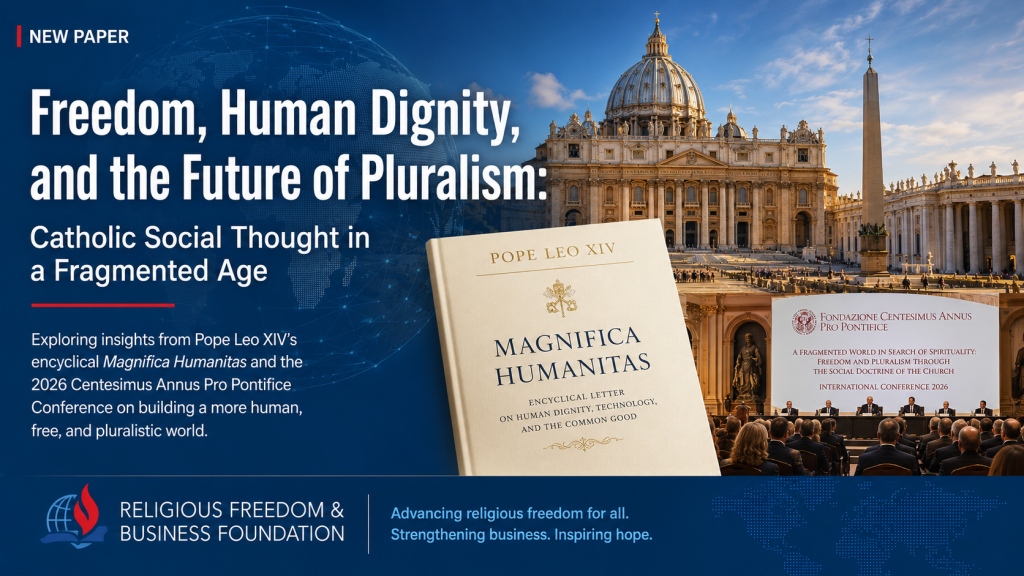
It is precisely within this context that the 2026 International Conference of the Centesimus Annus Pro Pontifice Foundation convenes in Vatican City under the theme: “A Fragmented World in Search of Spirituality: Freedom and Pluralism through the Social Doctrine of the Church.” The conference reflects a growing recognition that today’s crises are not merely political or economic. They are fundamentally anthropological and spiritual. The erosion of trust, the rise of tribalism, and the increasing inability of societies to sustain dialogue across differences point toward a deeper crisis concerning the meaning of freedom, the dignity of the human person, and the moral responsibilities necessary for democratic life.
Pope Leo XIV’s Magnifica Humanitas enters directly into these debates. Building upon the intellectual tradition of Rerum Novarum, Centesimus Annus, Caritas in Veritate, and Fratelli Tutti, the encyclical argues that human dignity must remain at the center of political, economic, and technological development. The document warns that societies increasingly shaped by algorithmic systems, digital fragmentation, and hyper-individualism risk losing the moral frameworks that sustain authentic freedom and solidarity. Technology itself is not presented as the enemy. Rather, the encyclical argues that technologies detached from ethical principles and moral accountability can deepen alienation, weaken community, and undermine democratic culture.
This concern echoes one of the central insights of St. John Paul II’s Centesimus Annus, which emphasized that freedom divorced from truth ultimately becomes self-destructive. In the decades following the collapse of totalitarian regimes in Europe, Centesimus Annus defended democratic governance, civil society, economic freedom, and human rights, while also warning that democratic institutions cannot survive without moral and cultural foundations rooted in human dignity and responsibility. That warning appears increasingly prescient today. Modern democratic societies face growing pressures from ideological extremism, disinformation, declining social trust, and the concentration of technological and economic power in ways that challenge both subsidiarity and pluralism.
The Vatican conference therefore represents more than an academic or theological gathering. It is an effort to recover a moral and spiritual vision capable of addressing the fragmentation now shaping international politics, civil society, and human relationships themselves. Discussions on artificial intelligence, media ethics, peacebuilding, migration, multilateralism, interreligious dialogue, and democratic resilience all point toward a central question: how can societies preserve freedom and pluralism while sustaining a shared understanding of the human person and the common good?
These questions closely intersect with the work of the Religious Freedom & Business Foundation (RFBF). In recent years, RFBF has increasingly engaged issues involving civic trust, pluralism, interfaith cooperation, responsible leadership, and the role of ethical frameworks in sustaining healthy societies and institutions. The organization’s emphasis on advancing freedom of religion or belief for all people aligns naturally with Catholic Social Doctrine’s defense of human dignity, conscience, and the mediating role of civil society.
The principle of subsidiarity, central to Catholic social teaching, is especially relevant in this context. Subsidiarity holds that larger institutions should support, rather than replace, the role of families, local communities, religious organizations, and civic associations. In an era when many citizens feel alienated from political institutions and disconnected from one another, intermediary institutions become essential for rebuilding trust, encouraging participation, and preserving democratic culture. Organizations like RFBF operate precisely within this mediating space—bringing together business leaders, policymakers, religious communities, and civil society actors around shared commitments to dignity, coexistence, and responsible engagement across differences.
The conference’s focus on artificial intelligence further highlights the growing relevance of these conversations. AI is rapidly transforming communications, labor markets, governance, and information ecosystems. Yet technological advancement alone cannot determine whether societies become more humane, more just, or more free. The ethical questions surrounding AI involve not only privacy, automation, and economic disruption, but also deeper concerns regarding truth, human agency, moral responsibility, and the integrity of public discourse.
Here again, Magnifica Humanitas offers an important contribution. The encyclical rejects both technological determinism and simplistic anti-technology narratives. Instead, it calls for human-centered innovation guided by ethical reflection, solidarity, and respect for the intrinsic dignity of every person. It argues that technologies must serve humanity rather than reshape humanity according to purely economic or ideological priorities. This perspective is increasingly relevant not only within religious communities, but also among policymakers, educators, business leaders, and civic organizations seeking frameworks capable of addressing the social consequences of technological acceleration.
RFBF’s engagement with questions of institutional trust, ethical leadership, and constructive dialogue positions it within this broader global conversation. The organization’s work demonstrates that religious freedom and pluralism are not peripheral concerns, but essential components of stable, innovative, and prosperous societies. In a fragmented world increasingly defined by suspicion and polarization, the ability to convene diverse actors around shared principles of dignity and mutual respect becomes strategically important for democratic resilience itself.
The Vatican conference also places strong emphasis on peacebuilding and multilateral cooperation. As geopolitical tensions intensify and societies become more fragmented internally, the need for institutions capable of fostering dialogue across political, religious, and cultural boundaries grows increasingly urgent. Catholic Social Doctrine offers a framework that resists both authoritarian centralization and radical individualism by emphasizing solidarity, subsidiarity, and the common good. These principles encourage cooperation without demanding uniformity and promote pluralism without collapsing into relativism.
Ultimately, the challenges confronting democratic societies today cannot be solved through policy reforms or technological innovation alone. The crises of polarization, distrust, and fragmentation are rooted in deeper questions concerning identity, meaning, moral responsibility, and the purpose of freedom itself. Both Magnifica Humanitas and the 2026 Centesimus Annus conference suggest that rebuilding democratic culture requires not only institutional renewal, but also moral and spiritual renewal.
That insight may prove to be the conference’s most important contribution. Authentic pluralism depends upon more than procedural tolerance. It requires a shared commitment to human dignity, dialogue, truth, and the common good. Freedom cannot endure without solidarity, and democratic institutions cannot remain stable without moral cultures capable of sustaining trust and responsibility.
In that sense, the convergence of Pope Leo XIV’s encyclical, the Vatican conference, and the work of organizations such as RFBF reflects a broader search for frameworks capable of preserving human dignity and democratic coexistence in an age of fragmentation. The questions now facing societies are not simply how to govern new technologies or manage political disagreement. They are how to sustain the moral foundations necessary for human flourishing itself.
The answer proposed by Catholic Social Doctrine is both demanding and hopeful: societies remain strongest when freedom is ordered toward truth, when institutions serve human dignity, and when pluralism is sustained not by coercion or indifference, but by solidarity, conscience, and a renewed commitment to the common good.