
Working for workplace religious belonging, inclusion & freedom

E-NEWS ACTION DONATE

Monthly Archives: March 2026

Freedom of Religion or Belief (FoRB) in the AI age

27 Mar, 2026

Brian J. Grim

Here, I summarize the important memo by the Faith Family Technology Network (FFTN) to the Department of Justice’s Religious Liberty Commission in preparation for the 250th anniversary of America’s founding, delivered March 23rd, 2026. FFTN, with over 130 experts across Judaism, Christianity, Islam, Hinduism, and Buddhism, offered this memo from the communities whose freedoms this Commission exists to protect.


The article “Religious Freedom in the Age of Artificial Intelligence: FFTN’s Memo to the Religious Liberty Commission” presents a compelling argument that artificial intelligence is not simply a technological development but a cultural force that is reshaping the conditions under which religious freedom is exercised. As AI becomes more embedded in communication systems, governance, and everyday decision-making, it introduces both opportunities and risks that demand careful ethical and legal consideration. The memo stresses that society is at a pivotal moment where decisions about AI will directly influence whether religious liberty is strengthened or diminished in the years ahead.

A central claim of the article is that AI systems are not neutral tools. They are designed by humans and reflect the values, assumptions, and biases of their creators. As the memo explains, “AI systems increasingly act as gatekeepers of speech and access,” which means they play a powerful role in determining which religious perspectives are seen, shared, or suppressed. This is particularly important in a digital age where much religious expression takes place online. Worship services, theological discussions, and community engagement are now frequently mediated through platforms that rely on AI-driven algorithms. While this can expand access and create new opportunities for connection, it also places significant control in the hands of technology companies.

The risks associated with this shift are substantial. One major concern highlighted in the article is the potential for algorithmic bias. AI systems may misinterpret religious language or practices, especially those from minority traditions, leading to content being wrongly flagged or removed. The memo warns that “without proper safeguards, AI could inadvertently discriminate against religious viewpoints,” creating an uneven playing field in the digital public square. This raises serious questions about fairness and the protection of diverse beliefs in an increasingly automated environment.

Another critical issue discussed in the article is surveillance. AI technologies have the capacity to collect and analyze vast amounts of personal data, including information about individuals’ beliefs and religious practices. The memo notes that “the ability of AI to track and infer deeply personal convictions presents new challenges for protecting the freedom of conscience.” In contexts where governments or corporations misuse this data, the consequences could include discrimination, coercion, or even persecution. This represents a direct threat to one of the core principles of religious freedom, which is the right to hold and express beliefs without fear.

The article also explores the deeper philosophical implications of AI in religious life. While AI can generate religious content or simulate spiritual conversations, it cannot replicate the lived and relational nature of faith. The memo emphasizes that religious freedom is not only about access to information but about meaningful human experience. If AI begins to mediate or replace aspects of that experience, it could subtly alter how people understand and practice their beliefs. This highlights the need for caution in adopting AI tools within religious contexts.

Beyond these concerns, the article calls for proactive engagement. It argues that policymakers, technologists, and religious communities must work together to ensure that AI systems respect fundamental rights. As the memo states, “the development and deployment of AI must be guided by principles that uphold human dignity and freedom.” This includes greater transparency in how algorithms function, as well as accountability for their outcomes. It also requires the inclusion of diverse voices, particularly those from religious communities, in shaping the future of AI.

Business Implications

This discussion has significant implications for the business world. Companies are at the forefront of AI development and deployment, which places them in a position of great responsibility. Businesses that design or use AI systems are not only making technical decisions but also ethical ones. The memo’s concerns about bias, censorship, and surveillance are directly relevant to corporate practices. If companies fail to consider religious freedom, they risk alienating customers, damaging their reputations, and contributing to broader social harm.

At the same time, there are opportunities for businesses to lead in this area. By adopting ethical AI frameworks that respect religious diversity, companies can build trust and demonstrate social responsibility. This might include auditing algorithms for bias, ensuring that content moderation policies are fair and transparent, and protecting user data from misuse. Businesses can also play a positive role by creating technologies that support religious expression rather than restrict it. In doing so, they not only comply with legal standards but also contribute to a more inclusive and respectful society.

In conclusion, the FFTN memo highlights that the rise of artificial intelligence is a defining moment for religious freedom. The choices made today about how AI is designed and governed will have lasting consequences. While AI offers powerful tools for connection and innovation, it also introduces new risks that cannot be ignored. Protecting religious liberty in this context requires vigilance, collaboration, and a commitment to ethical principles. As the article makes clear, the future of freedom in the digital age will depend not on technology itself, but on how humanity chooses to shape and use it.

Read the memo
Grim to Speak at High-Level International Conference

18 Mar, 2026

Politics has long demonstrated its capacity to misuse and co-opt religion — transforming deeply personal systems of belief into tools of power, division, and control. When faith is instrumentalised for political gain, it risks distorting sacred teachings, marginalizing vulnerable communities, and fueling conflict under the guise of moral authority. This dynamic not only undermines genuine religious freedom but also erodes trust in both political institutions and religious traditions themselves.

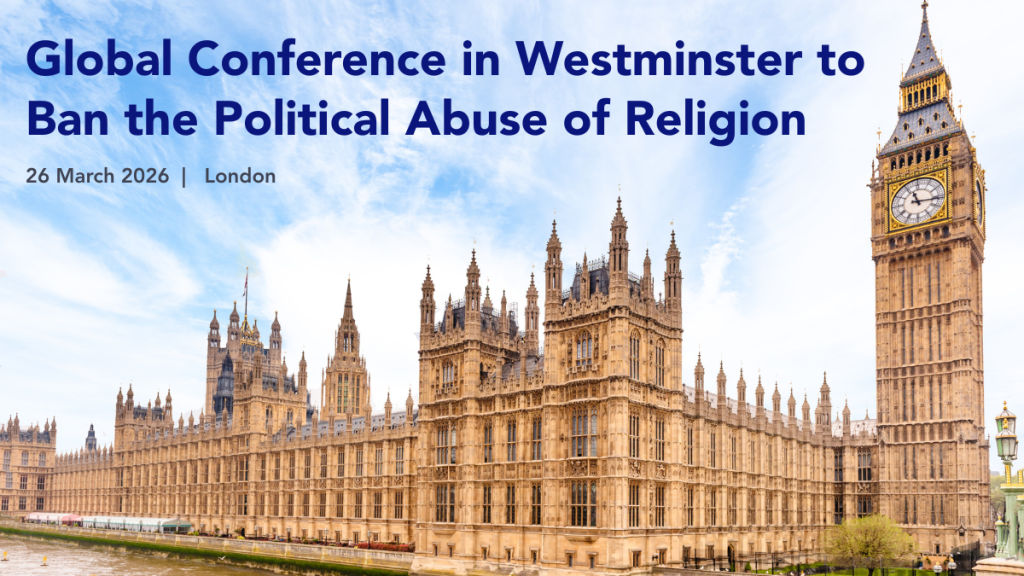
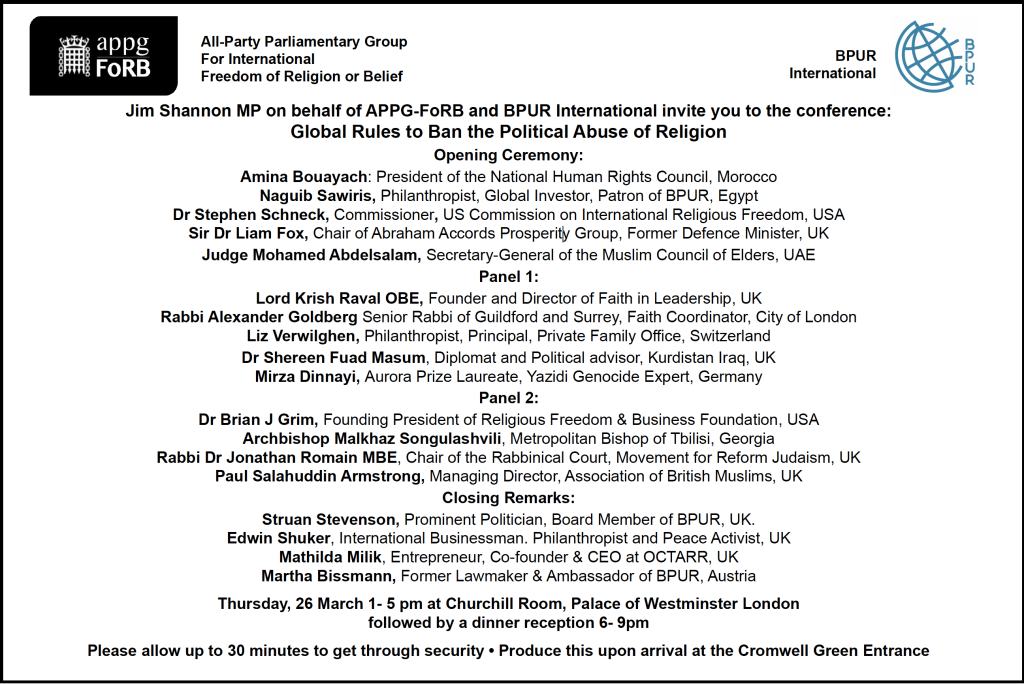
It is in response to this urgent global challenge that Religious Freedom & Business Foundation (RFBF) President Dr. Brian Grim will be speaking at a high-level international conference at the UK Parliament on March 26, convened at the House of Commons, where leaders and policymakers will gather to advance a global framework aimed at prohibiting the political abuse of religion and addressing one of the root causes of religious conflict worldwide. RFBF is a stakeholder in the UK All-Party Parliamentary Group for International Freedom of Religion or Belief (APPG FoRB).


BPUR International is organising this high-level international conference at the House of Commons in London on 26 March 2026, aiming to address one of the most persistent and destabilising drivers of global conflict, encapsulated in the title “Global Rules to Ban the Political Abuse of Religion – An International Partnership to Address the Root Causes of Religious Conflicts.”

The conference is sponsored by the UK All-Party Parliamentary Group for International Freedom of Religion or Belief (APPG FoRB), chaired by Jim Shannon MP.

The event, held in the Churchill Room at the Palace of Westminster, is a call for a global partnership of visionary officials, lawmakers, and prominent representatives of the international community to work together to introduce effective new global rules to address the root causes of religious conflicts and discrimination worldwide.

The objective is to build a global consensus on clear, indisputable international standards to define and prohibit all political abuses of religion, without offending any religious group or threatening the social and political stability of any country.

The partnership seeks to move beyond traditional dialogue by working towards a global framework that protects the sanctity of faith from political exploitation. It is a springboard for sustained momentum to advance the legislative and diplomatic efforts required to deliver a significant and historic transformation.

It is a platform for principled officials, lawmakers and global organisations to help shape a universal legal framework to ban the political abuse of religion that undermines equality, and all forms of religious discrimination, exclusion, and restrictions on freedom of religion or belief.

These fundamental rules, enshrined as international law, would be the ultimate tool to protect all victims of religious oppression and advance international humanitarian objectives by addressing the root causes of religious conflicts and many human rights violations.

The partnership aims to encourage governments to support the introduction of these rules at the UN General Assembly. It is a collective effort to develop and promote a landmark United Nations treaty to ban the political abuse of religion.

Such a standard would empower governments to join the global consensus on justice and equality, enhance stability, and pave the way for sustainable development to make the world more fair and more peaceful.

The campaign is already underway with several proposed parliamentary resolutions, including a significant supporting motion at the Council of Europe. It has active engagement with several governments and rapidly growing support in over 80 countries.

The conference aims to secure the participation of up to 100 prominent officials, lawmakers, stakeholders, and leading representatives of the international community to exchange ideas on how best to encourage governments to support this global effort.

AI Is Advancing Fast. But It’s Exposing a Deeper Question: What Are Humans For?

17 Mar, 2026

By Brian Grim, Ph.D.

In recent conversations with leaders from a major international business who were exploring how to support employee faith groups, I was asked a practical question: what kinds of topics have other companies addressed in this space? I mentioned that I had worked with Thomson Reuters Interfaith Employee Network on a program focused on Faith and Artificial Intelligence, From Values to Value: Interfaith Leadership in the Age of AI. That answer sparked immediate curiosity, but also some confusion. “What could faith have to say about AI?” they asked. Even among people already interested in faith, the connection was not obvious.

I began with the most tangible concerns. Artificial intelligence is already shaping how religion is experienced and understood in society. In some contexts, such as China, AI-driven surveillance technologies are used to monitor and exert control over ethnic and religious minorities, including Uyghur Muslims in Xinjiang. Elsewhere, generative AI systems produce content that demeans or distorts religious beliefs, reinforcing stereotypes, spreading misinformation, or presenting inaccurate portrayals of religious communities. These developments raise serious questions about religious freedom, human dignity, and the integrity of belief in a digital age.

But as the conversation unfolded, it became clear that these issues, while important, were not what most intrigued these leaders. What captured their attention was something more fundamental: not simply how AI affects religion, but what AI reveals about what it means to be human in the first place.

This question is not new. More than two decades ago, theologian and computer scientist Noreen Herzfeld explored it in her work on artificial intelligence and the image of God. Long before today’s AI boom in, she argued in 2002 that the way we design intelligent machines reflects our assumptions about human nature. Her insight is strikingly relevant today, particularly for business leaders navigating the rapid integration of AI into the workplace.

Herzfeld describes three primary ways of understanding what it means to be human.

  • — The first sees humanity in terms of properties we possess — especially intelligence or reason.
  • — The second defines us by what we do — our functions, capabilities, and productivity.
  • — The third understands humanity as fundamentally relational, grounded in our capacity to form meaningful relationships with others.

These frameworks are not merely philosophical distinctions; they shape how we approach AI itself.

Modern business culture has overwhelmingly embraced the second view. We define people by their roles, their output, and their measurable contributions. It is no accident that one of the first questions we ask upon meeting someone is, “What do you do?” This functional understanding of human identity aligns closely with how organizations deploy AI: to improve efficiency, automate tasks, and optimize performance. In this paradigm, AI is a powerful tool precisely because it can perform functions once reserved for humans, often faster, cheaper, and at greater scale.

Yet Herzfeld warns that this functional definition carries significant implications. If human beings are defined primarily by what they do, then machines that can do those things more effectively begin to look less like tools and more like replacements. The anxiety surrounding AI — whether about job displacement or longer-term existential concerns — flows naturally from this assumption. In a purely functional framework, the question is not whether machines will compete with humans, but how long it will take before they surpass them.

Faith traditions offer a different perspective. Across religious traditions, there is a consistent insistence that human beings cannot be reduced to intelligence or productivity. Instead, they are understood as relational beings, defined by their capacity for connection, responsibility, and moral agency. Herzfeld draws particularly on this relational understanding, arguing that it provides a richer account of human dignity, one that cannot be replicated by machines. Even within the field of artificial intelligence, this insight emerges in unexpected ways. The Turing Test, long considered a benchmark for machine intelligence, evaluates not computational accuracy but the ability to engage in meaningful conversation. In other words, it measures relational capacity rather than mere functional performance.

This distinction matters deeply for business leaders. AI systems do not simply execute tasks; they embody assumptions about what counts as valuable, meaningful, and human. When those assumptions are limited to efficiency and output, the risks are significant. Systems may amplify bias, misrepresent cultural and religious identities, or be deployed in ways that erode trust and dignity. These are not merely technical failures; they are failures of understanding what human beings are.

Recognizing this, a growing number of voices from faith communities are engaging directly with the development of AI. A recent multi-faith initiative, bringing together Jewish, Christian, and Muslim leaders, issued a statement calling for “moral guardrails” in artificial intelligence, emphasizing that what is at stake includes “the sanctity of human life, the right to privacy and dignity, and the freedom of conscience.” Their concern is not abstract. It reflects a recognition that the ethical boundaries shaping AI today will define the kind of society we inhabit tomorrow.

For organizations, this has practical implications. A workplace that is open to faith perspectives is not simply more inclusive; it is better equipped to grapple with the deeper questions AI raises. Religious traditions bring long-standing reflections on human identity, responsibility, and the limits of human creation, resources that are often missing from purely technical or economic discussions. Without these perspectives, companies risk operating with an incomplete understanding of the very people their technologies are meant to serve.

Ultimately, the question facing business leaders is not only how to use AI, but what vision of humanity their use of AI reflects. Herzfeld frames this as a choice between building systems that replace human beings and those that support and enhance human relationships. That choice is already being made, often implicitly, in decisions about how AI is designed, deployed, and governed.

The conversations I had with those business leaders began with uncertainty about what faith might contribute to discussions about AI. They ended with a clearer recognition that faith does not merely offer commentary on technology; it speaks to the foundational question technology now forces us to confront. As AI continues to expand what machines can do, it simultaneously presses us to reconsider what humans are—and what they are for.

That is why this moment calls for more than reflection; it calls for engagement. Business leaders, technologists, and policymakers alike should take seriously the emerging efforts to articulate ethical boundaries for AI grounded in human dignity. One practical step is to read the Moral Guardrails in Artificial Intelligence statement issued by the Faith Family Technology Network, consider its principles, and determine whether to add your voice.

The Moral Guardrails statement emerges amid a high-profile standoff between AI company Anthropic and the U.S. Department of War, where Anthropic has refused to remove safeguards preventing uses such as autonomous lethal weapons and mass surveillance, highlighting a growing tension between technological capability, national security demands, and moral responsibility.

At a time when the trajectory of AI is still being shaped, silence is itself a decision.


Reference: Herzfeld, Noreen. 2003. Creating in Our Own Image: Artificial Intelligence and the Image of God. Zygon ®: Journal of Religion and Science 37(2): 303-316.

Faith@Work UK Annual Summit

12 Mar, 2026

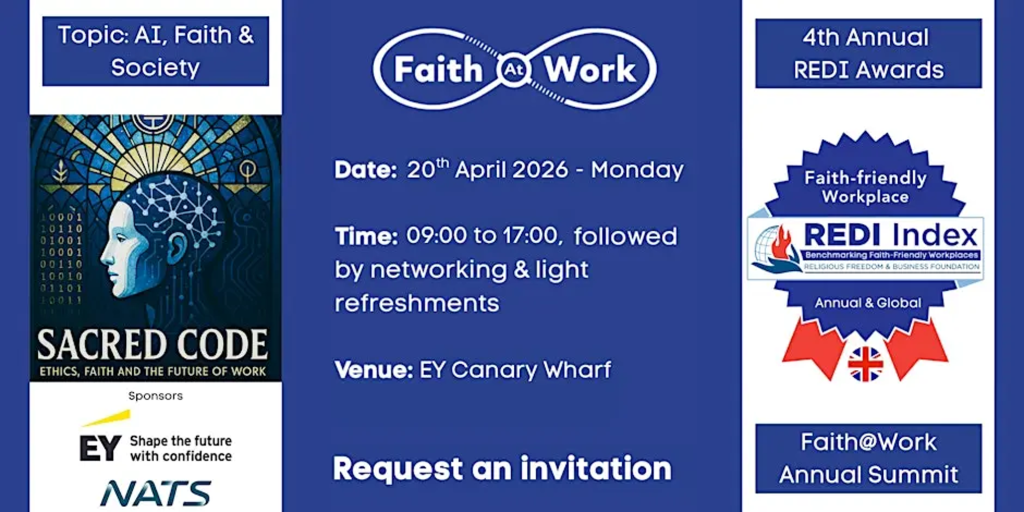
Join us for the Faith-Friendly Workplace ‘REDI’ Awards, panels on best workplace practices, and a timely exploration of AI, Faith & Society.

REQUEST INVITATION (registration will open next week – £40.00)

The 20th April 2026 Faith@Work Annual Summit hosted by EY at Canary Wharf is a high-level, one-day UK event celebrating excellence in workplace religious inclusion and exploring the intersection of AI, society, and faith.

The morning session recognises and awards organisations leading the way as the most faith-friendly workplaces in the UK, highlighting best practices that advance religious equity, diversity, and inclusion across sectors.

Professor Lord (Lionel) Tarassenko CBE FREng FMedSci will lead the discussion about the how business leaders need to respond to the ethical issues caused by increasing use of AI in the workplace. Lord Tarassenko is a leading Oxford engineer and House of Lords peer whose pioneering work applying AI and signal processing to healthcare has produced FDA-approved clinical systems and major industry innovations. A founder of multiple spin-outs, he bridges academia, industry, and policy on technology, health, and workforce transformation.

In the afternoon, expert panels will discuss the social and ethical implications of emerging AI technologies through the lens of faith, offering insights that can inform UK parliamentary initiatives on responsible AI development and governance.

In the context of recent calls in the House of Lords for expert commissions to assess the rapid progress of general-purpose AI and its societal impacts, this summit provides a timely forum to bridge faith-based perspectives with public policy and technological discourse.

New Data on Faith in the Workplace

12 Mar, 2026

Religion is one of the least discussed aspects of diversity at work, yet for many people it is a central part of identity. Around 62 percent of people in the UK identify with a religion. Despite this, new research suggests that many employees feel unable to acknowledge this part of their identity at work.

Workplace expert Binna Kandola unpacks the latest data on religion in the workplace in the video above.


Binna Kandola is a psychologist, co-founder of Pearn Kandola, and an award-winning author specialising in diversity, inclusion, and workplace culture. His latest book, Building a Psychologically Safe Work Environment, offers a practical, accessible guide to creating workplaces where people feel heard, valued, and able to contribute, equipping leaders with the tools to foster inclusive, effective, and high-performing teams.


In a new survey of employees in the UK who identify with a religion across a range of faith groups including Buddhist, Christian, Hindu, Jewish, Muslim and Sikh participants. Several headline findings stand out.

Religion remains a sensitive topic in workplaces. While severe incidents of discrimination are relatively rare, subtle forms of bias and misunderstanding remain widespread.

Many report feeling uncomfortable discussing their religion at work, while 66% feel uncomfortable discussing religion in general in workplace settings, including saying they have actively avoided conversations about religion because they fear misunderstandings or political tensions.

A majority of respondents believe religious discrimination exists in the workplace, and a sizeable number report having personally witnessed discrimination against someone because of their religion.

However, when discrimination occurs, people are often reluctant to intervene.

Brian Grim & Former Sec-Gen of Commonwealth Address Religious Freedom

11 Mar, 2026

Source: Aid to the Church in Need

Baroness Patricia Scotland, former Secretary-General to the Commonwealth of Nations, is to give a keynote address at a landmark conference in London addressing increasing challenges to religious freedom around the world.

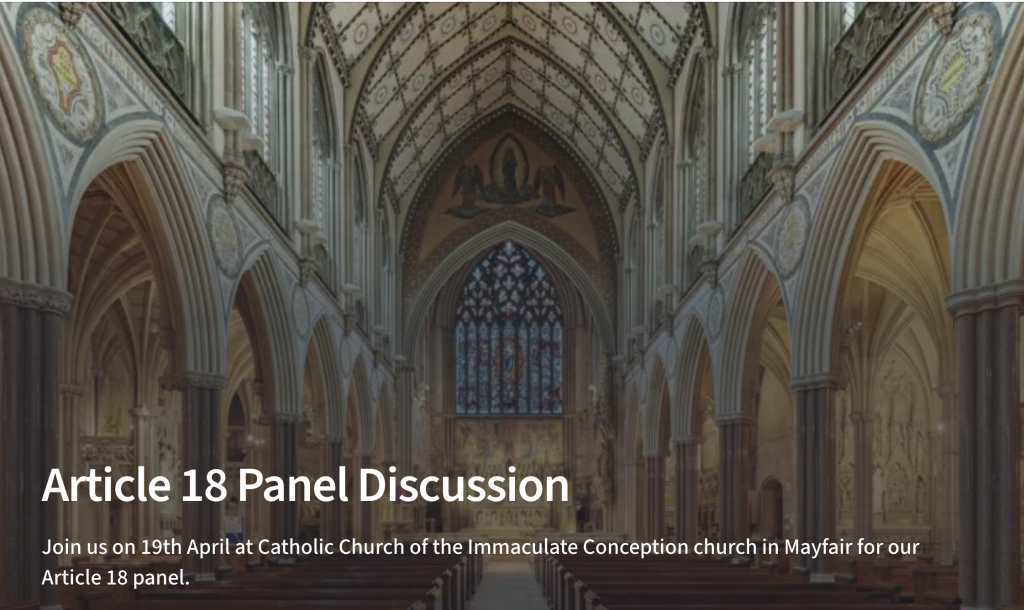
A panel discussion “Dare to Believe – Is Religious Freedom under growing threat around the world”, a hybrid event, is taking place at 3pm on Sunday, 19th April 2026 at Farm Street Catholic Church, W1K 3AH.

Another keynote speaker at the event, organised by Farm Street Church in conjunction with Catholic charity Aid to the Church in Need (ACN), is Professor Brian Grim, founding president of the Religious Freedom & Business Foundation and a globally recognised expert on religious freedom.

People of different faith backgrounds – including those almost killed for their beliefs – will provide testimonies of persecution.

An address will also be given by Bishop Philip Mounstephen of Winchester, who produced the ground-breaking Bishop of Truro’s Independent Review for the UK Foreign Secretary of Foreign and Commonwealth Office Support for Persecuted Christians.

The event follows the launch of ACN’s global campaign calling for the full enforcement of the principles of religious freedom set out in Article 18 of the Universal Declaration of Human Rights – “everyone has the right to freedom of thought, conscience and religion”.

Event chair Father Dominic Robinson, Farm Street parish priest, and ACN (UK) National Ecclesiastical Assistant, said: “Freedom to express religious belief is one of the basic human rights which is under daily attack in so many parts of the world.

“As a nation whose values of tolerance and mutual respect are enshrined in our laws, we can easily forget how people of faith are treated elsewhere. This is why this campaign to promote and protect Article 18 of the Universal Declaration is so vital to international peace and harmony and why educating ourselves in the issues surrounding this are so important. It is hoped that this event will help to serve this dire need.”

Compèring the event will be ACN (UK) Ambassador Dr Karen Singarayer and there will be a talk by John Pontifex, the charity’s head of press and public affairs, who for more than 20 years has researched religious freedom violations, especially against Christians, including on-the-ground fact finding in worst-affected countries.

Mr Pontifex said: “As a society, we urgently need a discussion in which we come together around the importance of religious freedom or belief and that’s why our panel discussion – like the ACN Article 18 petition – is vital not just to Christians but to people of all faiths and none.”

Audience members participating in the event will be invited to submit questions as part of an extended panel discussion.

•’Dare to believe: Is Religious Freedom under growing threat around the world?’ takes place on Sunday, 19th April 2026 at Farm Street Catholic Church, 114 Mount Street, London W14 3AH. The event is from 3pm-5pm and concludes with refreshments. Entrance is free. To register for the event see: https://acnuk.org/events.

•To sign the ACN Article 18 petition visit here.

Global ERG Impact Report Features Faith ERGs

11 Mar, 2026

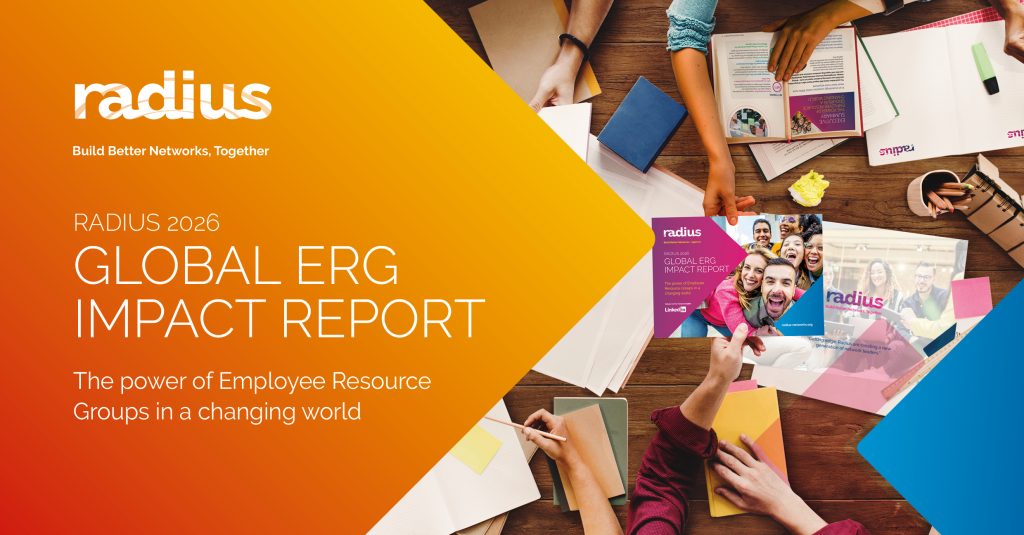
This new report from Radius Networks couldn’t have come at a better time. At this time of massive cultural and geo-political changes and strains on workplace cultures, ERGs, including faith ERGs (as shown in the report), are helping not only individuals but also organisations move forward successfully.

Check out the insightful ERG case studies created in collaboration with the world’s most inclusive employers and industry partners. Faith ERGs are featured throughout, with a special section from the Religious Freedom & Business Foundation on pp 133-135.

These stories showcase what’s possible when organisations come together to advance inclusion, belonging, and real-world impact.

Behind Ford CEO Vatican Visit Is Commitment to Helping Homeless

9 Mar, 2026

Behind Ford CEO Jim Farley’s Vatican Visit Is a Long Commitment to Helping Detroit’s Homeless

By Brian Grim

Ford CEO Jim Farley recently visited the Vatican with his wife, Lia, to present Pope Leo XIV with a custom-built Ford Explorer assembled in Chicago, the pope’s hometown. While the historic meeting drew global attention, Farley’s visit also reflects a deeper story of service. For decades, he has volunteered at Detroit’s Pope Francis Center, helping serve meals, distribute clothing, and support programs for men experiencing homelessness. Inspired partly by the loss of his cousin, comedian Chris Farley, Farley has helped raise funds and awareness for the center, encouraging others to give their time and resources to address homelessness in Detroit.


Ford Motor Co. CEO Jim Farley recently made headlines after he and his wife, Lia Farley, presented Pope Leo XIV with a custom-built Ford Explorer during a special ceremony at the Vatican on Feb. 28. While the unique SUV — assembled at Ford’s Chicago Assembly Plant, the pope’s hometown — captured global attention, the moment also reflects a broader story about Farley’s long-standing commitment to service and community impact.

The custom Explorer featured several personal touches celebrating the pope’s Chicago roots, including Chicago skyline stitching and seat tags inspired by the city’s flag. During the visit, Farley even took a brief drive with the pontiff to demonstrate the vehicle’s advanced features. For Farley, however, the meeting represented more than a ceremonial gift.

“For me, what stays with me most is the gratitude and joy we felt meeting the Holy Father and sharing a small gesture that reflects the pride of the Ford team back home in Chicago,” Farley said.

Farley’s connection to faith-driven service runs deep. For decades, he has volunteered at Detroit’s Pope Francis Center, an organization dedicated to helping people experiencing homelessness. The center provides hot meals, housing support, job training, and addiction recovery resources, serving as a lifeline for men working to transition back into stable housing.

Farley’s dedication is personal. The work is partly inspired by the loss of his cousin, comedian Chris Farley, who died of a drug overdose at age 33. Since then, the Ford CEO has spent years serving meals, distributing clothing, and helping in the kitchen at the center while also supporting its expansion through fundraising and advocacy.

During a recent visit to the Pope Francis Center’s Bridge Housing Campus, Farley received a meaningful gift from resident Allan Webster — a handcrafted Ford Model T made from coffee stirrers and found materials. Webster, who has struggled with addiction and homelessness, created the model as a tribute to Ford’s legacy of innovation.

Farley said the piece will be displayed in his office at Ford’s new world headquarters, a reminder of the resilience and creativity that can flourish when people are given the support they need.

The moment underscores a philosophy Farley often shares publicly: business leadership should go hand in hand with community responsibility. Whether delivering meals in Detroit or presenting a vehicle to the Vatican, Farley has consistently used his platform to encourage others to contribute time, resources, and compassion to address social challenges.

In that sense, the custom Explorer delivered to the pope may symbolize more than a one-of-a-kind vehicle — it highlights a broader commitment to service that extends from Ford’s factory floors to communities in need.

2026 Faith Holiday Calendar & Guide

5 Mar, 2026

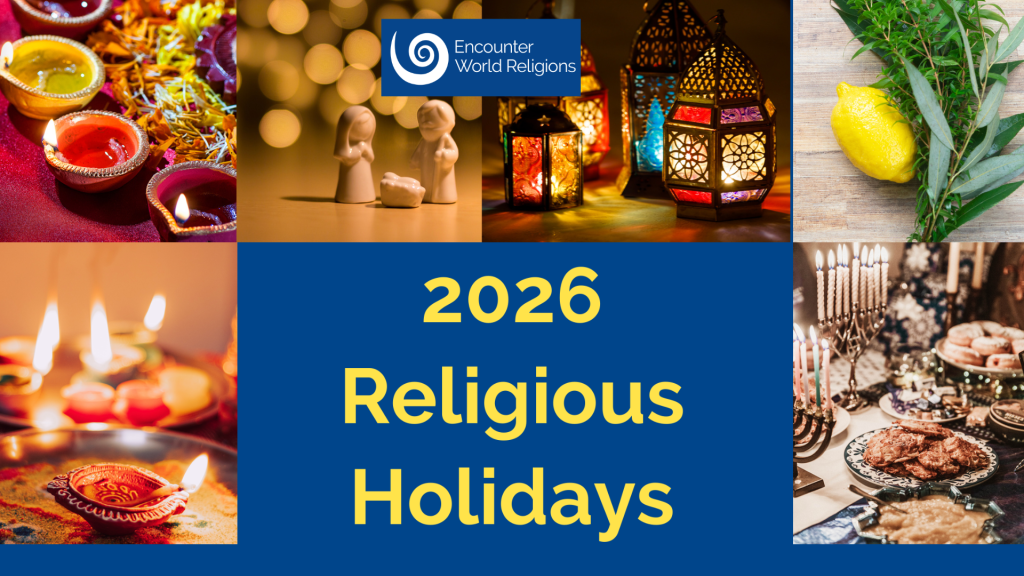
For more than 20 years, Encounter World Religions, a registered Canadian charity, has been honoured to help people, organizations and communities explore what it means to become religiously literate and enhance their understanding of one another.

They invite you to share this resource in your workplace, school, place of worship or community centre. Recognizing the religious holidays of others can be a powerful way to connect.

— For those in the minority, a holiday greeting from a colleague, neighbour, or classmate can help people feel seen and acknowledged.

— A heartfelt acknowledgement of religious observances can also open a conversation, create a safe space for others to share more about their lives, and help build a sense of belonging and community for all. Even just sharing resources like this one can communicate that everyone is welcomed.

— Lastly, and perhaps most importantly, knowing more about one another can provide an opportunity to authentically share in the joy of different communities’ many celebrations.

Please note that some celebration dates vary according to region or lunar calendars. We have been as accurate as possible and have prioritized using North American sources. Encounter World Religion

Advanced Spiritual Care for the AI Age

4 Mar, 2026

Advanced Spiritual Care for the AI Age
Date: March 25, 2026
Time: 3:00 pm ET
Location: Zoom
Register here
Webinar sponsored by the Religious Freedom & Business Foundation

This webinar will equip chaplains with essential AI literacy as they navigate the unique spiritual landscape of 2026 and beyond. Rather than focusing on technology for technology’s sake, this event explores how AI is reshaping the patient experience and how chaplains can use these tools to protect their most valuable asset: their presence.

The webinar centers on three core objectives:

  1. 1. Meeting the “Digital-First” Patient: Understanding why many now find “Digital Presence” less intimidating than human presence, and how chaplains can act as “Digital Translators” to bridge the gap to the sacred.
  2. 2. The Human Audit (Skeleton vs. Marrow): A practical look at using AI to draft the “skeleton” of prayers and reflections, followed by the “Human Audit” where we add the “marrow”—the specific theological and human nuances the machine cannot reach.
  3. 3. Reclaiming Presence: A strategic guide on using AI to save up to several hours a week on administrative and preparatory “noise,” allowing chaplains to reinvest that time into “Deep Down” human connection. The goal is to move beyond the fear of AI and empower chaplains to lead in a world that increasingly “speaks in code.”

Learning Outcomes

We have indexed this webinar to the following learning outcomes, which should not be construed as endorsement of this event by either ACPE or BCCI:

  • – ACPE C.2.IB: Articulate how one uses health relational boundaries in spiritual care contexts.
  • – ACPE D.1.IIA: Demonstrate flexible communication styles and skills, including trauma informed approaches, that develop spiritual care relationships using one’s authority.
  • – ACPE D.2.IA: Demonstrate an understanding an initiate the use of spiritual resources that address spiritual wellbeing.
  • – BCCI ITP3: Incorporate the spiritual and emotional dimensions of human development into one’s practice of care.
  • – BCCI PIC1: Identify one’s professional strengths and limitations in the provision of spiritual care.
  • – BCCI PIC4: Respects the physical, emotional, cultural, and spiritual boundaries of others.

Speaker

Ali Candir is Manager of Mission Integration & Spiritual Care at St. Luke’s Health in Houston, Texas. As a staff chaplain at CHI St. Luke’s Health, Candir provides spiritual care and support to patients, families, and staff of diverse backgrounds and faiths. He is board certified by the Association of Professional Chaplains. He is also skilled in university teaching, event planning, and fundraising. Candir is pursuing a career in AI in Healthcare, with years of experience in the healthcare field and data analysis.