Working for workplace religious belonging, inclusion & freedom

E-NEWS ACTION DONATE

Monthly Archives: January 2026

CEO/Board Brief: Faith and Belief Inclusion as a Workplace Governance Issue (2026)

29 Jan, 2026

CEO/Board Brief: Faith and Belief Inclusion as a Workplace Governance Issue (2026)

Context:
John Deere shareholders will vote on February 25, 2026, on a proposal asking the Board to assess the reputational, human capital, operational, and legal risks of failing to allow faith-based business resource groups (BRGs). Deere is urging shareholders to vote against the proposal.

Why this matters:
Faith and belief inclusion is emerging as a board-level workplace culture issue, distinct from broader political debates. Employees increasingly expect workplaces to accommodate religious identity fairly and consistently.

Key business considerations:

  • — Talent and engagement: Religious employees who feel excluded may disengage or leave.
  • — Culture and trust: Belonging includes faith and belief, not only other visible identities.
  • — Risk management: Clear policies and manager training reduce the risk of favoritism, coercion, or conflict.
  • — Governance trend: Shareholder proposals on faith inclusion are now appearing at major public companies.

Recommended action:
Companies should proactively benchmark workplace practices on faith and belief inclusion rather than react under external pressure.

Faith-Friendly Workplace REDI Index opportunity:
The Faith-Friendly Workplace REDI Index, used by many Fortune 500 companies, provides a structured benchmarking tool to evaluate organizational readiness, identify gaps, and demonstrate measurable progress.

The 2026 Faith-Friendly Workplace REDI Index survey is now open, and companies are invited to participate. https://religiousfreedomandbusiness.org/redi

Bottom line:
Faith is returning to the workplace as a strategic human capital issue. Boards that lead with clarity will be better positioned to strengthen culture, retain talent, and reduce risk.

Brian Grim, Ph.D.
President, Religious Freedom & Business Foundation
January 29, 2026
Contact: contact@religiousfreedomandbusiness.org


For a more detailed Governance / Human Capital Committee Brief (2026), download:

Board Oversight Brief: Faith and Belief Inclusion as a Workplace Culture and Risk Issue


Faith Finds Its Way Back to Business in 2026

29 Jan, 2026

Why companies are reintroducing faith into workplace culture

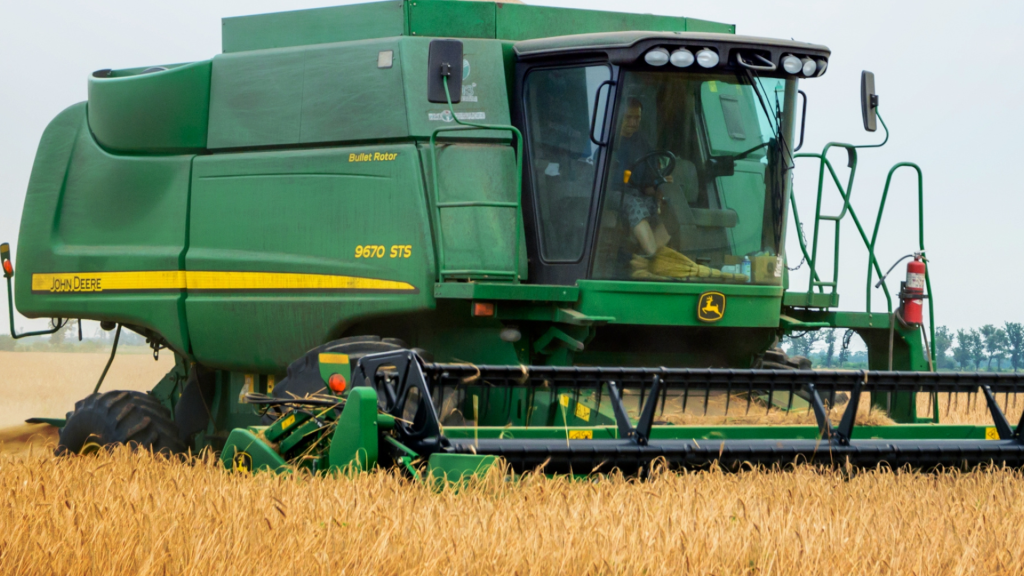
John Deere Combine Harvester Harvesting Wheat in Field, Stephan Botezatu, Zaporizhzhya, Ukraine, July 28, 2015 | Canva

Brian Grim
President, Religious Freedom & Business Foundation

At John Deere’s upcoming annual shareholders meeting on February 25, the board will face a question that more corporate leaders should be prepared to address: how should companies respond to the role of faith and belief in workplace culture?

A shareholder proposal submitted by Bowyer Research requests that Deere’s Board evaluate and report on the reputational, human capital, operational, legal, and other relevant risks of failing to allow faith-based business resource groups (BRGs).

Deere has urged shareholders to vote against the proposal, arguing that producing such a report would divert resources from strategic priorities and advance the views of the proponent.

Regardless of the outcome, the significance is clear: faith and belief inclusion has entered the boardroom.

For many employers, religion has long been viewed as a sensitive topic, raising concerns about misunderstanding, favoritism, or conflict. Legal experts emphasize that organizations must balance accommodation with clear guardrails, manager training, and consistent policies.

Yet the underlying reality is straightforward. Employees do not leave their faith or deeply held beliefs at the door when they come to work. For millions of workers, belief is a source of meaning, identity, and resilience. Companies that ignore this dimension of human experience risk weakening engagement and trust. Companies that address it thoughtfully can strengthen culture and retention.

A faith-and-belief-friendly workplace is not about endorsing religion. It is about fairness, dignity, and ensuring that employees of all faiths—and those with no religious affiliation—feel respected and included.

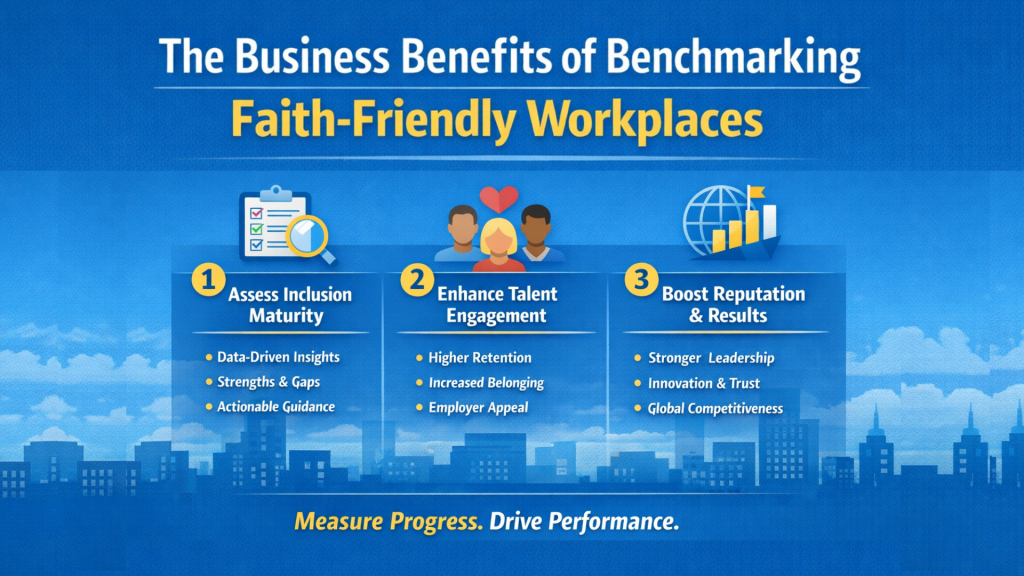
That is why the Religious Freedom & Business Foundation created the Faith-Friendly Workplace REDI Index, a benchmarking tool used by many Fortune 500 companies, that enables companies to assess and improve how well they are supporting faith and belief inclusion as part of workplace culture.

The 2026 REDI Index survey is now open, and we invite companies of every size and sector to participate. Benchmarking is one of the most practical steps an organization can take to evaluate its current posture, identify gaps, mitigate risk, and demonstrate measurable progress.

Boards and leadership teams will increasingly be asked not whether faith belongs at work, but whether they are managing religious inclusion with the same discipline, professionalism, and strategic clarity applied to every other dimension of human capital.

  • — To request the 2026 Faith-Friendly Workplace REDI Index survey, visit here.

Additional Resources and Commentary

The G20 Process & Challenges for Religious Freedom

28 Jan, 2026

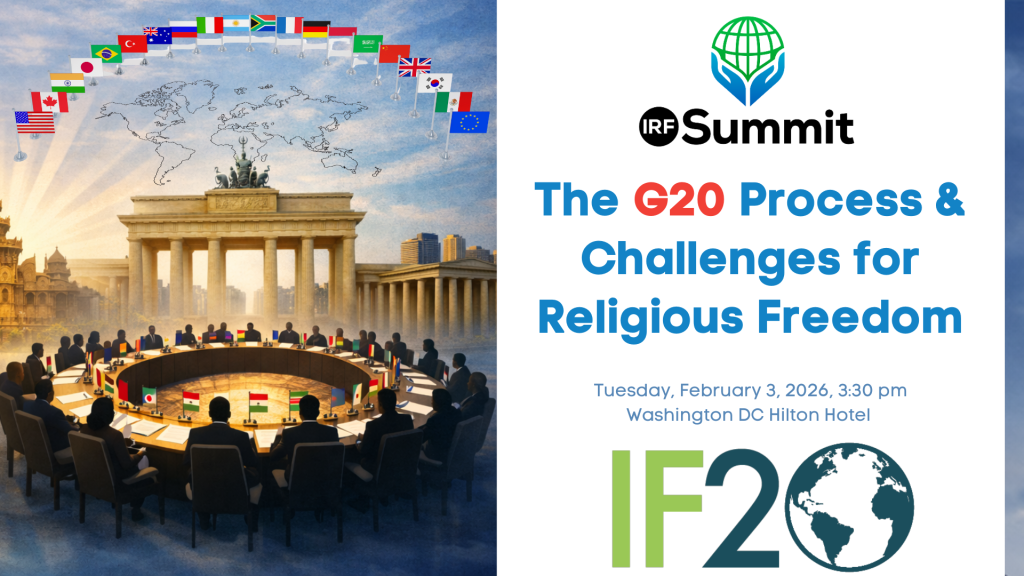
The G20 Process & Challenges for Religious Freedom

Washington DC: Tuesday, February 3, 2026, 3:30 PM to 5:00 PM EST, Washington DC Hilton Hotel (Tickets Required)

This high-level IRF Summit Affiliated Session — sponsored by the G20 Interfaith Forum — will look ay how religious freedom is an integral factor in successful societies and economies.

Speakers:

  • — W. Cole Durham, Jr., President, IF20
  • — Katherine Marshall, Vice President, IF20, and President, World Faiths Development Dialogue
  • — Brian Grim, President, Religious Freedom & Business Foundation
  • — Imam Mohamed Jag Magid, Resident Scholar, ASAMS Center
  • — Brett Scharffs, Director, International Center for Law and Religion Studies
  • — Marianna Richardson, Communications Director, IF20
  • — Eric LeCompte, Executive Director of the Jubilee USA Network
  • — David Saperstein, Director Emeritus, Religious Action Center for Reform Judaism

The G20 Process & Challenges for Religious Freedom is a high-level IRF Summit Affiliated Session sponsored by the G20 Interfaith Forum, exploring how religious freedom remains an essential pillar of stable, prosperous, and resilient societies.

During 2026, the United States will host the G20 Summit. Coinciding with the 250th Anniversary of the Declaration of Independence, the 2026 year will provide numerous opportunities to profile ways that key values such as freedom of religion can contribute to global progress, as envisioned in the G20 process. The G20 Interfaith Forum Association (“IF20”) has organized conferences and related activities in connection with successive G20 events each year for the past twelve years, and we anticipate that 2026 has potential to pursue those objectives. The side event will highlight progress and impact over the past several years, exploring how advances in freedom of religion can contribute to the wider success of G20 objectives.

This event will focus on priority focus areas that will have particular relevance this year. The announced priorities for the 2026 year in the United States are (1) Deregulation and Economic Growth; (2) Energy Security; and (3) Innovation and Technology. Continuing G20 Interfaith Forum priorities link to these topics in several ways. The IF20 side event will include presentations, notably (1) Religious Contributions to Enhancing Economic Growth; (2) Religious engagement on Energy Security; and (3) Religion, Religious Freedom, and AI. It will address several IF20 priorities including food security, human trafficking, and priority issues for children, health (including mental health), and human flourishing.

This event is part of the lead up to further programs during the 2026 year organized by the G20 Interfaith Forum Association. Highlights will include a Forum session on key policy issues to be held in Washington, D.C. at Georgetown University, May 26, 2026, and a larger Forum held in Salt Lake City (hosted by the University of Utah and Brigham Young University) October 15-17, 2026.

Related:

Plans for the 2026 G20 Interfaith Forum Year

Incentivizing Freedom: Building a Global Accountability Architecture Through Business, Policy, and Collaborative Reform


Incentivizing Freedom: High-Level IRF Summit Panel

26 Jan, 2026

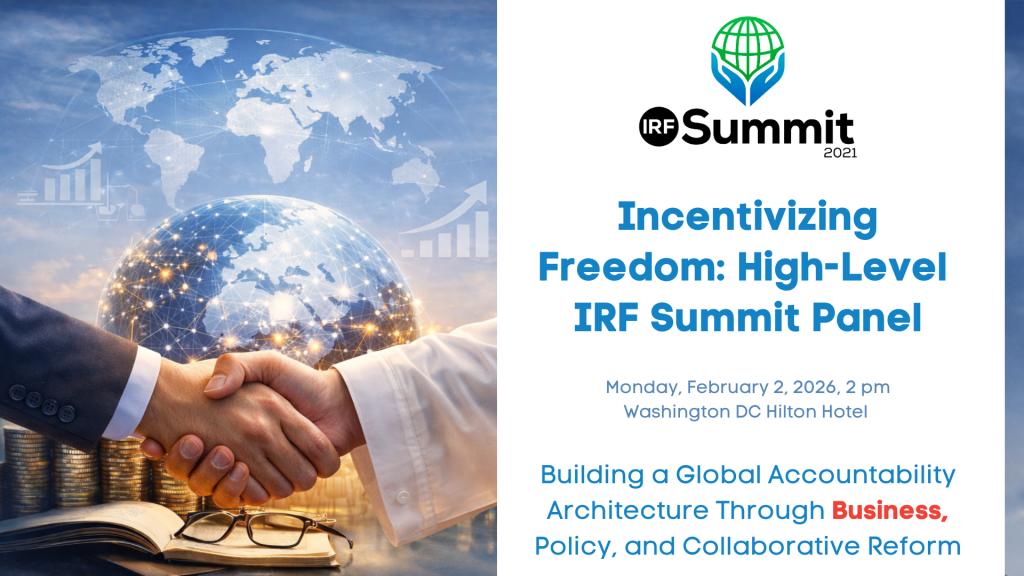
Incentivizing Freedom: Building a Global Accountability Architecture Through Business, Policy, and Collaborative Reform

Washington DC: Monday, February 2, 2026, 2:00 PM to 2:40 PM EST, Washington DC Hilton Hotel

This high-level IRF Summit panel will dissect the strategies needed to construct a comprehensive and effective global framework for religious freedom accountability. The discussion moves beyond solely punitive measures (such as sanctions) to focus on creating a self-reinforcing cycle of success through collaboration. The core focus is how key sectors—including business, policy, and reform initiatives—can work together to generate concrete solutions. Experts will provide an analysis of how market incentives can be utilized as economic leverage. This includes detailing how businesses and investors can employ tools—such as preferential trade agreements, corporate due diligence standards, investing metrics, and procurement policies—to reward governments and entities that protect religious freedom, and penalize those that violate it. We will also examine mechanisms for international pressure and the amplification of positive policies and successful programs already implemented by national governments. The ultimate goal is to define an accountability architecture driven by market forces and collaborative policy, creating actionable, evidence-based frameworks that align global pressure with local positive change and ensure tangible successes for religious freedom worldwide.

Confirmed Speakers & Moderator

Brian Grim (President, Religious Freedom & Business Foundation) Dr. Grim is a leading expert on the socio-economic benefits of religious freedom, specializing in how faith-friendly workplaces and religious diversity drive global economic growth. His research provides a unique data-driven perspective on why protecting religious liberty is a critical interest for the international business community.

Yusuf Khaled (Third Secretary, Embassy of Bahrain) Mr. Khaled offers insight into the Kingdom of Bahrain’s regional leadership in promoting interfaith dialogue and peaceful coexistence through initiatives like the “King Hamad Global Centre.” His perspective is vital for understanding the role of diplomatic engagement and national frameworks in fostering religious pluralism within the Middle East.

Marcela Szymanski (Head of International Advocacy for the pontifical foundation Aid to the Church in Need) Ms. Szymanski has over 20 years’ experience as a media correspondent and public affairs professional, helping to understand the value of promoting and protecting Human Rights by informing policy-makers, law professionals, media and academics of various disciplines. Between 2015 and 2024 Marcela was the Editor of the Aid to the Church in Need (ACN) report “Religious Freedom in the World”, for which she developed the Methodology and definitions. The report is published every 2 years and covers all major religions within 196 countries. Marcela is a member of the Council of Experts of the UN-based Article 18/International Religious Freedom or Belief Alliance (IRFBA), a member of the Board of the Jakarta-based G20 Religions Group (R20), and of the Center for Shared Civilizational Values.

Brett Scharffs (Director, International Center for Law and Religion Studies) — Moderator Professor Scharffs is a distinguished legal scholar who has dedicated his career to the comparative study of law and religion, with a focus on protecting freedom of conscience in diverse constitutional frameworks. He brings extensive experience in international diplomacy and legal education, making him an expert at navigating the complex intersection of human rights and state policy.

Religious Freedom: Society’s ‘X Factor’

24 Jan, 2026

By Allen D. Hertzke

Excerpted from Chapter 1 of Allen D. Hertzke, Why Religious Freedom Matters:  Human Rights and Human Flourishing, University of Notre Dame Press, April 1, 2026. Pre-order today!

Imagine a social force — a potent X Factor* —  that underpins democracy, bolsters civil liberties, builds citizen loyalty, undermines religious fanaticism, reduces societal violence, improves women’s status, fosters economic development, spurs uplift for the poor, and nurtures international peace.

Remarkable as it seems, new global research powerfully links religious freedom to all these social outcomes. Not solely, of course. But compelling evidence points to religious freedom – rightly understood and generously protected – as pivotal to the kind of world we want to inhabit: an X factor for flourishing societies.

Such a claim may seem startling to some modern ears, especially given the religious fanaticism and sectarian strife afflicting the globe today. Why promote such a divisive impulse as religion? Moreover, in our fraught and polarized times religious liberty itself has gotten a bad name in some progressive circles, depicted as a rightwing cause, an excuse for bigotry and discrimination, or a weapon in the culture war. We also see distorted views about religious freedom on the right – from religious nationalists who falsely believe that imposing a dominant religious identity on diverse societies will preserve their spiritual heritage.

Equally troubling, a chorus of intellectual critics attack the very idea of religious freedom as a definable, coherent set of rights. Or they see it as a western construct imposed on indigenous societies, a cover for imperialism, or a pretext for aggressive Christian proselytizing.

For those of us engaged in scholarship and advocacy on global religious freedom, such perceptions are anguishing. They often reflect a misunderstanding of what genuine religious freedom is and why it matters profoundly for the future most of us seek.

Why is religious freedom such a potent human right? Why is it so critical to human flourishing? Why does it have such a huge impact on so many arenas of human life? My central argument is that religious freedom uniquely matters to peaceful, democratic, and flourishing societies because it goes to the heart of human personhood and experience: the right to be who we are, to act on our ultimate commitments, and to be treated with equal worth and dignity. While I will probe specific empirical theories that link religious freedom to democracy, prosperity, women’s empowerment, uplift, and peace, they all converge on this overarching theme.

Let me elaborate. Suppose I ask what is ultimate to you, what makes the greatest claim on your conscience. Then I say, “You cannot live by that commitment, you cannot publicly affirm or act on it.” You would see this as a violation of your identity and dignity, as fundamentally unjust. This freedom to exercise one’s transcendent duties – to seek truth about ultimate questions and act on them – is so central to humanity that government or social repression, along with unequal treatment that privileges religious majorities, will inevitably harm societies, governance, and economics.

If religious freedom is the right to be who we are, it is under siege in the world today, assaulted by theocratic movements, violated by authoritarian regimes, attacked by ethno-nationalists, curbed by aggressive secular policies, and undermined by elite hostility or misunderstanding. All reflect the hegemonic impulse of regime leaders and dominant social groups. For theocrats: You must become us. For ethno-nationalists: You must be expelled from us. For autocrats: You must serve us before God. For aggressive secularists: You must hide your faith under a bushel. And for regimes that privilege majority faiths: You – religious minorities – must endure second class status.

These repressive impulses represent one of the greatest threats to more stable, democratic, prosperous, and peaceful societies in the twenty-first century.

In sum, empirically driven research demonstrates that restrictive laws, repressive societal practices, and state favoritism produce persecution and conflict, undermine democracy and civil liberties, contribute to terrorism and international conflict, and prevent empowerment of women or uplift for the poor. There are, in short, compelling reasons to see religious liberty as a fundamental and universal human right. Justice demands it. Violations disrupt the social order.


* The “X factor” refers to a hard-to-define, intangible quality or exceptional talent that makes a person or thing stand out in a distinctive way. It goes beyond measurable skills, creating a strong impression and often serving as the crucial element that turns something good into something truly remarkable. It’s that extra, unquantifiable spark—whether charisma, originality, or natural ability—that sets someone or something apart from the rest.


 

How Religious Freedom Helps Business – Fireside Chat

23 Jan, 2026

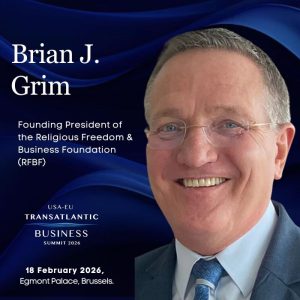
Fireside chat: Celebrating the 250th Anniversary of America’s Founding: How Religious Freedom Helps Business

Religious freedom is a cornerstone of the United States, allowing individuals to express their beliefs without fear of persecution.

Beyond politics, this principle also supports global business. Long-term international success depends not only on shared interests, but on trust, honesty, and cooperation- values often rooted in religious and cultural traditions.

From Christian ethics to Islamic finance, Hindu concepts of dharma and karma, and Jewish legal traditions, trade has long relied on shared moral frameworks. In today’s pluralistic societies, promoting international religious freedom helps sustain these ethical foundations and strengthens lasting transatlantic business ties.

Time and Venue
  • 12:55 – 13:15
  • 18th February 2025
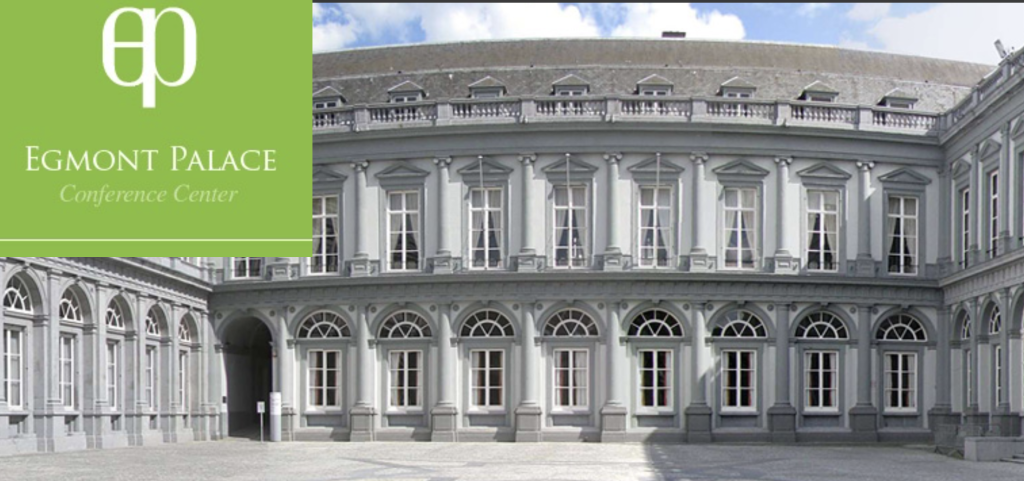
  • Egmont Palace

National Faith@Work ERG Summit Info Session

22 Jan, 2026

– Wed, Feb 11, 2026, 12:00 PM – 12:30 PM ET (9 AM PT) Zoom

Join us for a 30-minute information session on the premier national gathering for Fortune 500 Faith@Work ERGs.

Who should attend:
Workplace leaders involved with, exploring, or launching a faith-or-belief ERG; workplace culture pros; line leaders curious about how faith and values strengthen culture and performance. This is valuable for both veterans and those just getting started.


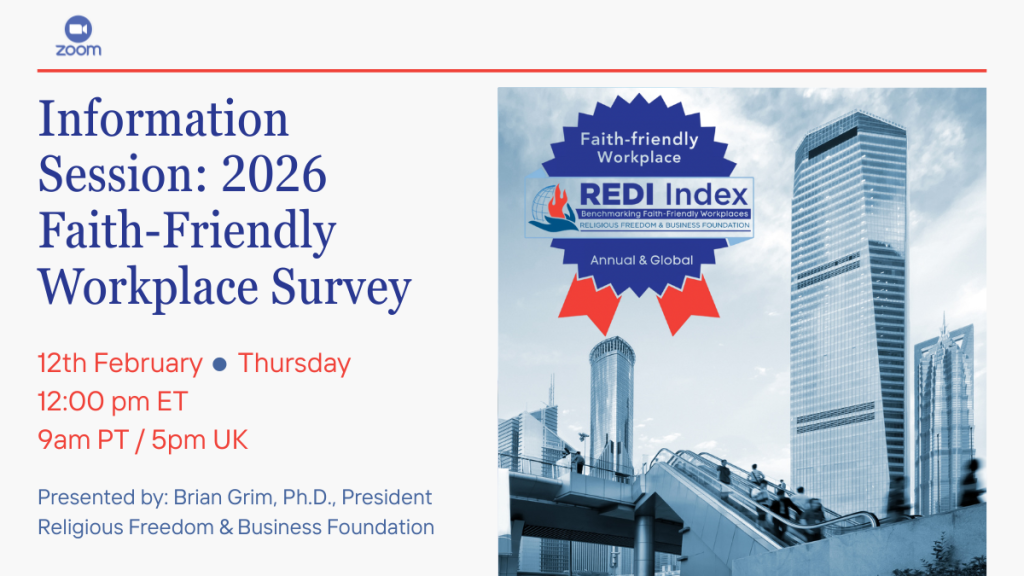
Info Session: 2026 Faith-Friendly Workplace REDI Survey

16 Jan, 2026

The Faith-Friendly Workplace ‘REDI’ Index is the premier tool for benchmarking faith-and-belief friendly workplace policies and actions. It measures an organisation’s commitment to including religion & belief as part of its overall people and belonging initiatives..

In this session, RFBF president Brian Grim will give an overview of the 2026 survey, with examples of best practices, followed by Q&A.


The 2026 survey will have the same 11 questions as in the 2025 survey, each worth 10 points, for a total of 110 points. Scoring for each point will be based on (a) answering in the affirmative with some evidence (5 points), and (b) demonstrating that the efforts are substantial (up to 5 additional points). The “b” part of each question offers the same “tick” lists as in 2024, which were based on company open-ended responses from the 2022 REDI Index survey.

Learn more here, including how to request a survey for your company and a link to download a pdf of the full questionnaire.

As in previous years, there will be a BONUS question. This year, we encourage participating companies to share their most impactful event or initiative in the past 12 months.

Why Face-to-Face Matters

16 Jan, 2026

Even More in a Digital, Global Business World

Brian J. GrimBrian J. Grim

Faith & Business Build a Better World

We live in an age when we can connect with anyone, anywhere, instantly. Yet as our tools for communication have multiplied, something essential has become easier to overlook: the power of being in the same room.

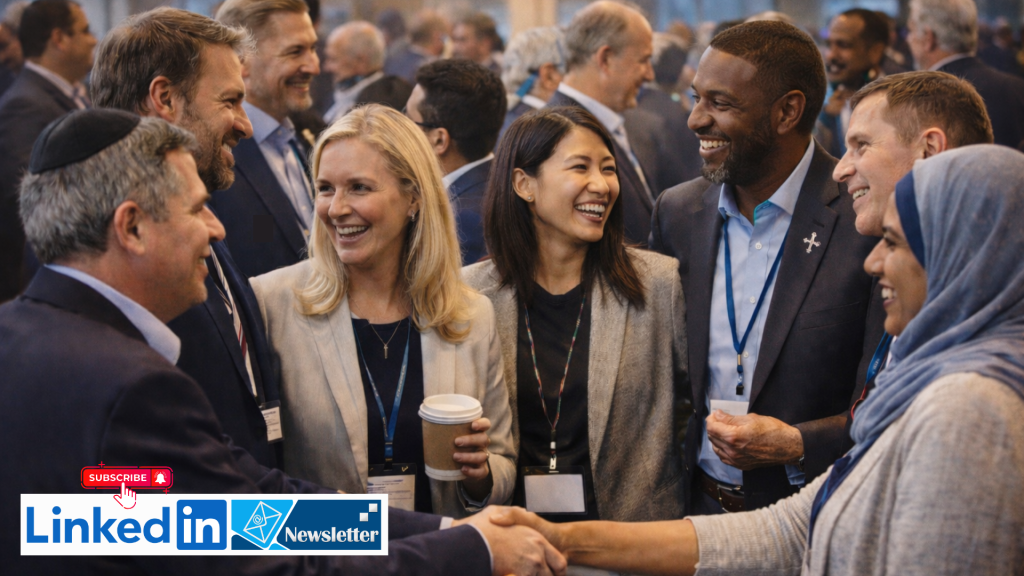
That truth comes through clearly in the voices captured in this video—and in the lived experience of those who gather at Dare to Overcome, the National Faith@Work ERG Conference.

“There are so many people on the planet who express a belief system,” one participant notes. “And if you want to do business on a global level today, you have to be able to talk to those people.”

Faith, belief, and values are not abstract concepts. They shape how people build trust, make decisions, and define integrity. And while digital platforms help us exchange information, relationships—especially across belief systems—are built most powerfully face-to-face.

At Dare to Overcome, leaders from Fortune 500 companies describe the gathering as an “epicenter”—a place where what’s actually happening inside corporations and communities comes into focus. When people meet in person, conversations go deeper. Listening improves. Learning accelerates.

“I’ve met people from all over the world … with a common interest and a real passion for this,” a participant shares.

That passion is hard to replicate on a screen. In-person, people don’t just compare policies, they share stories, challenges, and practical lessons from what actually works: spiritual care models, empowered ERGs, and values-driven leadership approaches.

In my faith tradition, there’s a phrase: iron sharpens iron. That’s what happens when people gather with shared purpose. Leaders challenge one another, learn from each other’s successes and missteps, and leave better equipped to lead authentically in complex environments.

This matters now more than ever. As companies navigate global markets and increasingly diverse workforces, understanding how faith and belief shape culture, integrity, and performance isn’t optional. It’s strategic.

Dare to Overcome 2026 is designed around that reality. Alongside the unveiling of groundbreaking global research on faith, integrity, and corporate success, the true value will be found in the conversations around it — the unscripted exchanges, the peer learning, and the relationships formed in hallways and over meals.

Digital tools will continue to connect us. But transformation still happens when people show up.


Ready to be in the room? Join Fortune 500 ERG leaders shaping the future of faith-friendly workplaces.

📍 Dare to Overcome 2026 🗓 May 20–21 | Washington, D.C.

👉 Register now

Show up. Connect. Lead.

Article content
May 20-21, 2026