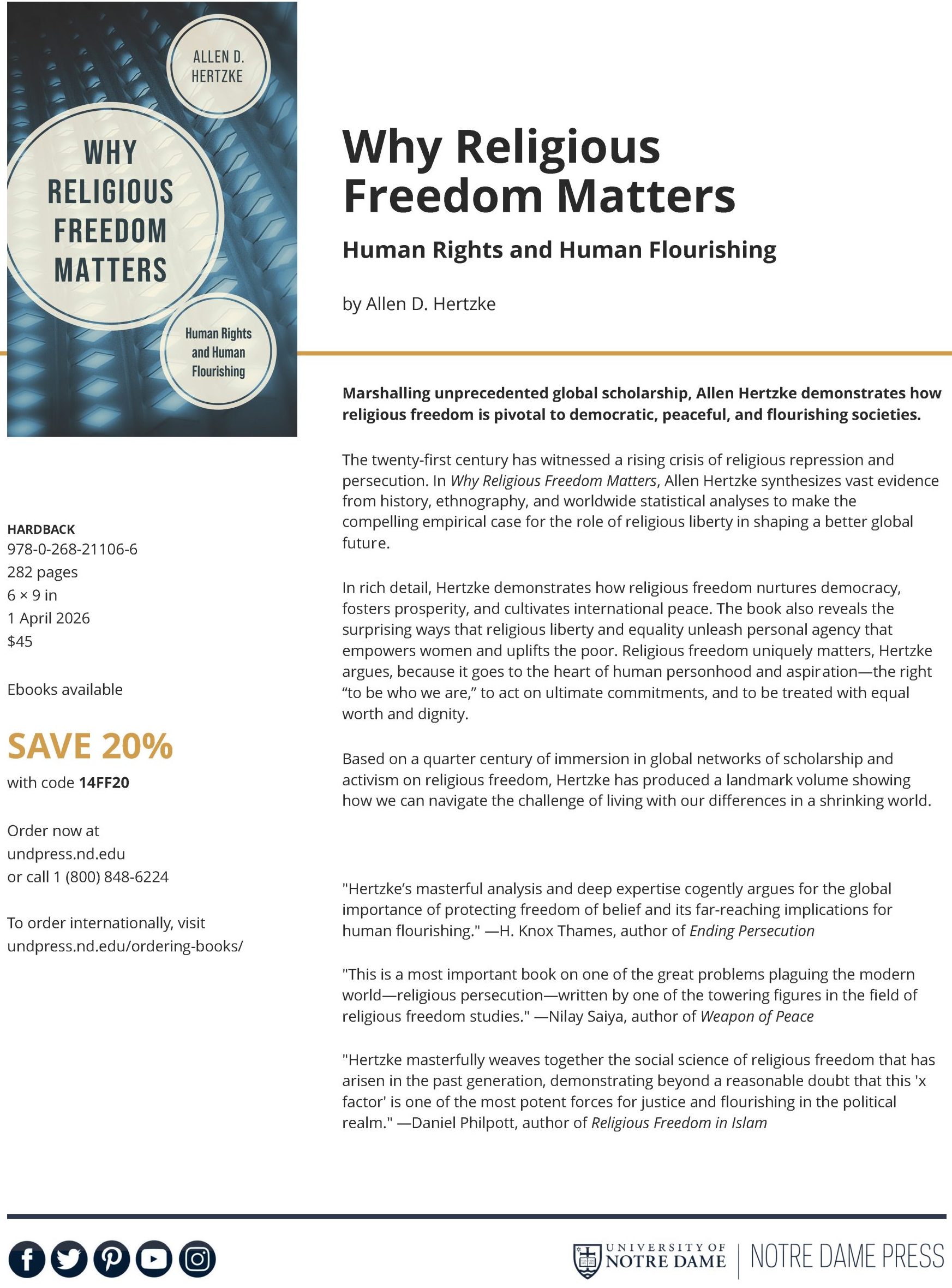
Excerpted from Chapter 1 of Allen D. Hertzke, Why Religious Freedom Matters: Human Rights and Human Flourishing, University of Notre Dame Press, April 1, 2026. Pre-order today!
Imagine a social force — a potent X Factor* — that underpins democracy, bolsters civil liberties, builds citizen loyalty, undermines religious fanaticism, reduces societal violence, improves women’s status, fosters economic development, spurs uplift for the poor, and nurtures international peace.
Remarkable as it seems, new global research powerfully links religious freedom to all these social outcomes. Not solely, of course. But compelling evidence points to religious freedom – rightly understood and generously protected – as pivotal to the kind of world we want to inhabit: an X factor for flourishing societies.
Such a claim may seem startling to some modern ears, especially given the religious fanaticism and sectarian strife afflicting the globe today. Why promote such a divisive impulse as religion? Moreover, in our fraught and polarized times religious liberty itself has gotten a bad name in some progressive circles, depicted as a rightwing cause, an excuse for bigotry and discrimination, or a weapon in the culture war. We also see distorted views about religious freedom on the right – from religious nationalists who falsely believe that imposing a dominant religious identity on diverse societies will preserve their spiritual heritage.
Equally troubling, a chorus of intellectual critics attack the very idea of religious freedom as a definable, coherent set of rights. Or they see it as a western construct imposed on indigenous societies, a cover for imperialism, or a pretext for aggressive Christian proselytizing.
For those of us engaged in scholarship and advocacy on global religious freedom, such perceptions are anguishing. They often reflect a misunderstanding of what genuine religious freedom is and why it matters profoundly for the future most of us seek.
Why is religious freedom such a potent human right? Why is it so critical to human flourishing? Why does it have such a huge impact on so many arenas of human life? My central argument is that religious freedom uniquely matters to peaceful, democratic, and flourishing societies because it goes to the heart of human personhood and experience: the right to be who we are, to act on our ultimate commitments, and to be treated with equal worth and dignity. While I will probe specific empirical theories that link religious freedom to democracy, prosperity, women’s empowerment, uplift, and peace, they all converge on this overarching theme.
Let me elaborate. Suppose I ask what is ultimate to you, what makes the greatest claim on your conscience. Then I say, “You cannot live by that commitment, you cannot publicly affirm or act on it.” You would see this as a violation of your identity and dignity, as fundamentally unjust. This freedom to exercise one’s transcendent duties – to seek truth about ultimate questions and act on them – is so central to humanity that government or social repression, along with unequal treatment that privileges religious majorities, will inevitably harm societies, governance, and economics.
If religious freedom is the right to be who we are, it is under siege in the world today, assaulted by theocratic movements, violated by authoritarian regimes, attacked by ethno-nationalists, curbed by aggressive secular policies, and undermined by elite hostility or misunderstanding. All reflect the hegemonic impulse of regime leaders and dominant social groups. For theocrats: You must become us. For ethno-nationalists: You must be expelled from us. For autocrats: You must serve us before God. For aggressive secularists: You must hide your faith under a bushel. And for regimes that privilege majority faiths: You – religious minorities – must endure second class status.
These repressive impulses represent one of the greatest threats to more stable, democratic, prosperous, and peaceful societies in the twenty-first century.
In sum, empirically driven research demonstrates that restrictive laws, repressive societal practices, and state favoritism produce persecution and conflict, undermine democracy and civil liberties, contribute to terrorism and international conflict, and prevent empowerment of women or uplift for the poor. There are, in short, compelling reasons to see religious liberty as a fundamental and universal human right. Justice demands it. Violations disrupt the social order.
* The “X factor” refers to a hard-to-define, intangible quality or exceptional talent that makes a person or thing stand out in a distinctive way. It goes beyond measurable skills, creating a strong impression and often serving as the crucial element that turns something good into something truly remarkable. It’s that extra, unquantifiable spark—whether charisma, originality, or natural ability—that sets someone or something apart from the rest.