
By Brian Grim
From Negative Narratives to Positive Entrepreneurship: A New Approach to Advancing Religious Freedom
Current global efforts to advance religious freedom often rely on a negative narrative, highlighting persecution and restrictions. While these issues are real and urgent, this approach has not reversed the trend: government restrictions on religion are at their highest level in the 14 years that Pew Research Center has tracked the issue. Even Pew discontinued the “Solutions” section of its annual report after 2013 (the last report I directed at Pew), signaling a lack of effective strategies.
Since founding the Religious Freedom & Business Foundation in 2014, I have championed a positive narrative, showing how religious freedom fosters innovation, inclusion, and economic growth. This approach has gained traction in the business world, yet not enough advocates have adopted similar strategies. To scale impact, we need a new paradigm: a Positive Entrepreneurial Approach.
It’s time to shift from seeing a world of problems to seeing a world of possibilities when it comes to religious freedom.
Advocates vs. Builders and Beyond
In his 2023 article, Advocates and builders, advancing religious freedom together, Chris Seiple distinguishes two main camps in religious freedom efforts:
Advocates work “outside-in,” raising awareness, naming and shaming regimes, and pressing governments through diplomatic pressure — often at the cost of lost access or nuanced engagement.
Builders operate “inside-out,” using quiet diplomacy to help governments improve systems and policies locally.
While both strategies can open space, a greater emphasis on showcasing the positive social, economic, and communal outcomes of religious freedom. That is where the Positive Entrepreneurial Approach that I am following breaks new ground, mobilizing communities and markets through constructive models, partnerships, and real-world benefits rather than just persuasion of governments.
The Concept
Entrepreneurship succeeds not by coercion but by creating value — building relationships, meeting needs, and empowering local leaders. I propose that we adopt entrepreneurial principles to advance religious freedom for all, not just to help those experiencing persecution, but to create flourishing societies where diverse faiths coexist and contribute.
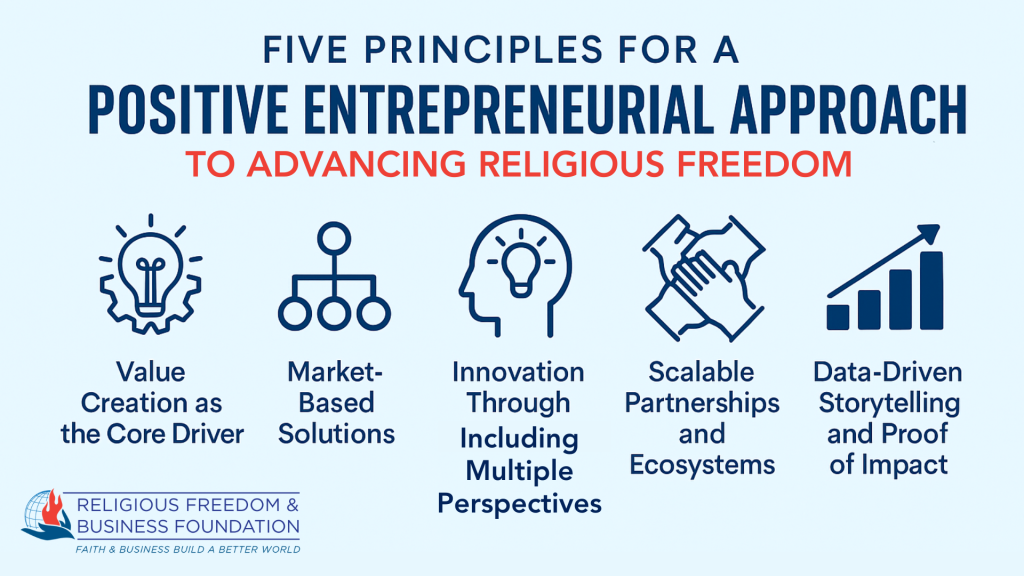
Five Principles for a Positive Entrepreneurial Approach
 Value Creation as the Core Driver
Entrepreneurs succeed by creating tangible value. Similarly, advancing religious freedom should focus on delivering measurable benefits — such as innovation, inclusion, and economic growth — rather than abstract ideals. When stakeholders see clear returns, engagement becomes natural.
 Market-Based Solutions
Entrepreneurship thrives on scalable models. We will design frameworks — like impact investment funds, multi-faith economy certifications, and inclusive business practices — that embed religious freedom into economic systems. These solutions make freedom a competitive advantage, not just a compliance checkbox.
 Innovation Through Including Multiple Perspectives
Entrepreneurs leverage multiple perspectives for creativity. Religious freedom unlocks diverse perspectives, fueling innovation in products, services, and organizational culture. By showcasing case studies where multiple perspectives drive breakthroughs, we position freedom as a catalyst for progress.
 Scalable Partnerships and Ecosystems
Successful ventures build ecosystems, not silos. We will foster cross-sector partnerships among businesses, investors, educators, and civil society to amplify impact. Toolkits, platforms, and collaborative networks will enable replication and growth across industries and regions.
 Data-Driven Storytelling and Proof of Impact
Entrepreneurs attract support through evidence. We will combine compelling narratives with hard data—demonstrating how religious freedom correlates with economic resilience, talent retention, and social stability. This approach transforms advocacy into an investment-worthy proposition.
Why This Matters
This approach shifts the conversation from “stopping persecution” to “creating flourishing societies.” It makes religious freedom attractive, practical, and scalable—just as entrepreneurship succeeds by being relational, contextual, and empowering.
Economic Transformation Through Common Growth
A key feature of this approach is transforming the economy through a new model of business that places human relationships and religious freedom at its core. Leveraging the Multi-faith Common Growth Fund impact investment model being launched on the London Stock Exchange along with a Multi-Faith Economy Mark, this initiative will align capital with values—funding enterprises that foster inclusion, dignity, and interfaith collaboration. By embedding religious freedom into economic systems, we create sustainable growth that benefits all stakeholders, proving that freedom is not just a moral imperative but a driver of shared prosperity.
By socializing and normalizing this approach, we can transform religious freedom advocacy from reactive to proactive—making it a cornerstone of human flourishing worldwide.