
5 UK Lessons in Leading Through Tension
By Brian Grim
Lessons from the UK for Faith Communities in the United States
I recently returned from the United Kingdom, where two of our partners, Cambridge University’s Woolf Institute and the Good Faith Partnership, are convening urgent national conversations and producing thoughtful research on a challenge that is no longer confined to any one country: how global tensions reshape local communities.
The Woolf Institute has launched a Commission on Interfaith Relations: UK Faith Groups and Global Conflict, while the Good Faith Partnership, in collaboration with Hope Not Hate, has released a major report titled Questions of Hope and Hate: Faith and Faultlines in a Changing Britain.
As conflicts reverberate across borders, their effects are not limited to distant battlefields. They enter neighborhoods, schools, workplaces, congregations, and civic life. In the UK, the aftermath of October 7, 2023, along with subsequent global crises, including an escalating war in Iran and the Gulf, has revealed how quickly international events can strain interfaith relationships at home. Rising hate crimes against Jewish and Muslim communities, growing mistrust within and between faith groups, and the politicization of religious identity have prompted British leaders to confront a pressing question: how can plural societies sustain cohesion under pressure?
The work underway in the UK offers insights that are not only relevant there, but deeply instructive for the United States. When combined with the Religious Freedom & Business Foundation’s embrace of Covenantal Pluralism, a framework that moves beyond mere tolerance toward active and principled engagement across deep differences, these efforts provide practical tools for navigating how global tensions impact local communities, including in the workplace where people of different faiths and beliefs must continue to work together.
Below, I’ll review these new resources and explain five key lessons learned that apply not only to the U.K., but any other country, including the U.S.
I. Global Conflict Is Now Local Reality
One of the Woolf Institute Commission’s core insights is that international conflicts (e.g., Israel-Palestine, Kashmir, Sudan, Ukraine, and others) are not “external” to the UK. They are experienced locally through diaspora communities, media ecosystems, and emotionally interconnected digital networks. The Commission explicitly asks:
How do global conflicts become translatable onto UK streets?
Why do some conflicts mobilize broad cross-community identification while others remain contained?
What mechanisms transmit global politics into local religious tension?
The Good Faith Partnership report reinforces this diagnosis. Religion in Britain is becoming more visible and more politicized, shaped by democratic fatigue, global crises, and internal transformations within faith communities. Faith, the report concludes, can be either a source of division or a force for cohesion.
For the United States, this is not hypothetical. The same dynamics are present:
American Jewish and Muslim communities have experienced spikes in hate incidents tied to global events.
Hindu and Sikh communities feel reverberations from South Asian political developments.
Debates over religion and nationalism intersect with broader global populist movements.
Social media amplifies emotional proximity to conflict, creating what one Woolf Commission speaker described as a “portal effect”: feeling both near and powerless.
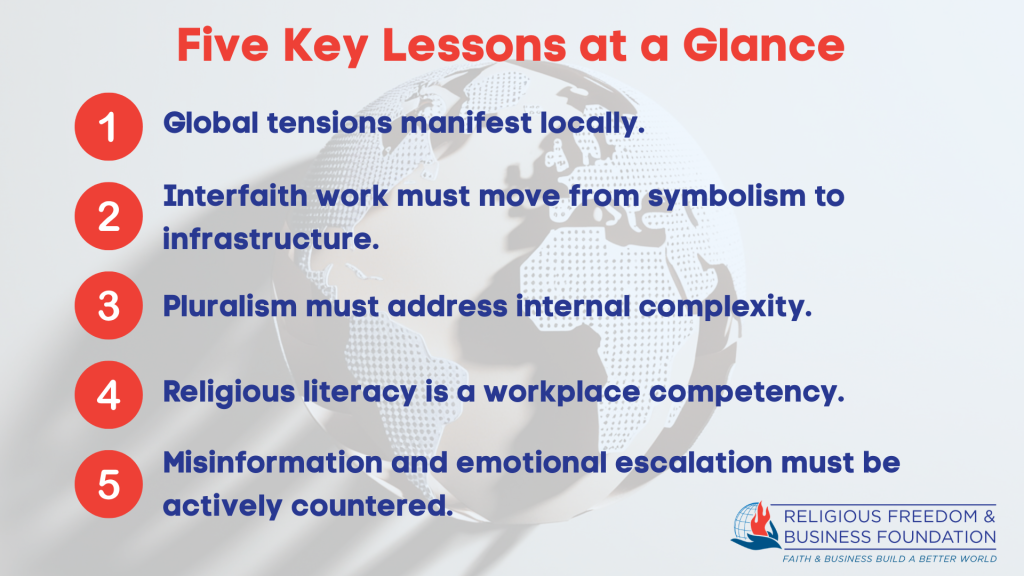
Lesson #1: Faith communities must assume that global tensions will manifest locally. The question is not whether they will, but how prepared institutions are to respond.
II. Interfaith Is Not Peripheral — It Is Frontline Civic Infrastructure
At the Woolf Commission’s Parliamentary launch, Rabbi Charley Baginsky stated that interfaith relations are no longer a specialist concern; they are “frontline issues for social cohesion, public trust and national resilience.” This framing is crucial.
The Good Faith report warns against caricaturing interfaith engagement as ceremonial or superficial. In reality, it argues, interfaith engagement is becoming an essential civic practice where contentious issues and profound ideological divides must be negotiated.
However, the report also identifies a critical weakness: While there is goodwill and strong intention, the necessary structures and infrastructure are often insufficient. Interfaith engagement often functions as crisis response or optics rather than as sustained, institutionalized practice. Relationships are stressed. Leaders fear backlash from their own communities. Some hesitate even to be photographed with leaders of other faiths.
This reveals a structural truth: relationships without institutional support are fragile under pressure.
Lesson #2: Interfaith work must move from symbolism to infrastructure. It requires:
Training
Funding
Professional skill
Sustained national and local frameworks
Religious literacy embedded in civic life
For the U.S., this applies not only to religious institutions but also to corporations, universities, hospitals, and government agencies. If faith diversity is present in the workforce, then faith literacy and relational competence are professional skills, not optional extras.
III. The Intrafaith Dimension: Fractures Within Communities
A particularly important contribution of the Woolf Commission is its refusal to treat communities as monolithic. Instead of speaking of “the Jewish community” or “the Muslim community,” the Commission examines fractures within traditions:
– How are Jewish communities navigating diverse viewpoints related to Gaza?
– How are Muslim communities navigating a range of perspectives in response to global events?
– How are Hindu and Sikh communities navigating diverse perspectives on political developments linked to South Asia?
This is a vital corrective. Global conflicts do not merely strain interfaith relations; they also strain intrafaith relations. The Good Faith report echoes this, noting that some leaders have been criticized within their own communities for engaging across religious lines. Fear of internal backlash can inhibit public solidarity.
Lesson #3: Effective pluralism must address internal complexity. Leaders need safe spaces to navigate disagreement within their own communities before they can model healthy engagement across communities.
In the U.S., this means acknowledging that:
– American Jews may disagree profoundly about Israel.
– American Muslims may differ in political and theological responses.
– Christians may be internally divided across theological and political lines..
Healthy pluralism cannot depend on artificial consensus. It must cultivate the capacity to hold disagreement without rupture.
IV. Religious Literacy as a Civic Skill
Both the Woolf Commission and the Good Faith report emphasize religious literacy, not as advocacy but as informed understanding. The Commission highlights that policymakers increasingly depend on religious literacy across sectors: education, housing, healthcare, security, integration. Poorly informed engagement can either reinforce polarization or unintentionally privilege one expression of faith.
The Good Faith report calls for improved religious literacy and renewed national narratives of belonging. Without these, faith becomes politicized in ways that deepen division. For American workplaces, this insight is especially relevant. Religious illiteracy in professional settings can lead to:
– Stereotyping
– Avoidance of difficult conversations
– HR over-correction or under-reaction
– Silencing of religious identity out of fear
Lesson #4: Religious literacy should be understood as a workplace competency. Employees and leaders should understand:
The difference between theological disagreement and discrimination.
The role of diaspora identity.
The emotional impact of global events.
The importance of protecting conscience without endorsing all beliefs as equally true.
The importance of supporting and sustaining faith-based employee resource groups (ERGs).
The importance of resources that promote spiritual health, such as multi-faith workplace chaplains.
V. From Tolerance to Covenantal Pluralism
The Religious Freedom & Business Foundation has embraced Covenantal Pluralism precisely because it provides a principled yet practical framework for workplaces navigating deep differences without demanding ideological conformity.
Here, Covenantal Pluralism offers a particularly powerful framework for American application. Covenantal pluralism moves beyond passive tolerance toward active engagement and mutual protection. It is:
Robust: It expects disagreement.
Relational: It prioritizes sustained relationships over symbolic gestures.
Non-relativistic: It does not require people to consider all beliefs equally true.
Protective: It mandates safeguarding the liberty of conscience for all.
This framework directly addresses the tensions identified in the UK context:
1. Beyond Tolerance: Tolerance alone collapses under pressure. When global conflict intensifies emotions, mere non-interference is insufficient. Covenantal pluralism requires proactive relationship-building.
In the UK, leaders emphasized “staying in the room” when conversations become uncomfortable. In U.S. workplaces, this translates to structured dialogue spaces, not silence or avoidance.
2. Equal Treatment: The Good Faith report warns against politicized religion and inconsistent engagement. Covenantal pluralism demands that no religion — or secularism — receive preferential treatment. In practice, this means:
– Clear policies protecting all faith groups equally.
– Consistent responses to antisemitism, Islamophobia, anti-Christian bias, anti-Sikh hate, etc.
– Avoiding selective outrage.
3. Shared Responsibility: Both UK initiatives stress shared civic responsibility. Interfaith engagement is not the work of minorities alone. Covenantal pluralism insists that everyone has a stake in protecting others’ freedoms.
For U.S. corporate environments, this suggests:
– Executive sponsorship of religious inclusion.
– Cross-faith employee resource groups collaborating.
– Senior leaders modeling principled engagement.
4. Virtue-Based Practice: The UK discussions repeatedly referenced trauma, fear, mistrust, and fatigue. Covenantal pluralism identifies virtues necessary to navigate this: Humility, Empathy, Patience, and Courage.
These virtues are not sentimental; they are strategic. Without them, dialogue collapses.
VI. Media, Misinformation, and Emotional Amplification
The Woolf Commission dedicates a full session to media and mis/disinformation. Digital platforms accelerate emotional contagion. Faith leaders report congregants experiencing anxiety, guilt, and despair through constant exposure to global suffering.
This dynamic exists even more intensely in the U.S.
Lesson #5: Faith communities and workplaces must actively counter misinformation and emotional escalation by:
Providing contextual education.
Encouraging media literacy.
Offering pastoral or employee wellbeing support.
Discouraging dehumanizing rhetoric.
Covenantal pluralism reinforces this by grounding engagement in relationship rather than algorithmic outrage.
VII. Practical Applications for U.S. Faith Communities
Drawing from the UK experience, American faith communities might:
– Conduct local assessments of how global conflicts are affecting congregational life.
– Build intrafaith dialogue spaces to address internal fractures.
– Invest in professional interfaith leadership training.
– Develop crisis-response protocols that prioritize relationship preservation.
– Advocate for religious literacy in civic and educational institutions.
VIII. Applications for Workplace Faith Communities
Workplaces are increasingly pluralistic microcosms of society. When global tensions rise, they surface in subtle and overt ways:
– Employee distress
– Political conflict spilling into professional spaces
– Tension within interfaith employee groups
Based on UK lessons and Covenantal Pluralism, workplaces can:
– Treat faith inclusion as part of diversity strategy.
– Provide structured dialogue during high-tension periods.
– Support chaplaincy or faith-based wellbeing resources.
– Train managers in religious literacy.
– Establish clear standards protecting conscience and prohibiting harassment.
Critically, they should cultivate environments where employees can remain in relationship despite deep disagreement, precisely the “culture of engagement” envisioned by Covenantal Pluralism.
Conclusion: From Fragility to Resilience
The UK experience demonstrates that plural societies cannot rely on goodwill alone. Good intentions fracture without infrastructure. Silence does not preserve unity. Monolithic assumptions distort reality. And global conflicts will continue to shape local relationships.
Yet these same reports also point toward hope:
– Faith communities are moral ecosystems.
– Interfaith engagement strengthens democracy.
– Religious identity can be a source of resilience rather than division.
Covenantal pluralism offers a constructive path forward for the United States. It neither denies difference nor demands uniformity. It asks citizens and institutions to make an intentional pledge: to protect one another’s liberty of conscience, to engage across disagreement, and to sustain relationships even under strain.
In an era of global tension, pluralism must become practiced, not presumed. The UK’s experience reminds us: cohesion is not automatic. It is cultivated.The real test of pluralism is not how societies function in calm moments, but how they respond when global fault lines run through local relationships. That test is now upon us.