
Five key findings
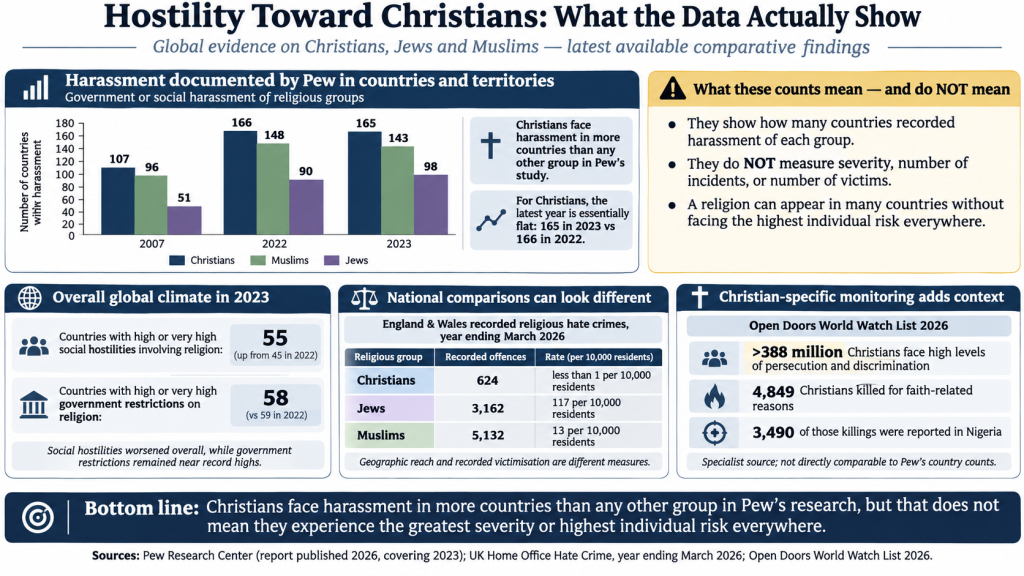
- 1. Christians face harassment in more countries than any other religious group: 165 countries and territories in Pew’s latest findings, covering 2023. Pew Research Center
- 2. The long-term geographic spread has increased, but the latest Christian count was essentially unchanged: 165 countries in 2023 compared with 166 in 2022. Pew Research Center
- 3. Geographic spread is not a ranking of suffering. These counts cannot establish which group experiences the greatest severity, most victims or highest individual risk. Pew Research Center
- 4. National comparisons reveal different patterns. Jews and Muslims face much higher population-adjusted rates of recorded religious hate crime than Christians in England and Wales. GOV.UK
- 5. Religious freedom should not become a competition between victims. Protecting Christians does not require minimizing the suffering of other communities.
What the global evidence establishes
Are Christians facing increasing hostility worldwide? The answer depends on what we measure. Documented harassment has spread geographically over the longer term. But that does not mean every measure is rising, or that conditions are deteriorating everywhere. Pew Research Center
Pew Research Center’s study, whose methodology I helped develop, separates government restrictions from social hostilities. It examines documented laws, policies and actions rather than relying on perceptions alone. Religious Restrictions Codebook README
The corrected historical dataset shows harassment of Christians in 107 countries in the baseline year, labelled 2007. By 2022, that number had reached 166. Muslims experienced harassment in 96 countries initially and 148 in 2022; the corresponding Jewish figures were 51 and 90. These historical comparisons use Pew’s corrected public dataset, which takes precedence over earlier publications. Pew Research Center Religious Restrictions Dataset …
Pew’s newer report, published in June 2026, covers 2023. It records Christian harassment in 165 countries, Muslim harassment in 143, and Jewish harassment in 98. The latest Christian count was effectively flat, while the Jewish count reached its highest point in the series. Pew Research Center
Publication dates also require care: the newest Pew analysis describes events several years earlier. More recent national and specialist reports help fill that gap, but their different definitions and coverage prevent simply joining their findings into one continuous worldwide trend. Pew Research Center
Across religions, countries with high or very high social hostilities increased from 45 to 55 between 2022 and 2023, although that remained below the 2012 peak of 65. Government restrictions remained near record levels. These are country-wide measures, not Christian-specific severity scores. Pew Research Center
What “most persecuted” obscures
The statement that Christians experience harassment in the largest number of countries is supported. Calling them the “most persecuted” without defining the measure goes beyond that finding. Pew Research Center
Pew’s group-specific indicators record whether qualifying harassment occurred, not how many people suffered or how severely. A country with one documented incident and a country with widespread repression can both enter the same group’s country count. Harassment encompasses nonphysical intimidation as well as serious abuse. Religious Restrictions Codebook
Population size and geographic distribution also matter. A widely dispersed religion has more opportunities to appear in country counts. A small community can face devastating persecution concentrated in relatively few places. Neither observation makes its suffering less significant.
Nor can we calculate individual risk by dividing countries with harassment by the worldwide population of a religion. Countries are not victims. A meaningful risk comparison needs compatible measures of people affected and populations exposed.
What Christian-specific monitoring adds
Open Doors’ World Watch List 2026 estimates that more than 388 million Christians face high levels of persecution and discrimination. Its reporting period runs from October 2024 through September 2025. Open Doors
This is a population estimate informed by assessments of pressure and violence, not a register of 388 million individually verified victims. It provides evidence about Christians but does not independently establish their position relative to other religions. Open Doors
Its latest indicators also move in different directions. Open Doors reports 4,849 Christians killed for faith-related reasons, compared with 4,476 in the previous edition. Meanwhile, recorded cases involving churches and public Christian properties fell from 7,679 to 3,632. Open Doors
Nigeria accounts for 3,490 of the latest reported deaths, making the interpretation of Nigerian violence particularly consequential. Open Doors US
Separate research by the Observatory for Religious Freedom in Africa recorded 22,835 Christian and 10,519 Muslim civilian fatalities between October 2019 and September 2025, with another 8,495 victims’ religious identities unknown. These are the organisation’s recorded totals, not proof of the motive behind every killing. Orfa
A Christian killed in conflict, a Christian community deliberately targeted, and someone killed specifically for practising Christianity are overlapping but different categories. Recognising that distinction neither excuses violence nor denies religious targeting.
Comparisons look different locally
National statistics offer comparisons within a shared reporting framework.
In England and Wales, police recorded 624 religious hate crimes targeting Christians in the year ending March 2026, up 24%. They recorded 3,162 targeting Jews and 5,132 targeting Muslims. GOV.UK
Relative to population, the published rates were 117 offences per 10,000 Jewish residents, 13 per 10,000 Muslim residents and fewer than one per 10,000 Christian residents. These are offence rates, not the percentage of individuals victimised. Underreporting and changes in police recording also limit interpretation. GOV.UK
In the United States, ADL’s analysis of FBI data identified 1,528 anti-Jewish incidents in 2025, approximately 63% of recorded single-bias religious hate-crime incidents. That represented a decline from 2024, yet remained the third-highest annual anti-Jewish count recorded. ADL
Neither national pattern determines the worldwide ranking. Both demonstrate why geographic reach, individual exposure and recorded incidents must remain distinct.
Protect people, not rankings
The evidence warrants concern about hostility towards Christians without requiring exaggerated claims. It also warrants concern about antisemitism, anti-Muslim hostility and threats to smaller religious communities. Pew Research Center
Good reporting should identify the source, observation period and unit being counted. Countries, crimes, complaints, deaths and populations living under restrictive conditions are not interchangeable. Reports drawing on overlapping evidence should not be treated as wholly independent confirmations.
We should neither minimise persecution because a statistic has limitations nor abandon scrutiny because the suffering is real.
The case for protecting Christians does not depend on proving that someone else suffers less. Religious freedom is a commitment to protecting people’s freedom of conscience, whether their beliefs are ours or not.