Working for workplace religious belonging, inclusion & freedom

E-NEWS ACTION DONATE

Monthly Archives: October 2026

MSD Recognised as Global Leader in Faith-Friendly Workplaces in Biopharmaceutical Industry

28 Oct, 2026

Religious Freedom & Business Foundation honours MSD with its 2026 Faith-Friendly Workplace REDI Award for advancing dignity, belonging and respect for faith and belief in the workplace.

FOR IMMEDIATE RELEASE

LONDON, 28 October 2026 — The Religious Freedom & Business Foundation (RFBF) has recognised MSD as the leading global faith-friendly workplace among biopharmaceutical organisations in its 2026 Faith-Friendly Workplace REDI Index Awards.

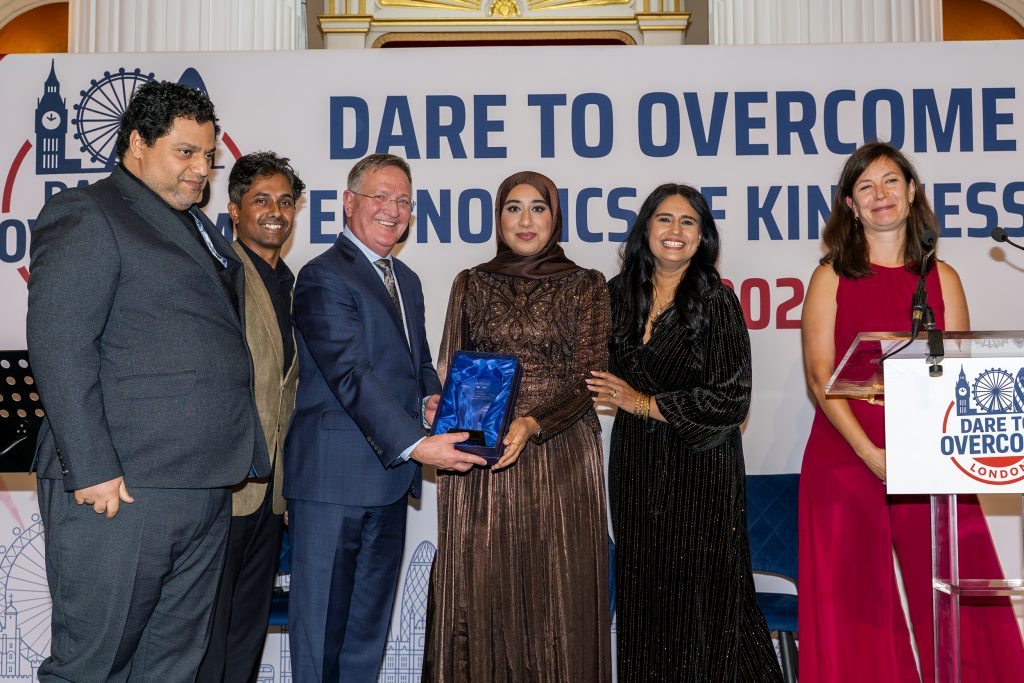
The recognition, celebrated at the Dare to Overcome Global Awards Gala at Mansion House in London on 13 October, highlights MSD’s commitment to creating a workplace where employees of different religious and non-religious beliefs are respected, welcomed and able to contribute fully.

In an industry dedicated to improving human health and wellbeing, MSD demonstrates that respecting the whole person, including deeply held faiths and beliefs, is an important dimension of workplace culture.

MSD’s Commitment to Faith and Belief Inclusion

A significant example of MSD’s approach is its Interfaith Organisation, one of the company’s ten Employee Business Resource Groups (EBRGs). MSD describes the Interfaith Organisation as a welcoming, respectful and nurturing community for employees from all spiritual paths and backgrounds.

The Interfaith Organisation provides opportunities for employees to learn about different faith traditions and philosophies, build understanding across differences and strengthen a culture of respect and belonging.

MSD’s broader commitment to employee inclusion is substantial. According to its 2025/2026 Purpose for Progress Impact Report, more than 28,000 employees, representing over 35% of its global workforce, participated in at least one of its ten employee business resource groups at the end of 2025.

“MSD demonstrates that scientific excellence and respect for the human person go hand in hand,” said Dr Brian Grim, President of the Religious Freedom & Business Foundation. “In a sector devoted to improving lives, MSD is also showing what it means to value the whole person at work. Its leadership in faith and belief inclusion provides an inspiring example for the global biopharmaceutical industry.”

Why Faith-Friendly Workplaces Matter

The recognition comes as RFBF’s 2026 REDI Monitor: Emerging Trends in Faith and Corporate Culture identifies an important shift in corporate approaches to faith inclusion.

The longitudinal study of Fortune 500 and FTSE 100 companies found that public-facing references to religion and belief declined in 2026, even as workplace structures supporting faith inclusion, particularly faith-oriented employee resource groups, proved more resilient.

The findings underscore the importance of moving beyond public statements to meaningful workplace practices that foster trust, dignity, belonging and engagement.

MSD’s recognition demonstrates how faith and belief inclusion can form part of an organisation’s broader commitment to its people and purpose.

About the Faith-Friendly Workplace REDI Index

The Faith-Friendly Workplace REDI Index is an international benchmarking initiative of the Religious Freedom & Business Foundation. It recognises organisations that demonstrate meaningful efforts to include religion and belief, including non-religious worldviews, within their workplace cultures.

The Index assesses evidence of workplace practices, employee networks, policies and leadership commitment that help people of different faiths and beliefs contribute fully.

MSD, known as Merck & Co., Inc., Rahway, New Jersey, USA in the United States and Canada, was also recognised in the biopharmaceutical sector during the 2026 U.S. REDI Index Awards in Washington, DC, on 20 May.

Learn more: Faith-Friendly Workplace REDI Index

About the Religious Freedom & Business Foundation

The Religious Freedom & Business Foundation (RFBF) is a non-partisan, non-profit organisation dedicated to demonstrating the positive impact of religious freedom and faith and belief inclusion on business, workplaces and economies worldwide. Through research, benchmarking, awards and global engagement, RFBF promotes workplaces where people of all faiths and beliefs, including those with no religious affiliation, are treated with dignity and respect.

Media enquiries: contact@religiousfreedomandbusiness.org
Website: https://religiousfreedomandbusiness.org

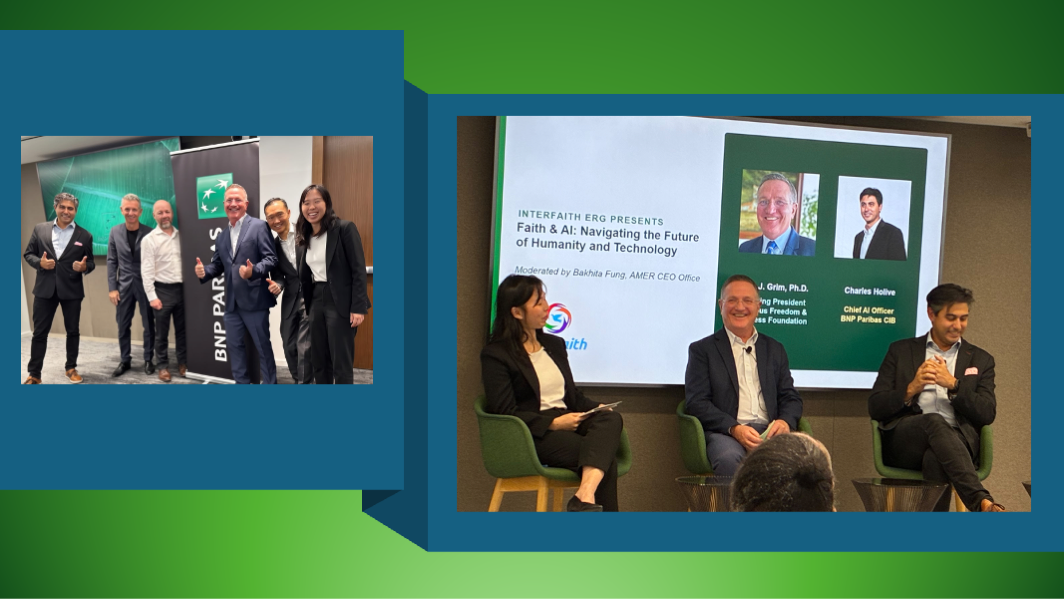
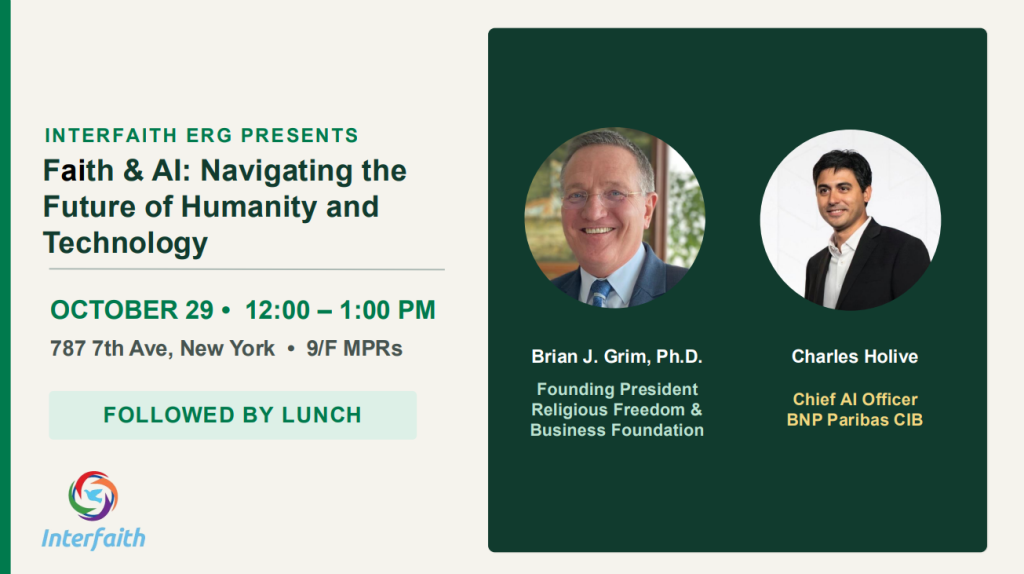
Faith & AI: Navigating the Future of Humanity and Technology

22 Oct, 2026

As Artificial Intelligence continues to rapidly reshape our professional landscapes and personal lives, it brings with it profound questions regarding ethics, human agency, and our shared values.

The BNP Paribas Interfaith ERG will host its 2026 flagship event: “Faith & AI: Navigating the Future of Humanity and Technology.”

Event Details:

  • – Date: Thursday October 29, 2026
  • – Time: 12:00PM – 1:00 PM (Followed by a lunch reception)
  • – Location: 787 7th Avenue, 9th floor
  • – Format: Panel Discussion & Networking Lunch

 Distinguished Speakers:

  • – Brian Grim: Founding President of the Religious Freedom & Business Foundation (RFBF) and a leading expert on the intersection of faith, automation, and religious freedom.
  • – Charles Holive: Chief AI Officer, BNP Paribas CIB, a recognized leader in AI transformation specialized in “agentic AI” and has previously led global AI strategies for major enterprises including PepsiCo and JPMorgan Chase

Discussion Highlights:

This special session aims to move beyond the conversation of mere efficiency, exploring how we can foster a human-centric approach to AI. Our panelists will engage in a deep dive into how AI affects our understanding of work, morality, and what it truly means to be human. We will explore the balance between innovation and human dignity and the theological responses to emerging technologies

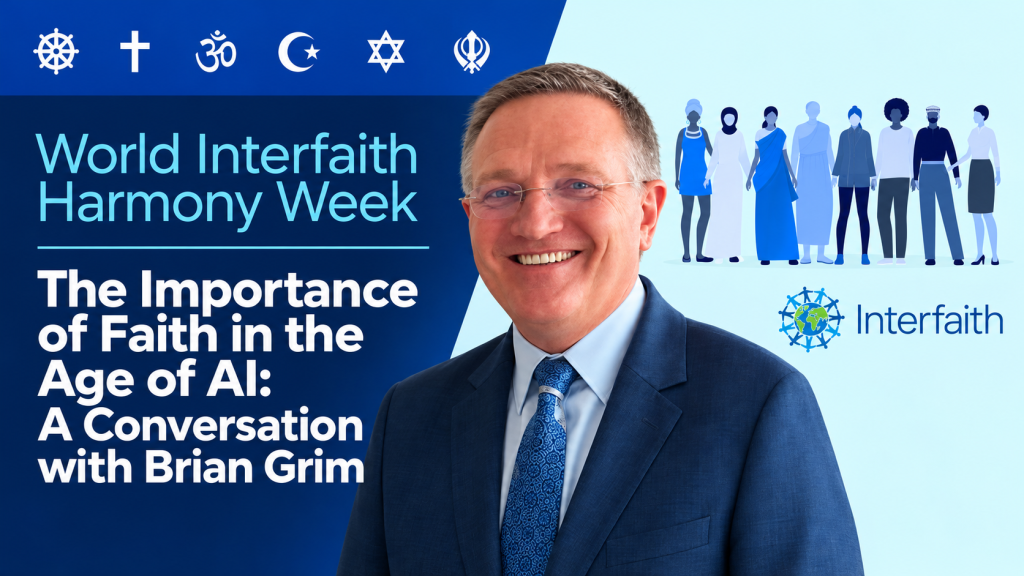
DELL Interfaith: The Importance of Faith in the Age of AI

21 Oct, 2026

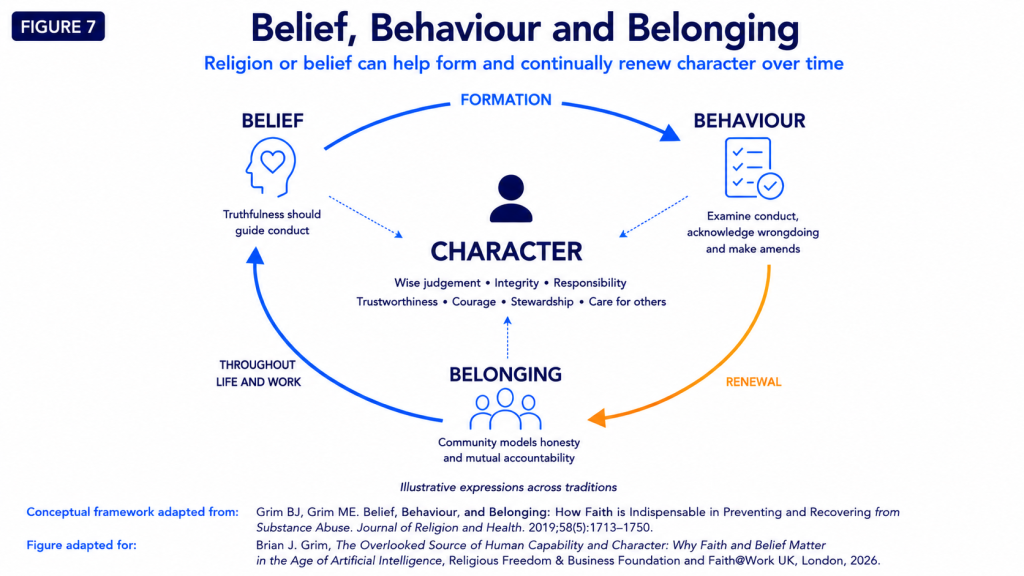
During Dell’s Interfaith event for World Interfaith Harmony Week, hosted with the support of Ihab El Ghazzawi, Dr Brian Grim, President of the Religious Freedom & Business Foundation (RFBF), shared how faith and belief help develop the very qualities organisations increasingly need: wise judgement, integrity, responsibility, trustworthiness, courage and care for others.

Faith provides a self-reinforcing cycle of character development through belief, repeated practices and communities that encourage accountability and service. These qualities shape behaviour, organisational culture, trust and long-term performance. As AI expands what organisations can do, human character becomes increasingly important in determining what they should do, making faith an overlooked organisational asset.

2026 Global Faith-Friendly Workplace ‘REDI’ Awards

13 Oct, 2026

Our newly released White Paper, Why Faith and Belief Matter in the Age of Artificial Intelligence, makes a simple but powerful point: organisations cannot improve what they cannot see. Benchmarking makes practice visible. It helps leaders identify strengths and gaps, and it creates a basis for learning and continuous improvement.

That is exactly what the Faith Friendly Workplace REDI Index is designed to do. It recognises organisations creating meaningful, practical conditions for people of different faiths and beliefs to contribute fully at work.

Today, we are proud to celebrate two outstanding global leaders.

Salesforce is recognised as the leading global faith-friendly workplace among AI and CRM organisations on the 2026 REDI Index. In a sector shaping the future of work, Salesforce is showing that innovation, human dignity, and respect for faith and belief can advance together.

MSD is recognised as the leading global faith-friendly workplace among biopharmaceutical organisations. In a field dedicated to human health and wellbeing, MSD is demonstrating a powerful commitment to dignity, inclusion, and the whole person.

Please join us in congratulating Salesforce and MSD. Their leadership sets an inspiring global benchmark for workplaces where faith and belief are respected, welcomed, and able to contribute with confidence.

The Overlooked Source of Human Capability and Character

8 Oct, 2026

Why Faith and Belief Matter in the Age of Artificial Intelligence

A Board Paper on Human Character, Corporate Governance and Long-Term Value

Executive Summary

As artificial intelligence increases organisational power, it is changing the balance between competence and character. AI can perform or augment tasks once carried out by people, but it cannot assume responsibility, determine purpose or exercise judgement on an organisation’s behalf. As AI expands what organisations can do, the character of those deciding what they should do becomes more consequential.

Religion or belief belongs on the Board agenda because, for many people, it is an important and frequently overlooked source of character. Organisations depend on wise judgement, integrity, responsibility, trustworthiness, courage, stewardship and care for others. They do not create these qualities from scratch. They are formed and renewed through families, communities, education, experience, service and traditions of religion or belief.

In this paper, “religion or belief” means religious and non-religious worldviews that shape meaning, purpose, identity and responsibility. Around half the UK population identifies with a religion; major global estimates put affiliation at between three-quarters and nearly nine in ten people worldwide. For many, the influence is lived through belief, behaviour and belonging: frameworks of meaning, repeated practices, and communities that offer example, support and accountability. It is not merely a demographic label or an accommodation issue.

Character is expressed in behaviour, and repeated behaviour becomes culture. Strong cultures support trust, collaboration, adaptability and long-term performance; poor cultures put reputation, trust and enterprise value at risk. Leading companies already declare priorities — especially innovation, integrity and people focus — that depend on character to become real. Character becomes organisational capability when it is translated through leadership, culture, management practice, learning, policies, systems and accountability. The case studies show that this is already happening through multiple pathways.

FTSE 100 practice is established but uneven: 42 companies show emerging, developing or leading practice; 58 show minimal or no visible evidence. The REDI Monitor and REDI Index give Boards ways to benchmark visible practice, assess conditions and set priorities.

Concerns about division, proselytising, competing rights, accommodation, fairness and privacy require capable governance, not avoidance: neutrality, voluntary participation, clear boundaries and protection from coercion. Boards govern conduct, culture and organisational conditions, not employees’ beliefs. No tradition guarantees good conduct. Boards should neither endorse nor assess what people believe.

Immediate Board actions

  • — Recognise the competencies and qualities of character most material to strategy, culture, risk and responsible technology, and whether religion or belief is an overlooked source.
  • — Enable employees who wish to do so to bring religion or belief into working life appropriately and voluntarily, including employee experience and managers’ confidence.
  • — Value the potential contribution of perspectives shaped by religion or belief in leadership, culture, decision-making and the responsible use of technology.
  • — Review the baseline; how conduct, accommodation, competing rights and privacy are governed; priorities; executive ownership; and Board oversight.

The aim is not to make the workplace religious. It is to recognise an overlooked source of character and govern the conditions in which it can contribute to culture, wise judgement and trusted performance. The first step is not a new programme. It is to ask the question.

Read full paper.