By Brian Grim
 On Easter Sunday, President Trump posted the following on his Truth Social platform. I reproduce this because many may not have seen this, or only excerpts from it. [Warning: quote below contains shocking and vulgar language]:
Shortly before he made this post — as I share in this newsletter — various Christian clergy likened Trump to Jesus at a White House Easter celebration, attended also by Catholic Bishop Robert Barron.
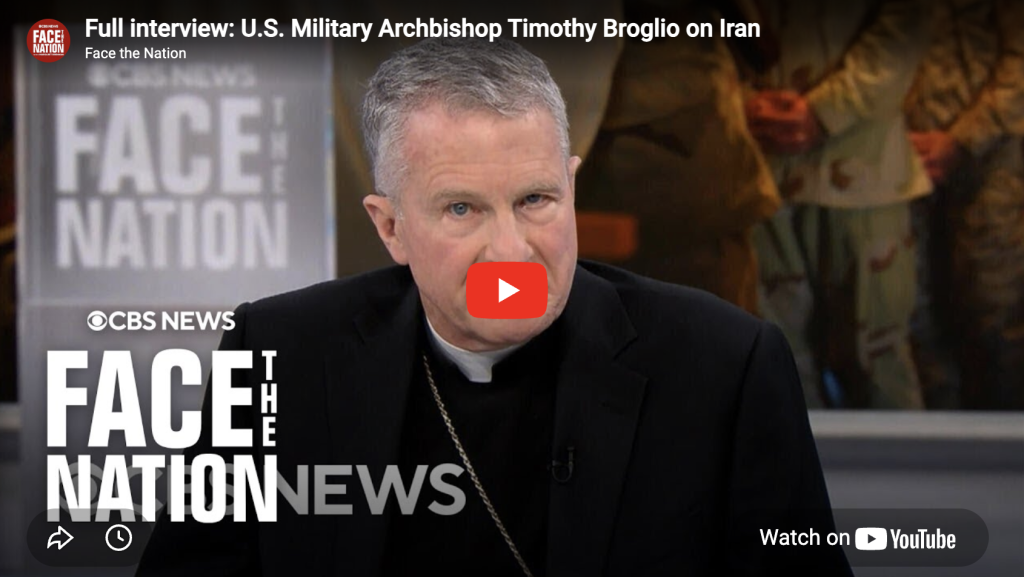
Since 2008, my wife and I been a members of the Catholic Community at the US Naval Academy in Annapolis, where Archbishop Timothy Broglio, Archbishop of the Military Services USA, is a frequent celebrant.
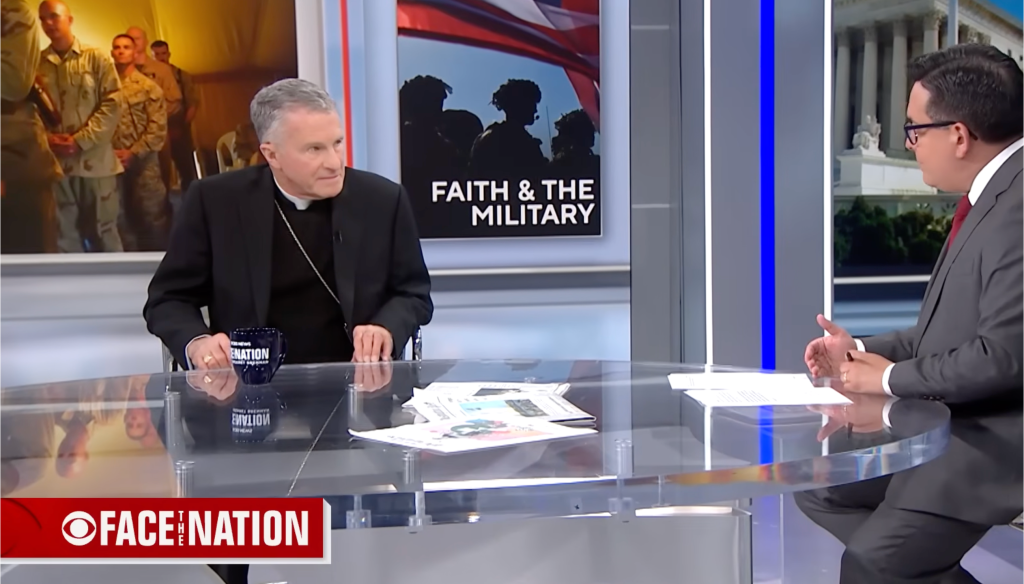
With religious rhetoric being weaponized, I was heartened by my bishop’s comments aired on Easter Sunday (recorded on April 2, 2026), which I highlight in this week’s newsletter (also available on LinkedIn).
Preemption and the Moral Limits of Just War
In a CBS Face the Nation interview, Archbishop Timothy Broglio offered a rare public challenge to the moral logic of the current war with Iran. Under Catholic teaching, he suggested, the conflict likely fails the standard of a just war.
“I would think under the just war theory, it is not,” he said. While Iran “was a threat with nuclear arms,” the United States, he argued, is “compensating for a threat before the threat is actually realized.”
That distinction is central. Just war reasoning requires necessity and last resort. A preemptive logic shifts those criteria. It moves from responding to harm toward anticipating it.
Broglio did not dismiss the difficulty facing policymakers. Leaders, he said, “may have information that led them to think that that was the only choice they had.” But he returned to first principles. “War is always a last resort.” The message of Jesus is one of peace.
He also aligned himself with Pope Leo XIV’s call for negotiation. “I would line myself up with Pope Leo, who has been urging for negotiation,” he said. He acknowledged the practical difficulty of identifying a negotiating partner.
At the same time, he pointed to the human cost. “Lives are being lost, both there and also among our troops. So it is a concern.”
His comments were not only theoretical. They were pastoral. Service members, he noted, are generally required to obey lawful orders, even amid moral ambiguity. Within that constraint, his guidance is practical. “Do as little harm as you can, and… preserve innocent lives.”
But Broglio’s concern does not end with the ethics of war itself.
Asked about leaders invoking Jesus in support of the conflict, he struck a more pointed note. Such framing, he said, is “a little bit problematic.” It is “hard to… cast this war… as something that would be sponsored by the Lord.”
Taken together, his argument does not resolve the strategic debate. But it clarifies the moral stakes. If preemptive force becomes easier to justify, the framework meant to restrain war begins to shift with it.
Religion as Rhetoric
Broglio’s caution comes at a moment when the role of religion in public life is under strain.
Recent reporting points to a broader pattern. Religious language is increasingly used less as a source of moral constraint and more as political symbolism. Rather than disciplining power, it can reinforce it.
That shift is visible in rhetoric surrounding the Iran conflict. Christian language has been invoked to frame military action in moral or even providential terms. In that context, Broglio’s warning reads as a corrective.
The concern extends beyond war.
At a recent White House Easter gathering, televangelist Paula White addressed President Trump in language that drew immediate criticism. Drawing on the narrative of Jesus’ suffering and resurrection, she told the president, “No one has paid the price like you have paid the price… You were betrayed and falsely accused. It’s a familiar pattern that our Lord and Savior showed us.”
She then linked Trump’s political success directly to Christ’s victory. “Because he rose… you rose up. Because he was victorious, you were victorious.”
Inside the room, the tone was celebratory. Outside it, the reaction was swift. Religious leaders warned that such comparisons risk trivializing core Christian claims. Political observers pointed to the fusion of religious symbolism with personal and political loyalty.
Critics see in this a deeper inversion. Religion no longer serves as a standard against which power is judged. It becomes a language through which power is affirmed.
The pattern is not isolated. Across the political landscape, religious imagery, prayer, and theological language are increasingly used in ways that prioritize mobilization over moral clarity. The effect is cumulative. Religion risks becoming symbol rather than substance. It is invoked to sanctify decisions rather than to question them.
This is the backdrop to Broglio’s intervention. His appeal to just war principles is not only about when force is justified. It is also about what role religious reasoning should play in public life.
If religious language becomes a way to authorize political action, especially violence, rather than to limit it, something fundamental shifts. The tradition is not simply applied differently. It is repurposed.
And that raises a more basic question. When faith enters the public square, does it still function as a check on power, or has it become one of its instruments?
Why it matters
Broglio’s intervention highlights a deeper tension at the intersection of faith and public life.
The question is not whether religion belongs in political discourse. It already does. The question is what it does there.
Does it serve as a source of moral accountability? Or does it become a form of moral cover?
In that sense, the debate over preemption is also a debate over meaning. Not only what counts as a just war, but what counts as a serious use of religion in the first place.