How RFBF’s Faith-Friendly Workplace ‘REDI’ Index Contributes to the Development of a Multi-Faith Economy Mark
The global economic order is undergoing what some leaders have called a profound “rupture”: a breakdown not only of geopolitical stability, but of the moral assumptions that have underpinned markets for decades. In this context, the central question is no longer simply whether capital can generate returns, but whether it can generate resilience, stability and shared flourishing. Against this backdrop, our proposed Multi-Faith Economy Mark (MFEM) is emerging as a timely and ambitious response — positioning faith-friendly investing as a practical pathway for global renewal.
The London Stock Exchange Group (LSEG) has already demonstrated global leadership in values-based finance through the Green Economy Mark (GEM). GEM provides a clear market signal: a company or fund derives a substantial proportion of its revenue from environmentally sustainable activity. Building on that precedent, the Multi-Faith Economy Mark is being developed as a complementary classification concept, extending the logic of market-based signalling from environmental alignment to faith-friendly economic practice.
The MFEM is currently under structured development, with the explicit aim of presenting and refining its taxonomy, governance model and eligibility criteria in London this October during the Shape the World Summit at Dare to Overcome: The Economics of Kindness. The October gathering is intended not merely as an announcement, but as a convening point for financial leaders, faith-based investors and institutional stakeholders to review, strengthen and help finalise the framework. It is therefore both a milestone and an invitation to collaboration.
Faith traditions collectively represent significant long-term economic stewardship. Islamic finance alone operates at multi-trillion-pound scale. Religious institutions globally remain major asset holders and landowners. Yet these capital pools have not been systematically linked to public market classifications through a shared structure. The Multi-Faith Economy Mark seeks to provide that connective architecture.
As currently envisioned, the framework would include defined eligibility thresholds. Companies or funds may be required to demonstrate that a substantial proportion of their revenue or assets align with a Multi-Faith Taxonomy covering socially constructive sectors. Integrity tools under consideration include transparent reporting, periodic review and the possibility of revocation if criteria are no longer met. These elements are being developed to ensure definitional clarity and methodological consistency before broader implementation.
Governance is central to the October agenda. Any future implementation within the London Stock Exchange market ecosystem would require clear role delineation. LSEG would host or facilitate the classification within its market infrastructure, while an independent multi-faith advisory council would oversee criteria integrity and ongoing review. The Religious Freedom & Business Foundation (RFBF) is working with the global design firm Consulus and the FoRB Foundation to stand up this advisory group. The October summit will serve as the formal moment to introduce and consolidate this coalition, bringing together expertise in faith practice, finance, governance and public policy.
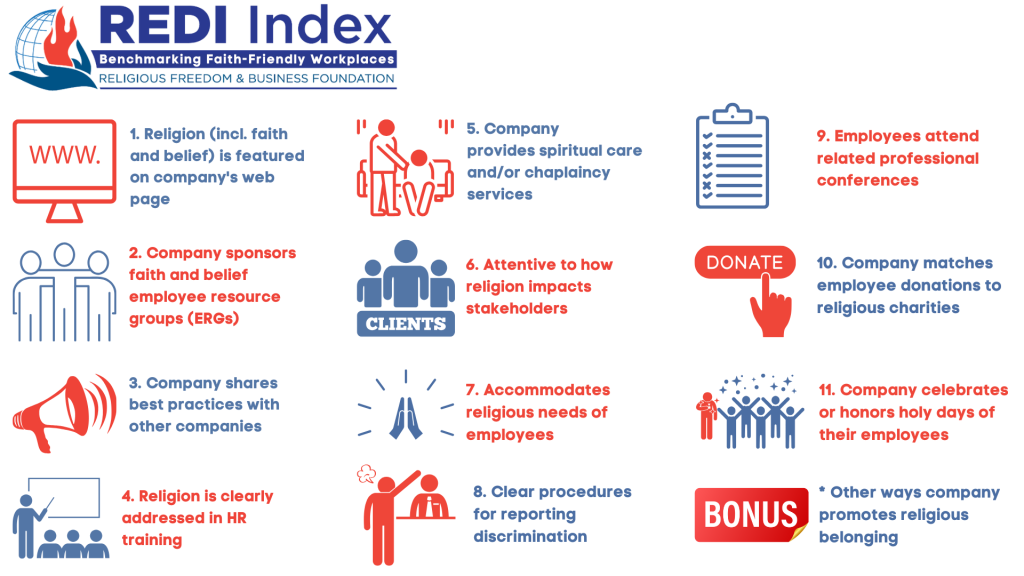
At the centre of this developing model lies RFBF’s Faith-Friendly Workplace ‘REDI’ Index. REDI functions as an operational benchmark through which companies can demonstrate measurable faith-friendliness within workplace practice. It evaluates how organisations integrate religion and belief into people policies, leadership capability and corporate culture.
Within a future Multi-Faith Economy Mark taxonomy, REDI would operate not as a standalone ethical badge, but as a measurable proof-point embedded within a broader multi-faith economic classification. REDI provides documented evidence of internal organisational conduct. The MFEM would assess broader economic alignment, including revenue composition, sectoral contribution and structural impact. Together, they create a bridge between workplace practice and capital market visibility.
REDI-aligned companies demonstrate observable practices: acknowledgement of religion and belief in corporate policies, support for faith-based employee groups, appropriate accommodations such as prayer spaces and flexible scheduling, managerial literacy regarding religious expression, and clear processes for preventing discrimination. These practices are measurable and reviewable, making them suitable components within a structured classification model.
Beyond workplace practice, the Multi-Faith Economy Mark is being shaped in dialogue with the principles of the Economy of Communion. The EoC 7 Impact Measures provide a framework for assessing how businesses embed reciprocity, ethical supply chains, participatory governance, innovation for the common good and community-building into their core operations. These measures deepen the taxonomy by linking organisational design with broader socio-economic impact.
The financial implications are material. Institutional faith-based investors, including pensions, foundations and endowments, often require clarity regarding alignment with religious principles. A structured multi-faith classification could reduce ambiguity and support disciplined capital allocation. In a period of heightened governance sensitivity and reputational risk, the development of transparent faith-friendly standards carries practical significance.
October’s summit in London therefore represents more than a thematic conference. It is intended as a working platform to advance the technical architecture of the Multi-Faith Economy Mark, and to move the Mark forward.
Being developed with care and institutional discipline, the Multi-Faith Economy Mark can help catalyse a market environment in which faith-aligned economic conduct becomes visible within capital markets. At a time of systemic uncertainty, the structured integration of faith-friendly standards into market frameworks represents a measured and collaborative step toward aligning long-term capital with long-term human flourishing.