
By Brian Grim, Ph.D.
Taken together, global evidence from empirical research shows that supporting religious identity and spiritual expression in the workplace is not an isolated or tradition-specific practice, but a culturally portable driver of human flourishing, organizational trust, and ethical responsibility. Across diverse industries, belief systems, and regions, research increasingly links faith-friendly environments to stronger employee well-being, motivation, engagement, civility, and values-aligned leadership.
With inclusive guardrails and emerging tools to measure and benchmark progress, organizations can scale faith inclusion responsibly while strengthening performance, integrity, and long-term resilience.
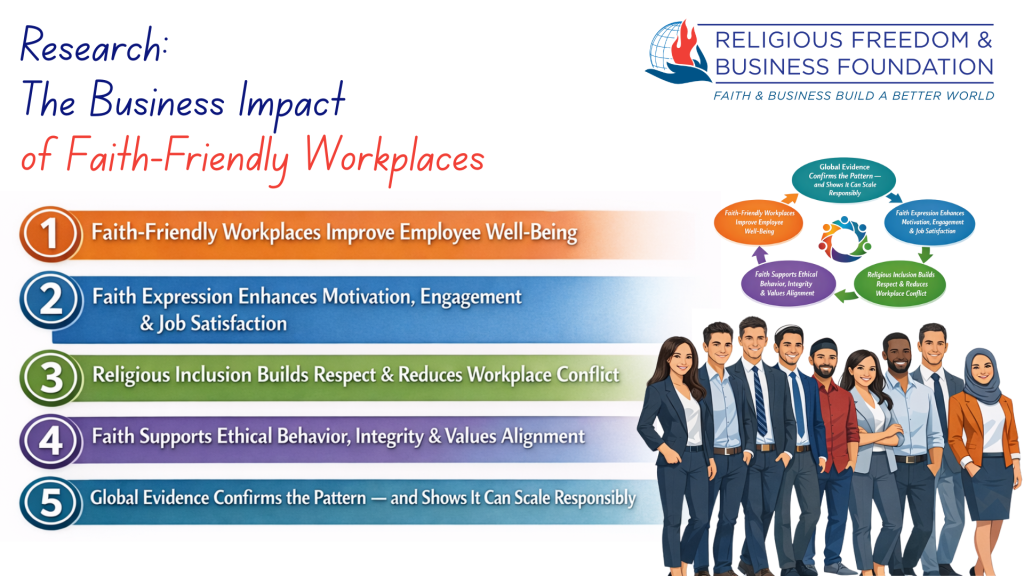
The following five research-backed findings summarize why allowing employees to bring their faith and beliefs to work matters for both people and business (references). These five for a self-reinforcing cycle that multiplies the business impact of faith-friendly workplaces: people thrive → perform → collaborate → act ethically → outcomes scale globally.
1) Faith-Friendly Workplaces Improve Employee Well-Being
Research increasingly shows that when workplaces support employees’ religious and spiritual identities—beyond mere accommodation—workers experience higher well-being, lower burnout, and greater psychological resilience.
Evidence
Harold G. Koenig — one of the most published and cited researchers in religion and health — has documented across hundreds of studies that religion and spirituality are robust predictors of better psychological outcomes, including meaning, coping, and reduced distress, in both clinical and general populations.
A systematic literature review of 38 global studies found that religiously supportive workplaces significantly improve employee well-being, motivation, and psychological health. The review stresses the importance of inclusive spirituality policies to maintain harmony. (Journal of Religion and Health, 2020–2024)
An analysis of Gallup World Poll data (2012–2022), also summarized in Why Faith Is Good for the Workplace, shows that people who consider religion essential report higher positive emotions, social satisfaction, and community engagement—all key markers of workplace well-being.
A 2025 article in Sociology of Religion finds that workplace support for religion and spirituality buffered burnout during the COVID-19 pandemic, with employees reporting significantly less exhaustion and cynicism when their faith expression was supported, especially among frontline workers. Greater workplace support for religious/spiritual identity had an effect even after accounting for personal religiosity and general workplace support.
Broader health research consistently links religion and spirituality with better mental health outcomes, including lower anxiety and depression, based on systematic quantitative reviews of research between the late 19th century and today. Findings from this literature provide a health foundation for why well-being outcomes in workplace settings are credible.
Historical and theoretical work in the sociology of religion also links meaningful integration of religious identity in work to greater satisfaction, reduced alienation, and improved work–life balance, lower burn-out, helping explain why well-being improves when faith is recognized rather than suppressed.
Why this matters:Employee well-being is a cornerstone of retention, engagement, productivity, and resilience. When workplaces go beyond neutral tolerance and actively support religious and spiritual expression, employees report less burnout, stronger psychological health, and greater purpose at work, contributing to a thriving organizational culture.
2) Faith Expression Enhances Motivation, Engagement & Job Satisfaction
Research repeatedly shows that when employees are able to integrate their faith and beliefs at work, they experience higher intrinsic motivation, stronger engagement, greater job satisfaction, and deeper organizational commitment.
Evidence
A multi-faith study in the Journal of Organizational Culture, Communications and Conflict, “Faith and Job Satisfaction: Is Religion a Missing Link?“, found that religious commitment positively impacts job satisfaction across Buddhism, Christianity, Hinduism, Islam, Judaism, and other traditions—suggesting faith identity is a meaningful driver of workplace attitudes.
A study on Christian values (“Fruit of the Spirit”) found these values significantly predict multiple organizational outcomes:
- — Love, self-control → employee engagement
- — Joy, gentleness → job satisfaction
- — Love → organizational commitment
- — Love, peace → organizational spirituality
Research on faith–work integration in the Journal of Business Ethics shows positive relationships with job satisfaction, self-rated performance, organizational commitment, and lower intent to leave—indicating that belief–work alignment supports both retention and productivity.
A study by marketing Professor Ronnie Gao and and Law Professor Kevin Sawatsky (who focuses on charities law) found that motivation mediates the relationship between personal faith and job satisfaction, especially when employees perceive alignment between their faith and organizational mission.
A multinational study published in Cogent Psychology found that religiously sensitive HR practices (faith-aware training, development, appraisal) have a significant positive effect on job engagement, especially when paired with strong religious work ethics.
Recent research in VIKALPA: The Journal for Decision Makers (SAGE Journals ) found that workplace spirituality increases work engagement and organizational commitment, with trust serving as a key mediator.
Why this matters: Motivation and engagement are among the strongest predictors of performance, retention, and organizational success. Faith-supportive workplaces—when inclusive and voluntary—help employees bring deeper purpose and commitment to their work.
3) Religious Inclusion Builds Respect & Reduces Workplace Conflict
When faith is acknowledged rather than suppressed, workplaces experience stronger cultures of respect, deeper belonging, and fewer incidents of incivility, discrimination, and misunderstanding. Research increasingly shows that religious inclusion is not merely a compliance issue, but a proactive strategy for building trust across deep differences.
Evidence
SHRM’s Civility Index research shows that workplace incivility, including widespread rude or disrespectful behaviors, costs U.S. employers approximately $2 billion per day in lost productivity and absenteeism, underlining how a lack of respectful inclusion can harm organizational performance.
Large-scale research from Rice University’s Boniuk Institute (Religion in a Changing Workplace, 2024), based on 15,000+ surveys and 300+ interviews, concludes that workplaces are among the most important environments for building respect across differences. Researchers found that avoiding religious identity increases alienation, while respectful engagement strengthens trust, belonging, and social cohesion.
Legal and organizational guidance reinforces these findings. The American Bar Association (2024) notes that workplaces lacking structured religious accommodation experience higher levels of conflict, harassment, and legal disputes, recommending clear inclusion policies to prevent interpersonal tension.
Research on workplace religious diversity (Palgrave Studies, 2022) shows that faith inclusion contributes to higher intergroup trust, reduced stereotyping, and fewer culture-based misunderstandings.
Broader evidence from Pew Charitable Trusts (2024) finds that structured interfaith dialogue and positive contact across religious groups are among the most effective interventions for reducing bias and preventing conflict.
Research shows that workplace incivility and disrespect often stem from or disproportionately affect employees based on social identities, including political and socio-cultural differences, and that these uncivil dynamics erode morale, engagement, and productivity when left unaddressed.
Why this matters: Respectful faith inclusion strengthens psychological safety, reduces costly workplace conflict, and builds healthier, higher-performing cultures of trust, belonging, and collaboration, especially in increasingly diverse workplaces.
4) Faith Supports Ethical Behavior, Integrity & Values Alignment
Research shows that faith and spirituality often provide a powerful ethical foundation, strengthening moral reasoning, integrity, accountability, and values-driven decision-making in organizations. It’s not that people of faith are more ethical, per se, but faith gives people added ethical resources and motivations, i.e., faith traditions across cultures emphasize virtues such as compassion, service, integrity, and non-harm — values that reinforce organizational ethics and strengthen workplace community.
Evidence
Empirical research reviewed in Faith and Behavior (Springer, 2014) finds that religious commitment is consistently associated with higher levels of prosocial behavior, altruism, forgiveness, and ethical choices, alongside lower rates of harmful or unethical behavior.
A systematic review in the International Journal of Academic Research in Business and Social Sciences on religion’s role in ethics development (2019–2023) identifies key mechanisms through which faith shapes moral action, including behavioral guidance, identity formation, mindfulness, and spiritual development.
A 2022 study in the International Journal of Evaluation and Research in Education support for the idea that religiosity enhances ethical intentions by strengthening the influence of personal attitudes and social expectations on ethical decision-making. This aligns with the argument that faith and belief expression contribute to moral reasoning and ethical conduct, not just abstractly but in measurable behavioral intentions.
The 2023 study, Role of Religion in Shaping Ethical and Moral Values Among Youth in Athens, found that youth who are active in religious communities exhibit higher moral reasoning, empathy, and prosocial behavior.
A Central Michigan University 2023 study explicitly linking spirituality and civility found that spiritual self-care and spiritual health correlate with improved moral and ethical character, emotional regulation, and interpersonal decency—all core behaviors that reinforce workplace civility.
The 2018 article Emerging Adult Religiosity and Spirituality: Linking Beliefs, Values, and Ethical Decision-Making demonstrates that growing moral awareness is directly tied to exposure to spiritual traditions and reflective religious engagement.
Organizational ethics research demonstrates that religion and spirituality influence workplace integrity through ethical leadership, governance practices, CSR strategies, and trust-based organizational culture, including value-driven models across global traditions.
Recent systematic reviews confirm a robust relationship between spirituality and moral development, showing that spiritually engaged individuals exhibit higher levels of empathy, integrity, altruism, and moral reasoning, helping them navigate ethical dilemmas with greater clarity.
A 2024 article in the Journal of Organizational Culture, Communications and Conflict highlights how faith-based values shape workplace ethics by strengthening integrity, fairness, and respectful conduct across teams.
Why this matters: Faith traditions often supply moral language, virtues, and motivations that reinforce integrity, accountability, and ethical decision-making, supporting values-aligned organizational culture.
5) Global Evidence Confirms the Pattern — and Shows It Can Scale Responsibly
Across countries, industries, and belief traditions, research consistently shows that supporting religious identity and spiritual expression is associated with stronger employee well-being, engagement, ethical culture, and social stability. Importantly, these benefits are not limited to the U.S., but appear across diverse cultural and organizational contexts worldwide.
Evidence
Global cross-national research shows that greater freedom of religion and belief correlates with stronger economic competitiveness and social stability, suggesting that environments supportive of belief and identity contribute to scalable outcomes across societies.
A 2025 systematic review in the Journal of Sustainable Business finds that integrating spiritual values into CSR frameworks supports ethically grounded, stakeholder-oriented strategies globally. This suggests that spirituality can enrich corporate responsibility models beyond compliance and reputation.
The systematic review of 38 international studies (2020–2024) finds that workplace spirituality and religious environments are generally linked to higher employee well-being, engagement, and job satisfaction across cultures—highlighting the global relevance of inclusive faith-supportive practices.
Gallup World Poll findings reinforce that religion is associated with stronger emotional and social well-being, key contributors to workplace flourishing.
In India, workplace spirituality was found to significantly increase work engagement and organizational commitment, with trust mediating these effects.
In Indonesia, religiously sensitive HR practices strengthen job engagement, especially when paired with strong ethical work norms.
Emerging tools such as the internationally accepted Faith-Friendly Workplace ‘REDI’ Index provide organizations with a replicable way to measure and benchmark faith inclusion across cultures while tracking outcomes responsibly.
Why this matters: For global organizations operating across diverse cultures, inclusive support for faith and belief is not merely a values issue—it is a scalable strategy that strengthens engagement, ethical integrity, and social stability across markets.
⭐ Guardrail (Essential)
The upside depends on supporting expression without privileging one belief system and without creating pressure to conform. The most effective workplaces foster faith inclusion through respect, voluntariness, and equal dignity for all employees.